

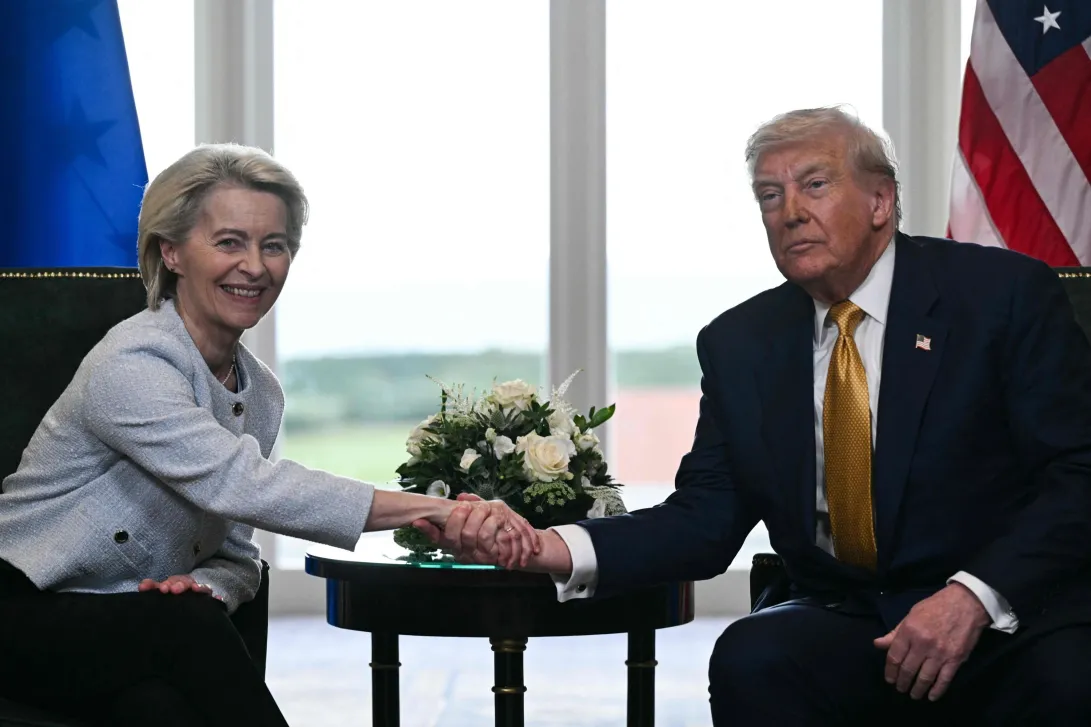
U.S. President Donald Trump has issued a high-stakes ultimatum to European Commission President Ursula von der Leyen, threatening to impose significantly higher tariffs on European goods if the “historic” bilateral trade agreement signed last summer is not implemented by July 4, 2026.
Following a telephone conversation with von der Leyen on Friday, Trump took to Truth Social to demand that Brussels honor the terms of the Turnberry Agreement, finalized in Scotland in July 2025. The president emphasized that the deadline coincides with the 250th anniversary of the United States.
“A promise was made that the EU would do its part and reduce its tariffs to zero!” Trump posted. “I agreed to give them until July 4; otherwise, unfortunately, their tariffs would immediately soar to much higher levels.”
The Turnberry Agreement was designed to recalibrate the transatlantic trade relationship. Under its terms, the U.S. agreed to cap tariffs at 15% for the majority of European exports—including critical sectors like automobiles, semiconductors, pharmaceuticals, and timber. In exchange, the EU pledged to eliminate most remaining duties on American industrial products.
Read more about this topic: Brussels urges Trump to return to terms of EU-US agreement (with video)
The White House has grown increasingly impatient with what it perceives as European foot-dragging. On May 1, Trump previously threatened to hike auto and truck tariffs to 25%, claiming the EU was in breach of the deal.
While von der Leyen and several EU member states are pushing for rapid ratification, the process has stalled in the European Parliament. Some MEPs are demanding “safeguard mechanisms” to protect the single market from sudden import surges and to ensure EU territorial integrity following recent American diplomatic pressure regarding Greenland and Denmark.
The threat is part of a broader “America First” trade strategy initiated on Trump’s first day in office in January 2025. Over the past year, his administration has declared a national emergency over trade deficits, implemented universal steel and aluminum duties, and applied “reciprocal” tariffs, such as a 104% rate on Chinese goods.
Beyond trade, Trump described the call with von der Leyen as “excellent,” noting that the two leaders found common ground on Middle Eastern security. He stated that both sides remain “totally united” in the conviction that Iran must never obtain a nuclear weapon, especially as the current conflict in the region continues to escalate.
