

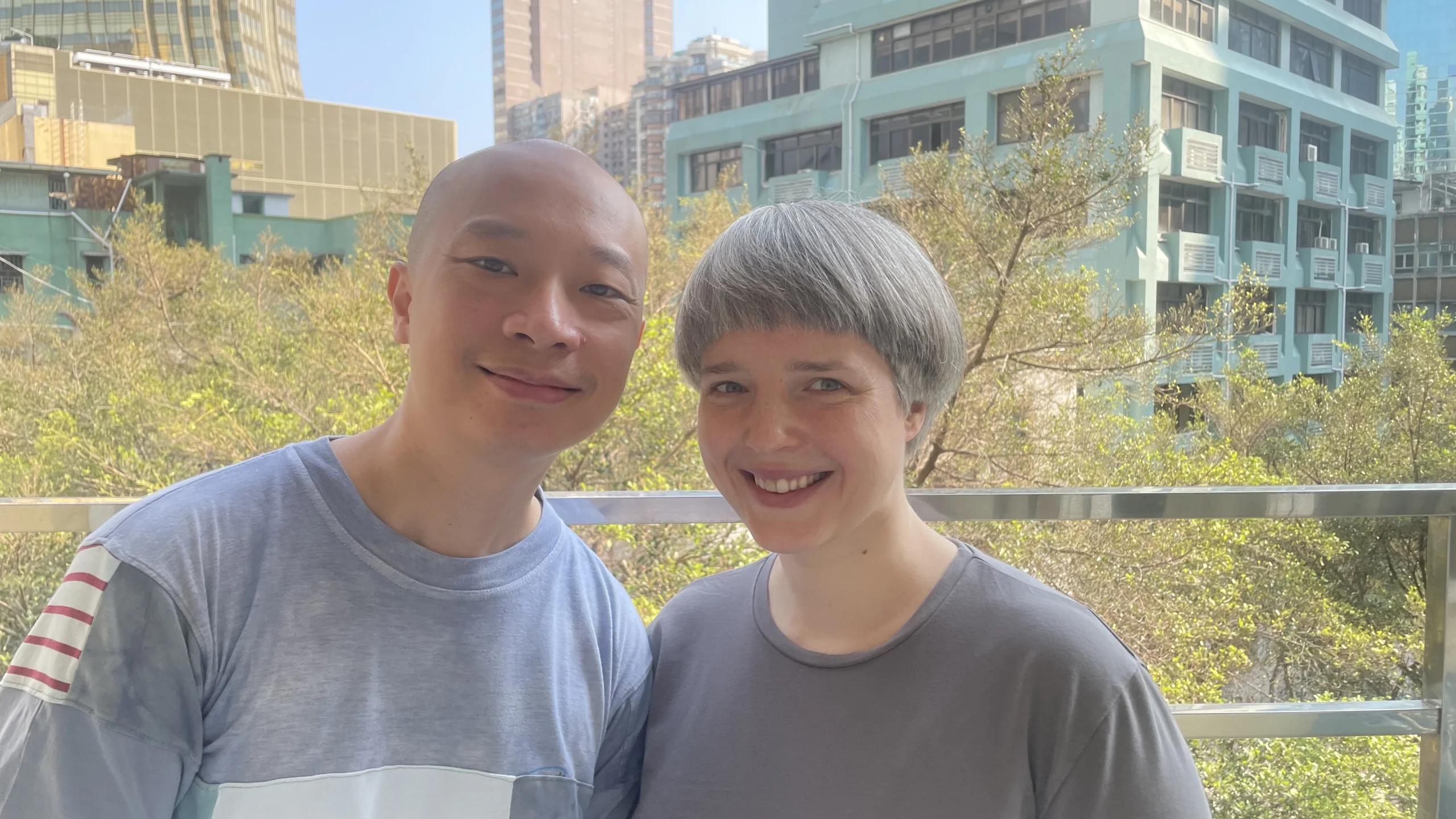
“In a way, we are children of the post–Cold War era,” Cheong comments. This generational awareness shapes their artistic practice: differences are no longer obstacles but become material.
The connection between the two cities may seem unlikely, but there are parallels. “Macau has changed drastically, just like Germany,” Cheong notes, pointing to deep transformations in both contexts. More than a historical coincidence, it reflects a shared sensibility: living in a politically tense time, where global narratives are increasingly polarised.
In Berlin, “post-colonial artistic movements have been very strong,” Cheong continues. “Everyone is a minority”—the city offers an environment where identity, rather than being fixed, is constantly negotiated. In their view, that feeling matters more than any objective definition: “It’s not about reality, but about the feeling.”
Their artistic practice emerges precisely from this intersection. It is not confined to a single medium: “it is multidisciplinary—anthropological research, textiles, experimental film, books,” Cheong explains. What matters most is how they work: direct engagement with communities, collecting stories and materials that are usually marginal to dominant narratives.
Read also: Macau: “A Glimpse of Chinese Culture” in Lisbon
Textiles are central to this process. Marta explains: “I select leftover materials that would normally be discarded.” From these fragments, they construct bodies, objects and installations that function as collages of memory. The narrative “breaks the rules of linear storytelling,” making space for what is usually discarded—both materially and symbolically.
Sustainability emerges as a consequence, not a manifesto. “I wouldn’t say we are zero-waste heroes,” Marta stresses. The concern exists, but they reject simplifications: “The problem is much more complex.” The focus lies instead on the stories these materials carry and how they create new connections.
The idea of connection runs through the couple’s entire process, shaping their approach.
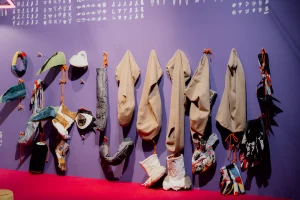
Textile and fresco installation “The Image is an Elephant” (2026), at the Cricoteka museum in Poland. Photo by M. Zygmunt / Cricoteka – Tadeusz Kantor Museum
Art without confrontation
In a global context marked by tensions—“a new Cold War between different worlds,” as Marta describes it—their response is deliberately simple. “There is no need to have problems with governments,” says Cheong; what matters is direct contact between people. Art becomes an intermediary space, where empathy can be created without immediate confrontation.
Marta reinforces the everyday dimension: “When you start from something else, it is possible to create a more human atmosphere.” Before politics comes relationship; before debate, encounter.
They are preparing to bring this approach to Macau between June and July. “My expectation is to bring together groups of people who are not usually together,” Cheong explains, referring to the city’s linguistic and cultural diversity. The central aim is to create experiences where these differences coexist “in an active way, not just symbolically.”
Read also: Macau: More Culture, Less ‘Decoration’
For Marta, the city itself suggests that possibility. “When you see Latin letters and Chinese characters, it is easier to feel a connection.” The visual coexistence of distinct codes becomes a metaphor for what they seek to build.
The project they present along these lines includes an installation with “human-shaped sculptures—patchwork,” made from textiles collected in different contexts. But their focus remains on the audience, on interaction and performance. “That is much more important,” Marta says. More than showing, they want to involve.
Between political blocs, power narratives and rigid identities, they choose a smaller space—perhaps a more effective one for alternative narratives. “In a way, we are naturally connected,” they both agree.
In a time of fragmentation, their approach is almost counterintuitive: to believe, to connect people—even if only through a piece of fabric and a shared story.
