


In August 1945, as the Second World War was drawing to a close, the United States dropped two atomic bombs on Japan just three days apart. Hiroshima was hit on August 6; Nagasaki on August 9.
Among the tens of thousands killed and the survivors forever marked by the attacks, the story of Tsutomu Yamaguchi stands out for an almost unimaginable reason: he was present in both cities, survived both explosions, and would later become the only man officially recognised by Japan as a survivor of both bombings.
He was 29 years old, a naval engineer at Mitsubishi Heavy Industries, and was in Hiroshima on business. The trip, which had lasted three months, was about to end.
After spending the summer working on the design of a new oil tanker, he was preparing to return home to Nagasaki, where his wife, Hisako, and their baby son, Katsutoshi, were waiting for him. It was supposed to be the final day of a routine business assignment. Instead, it became the beginning of a story that seems to defy logic.
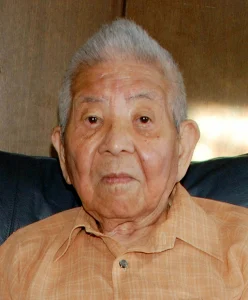
Tsutomu Yamaguchi, the only person officially recognised by the Japanese government as a nijuu hibakusha – a person bombed twice (credits AFP)
Less than three kilometres from hell
On the morning of August 6, 1945, Yamaguchi was on his way to the Mitsubishi shipyards when he heard the sound of an aircraft. Looking up, he saw an American B-29 bomber flying over the city and dropping a small object attached to a parachute.
Moments later, everything dissolved into an unbearable white flash. He would later describe it as resembling “the flash of a huge magnesium flare”, according to an interview with the British newspaper The Times.
He managed to throw himself into a ditch before the shockwave lifted him off the ground, spun him through the air and hurled him away. He had been less than three kilometres from the hypocentre. When he regained consciousness, the sky had darkened with dust, ashes and debris. Around him, Hiroshima was burning.
“I did not know what had happened,” he later recalled to The Times. “I think I fainted for a while. When I opened my eyes, everything was dark and I could hardly see. It was like the beginning of a film at the cinema, before the picture starts, when there are just blank frames flickering without sound.”
Yamaguchi suffered severe burns to his face and arms, and both eardrums were ruptured by the force of the blast.
Dazed, he made his way to what remained of the shipyard, where he found two colleagues who had also survived: Akira Iwanaga and Kuniyoshi Sato. They spent the night in an air raid shelter and, the following day, headed for the train station after learning that trains were still running.
The journey home through devastation
The route to the station took them through an apocalyptic landscape. Fires raged, buildings lay in ruins, bridges had collapsed and bodies were scattered across the streets. At one river crossing, Yamaguchi had to swim through floating corpses.
When he finally boarded a train to Nagasaki, he travelled alongside passengers who were burned, traumatised and unable to fully comprehend the scale of what had happened.
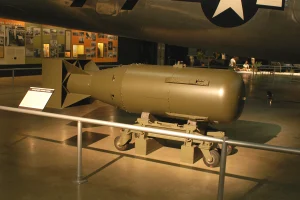
A replica of the atomic bomb “Little Boy”, dropped on Hiroshima, at the National Museum of the United States Air Force (credits: National Museum of the United States Air Force)
Meanwhile, the world was beginning to grasp the meaning of Hiroshima. The “Little Boy” bomb, dropped by the B-29 Enola Gay, killed around 80,000 people instantly, with many more dying in the following days and weeks.
Yamaguchi arrived in Nagasaki on the morning of August 8 and went straight to hospital. His burns were so severe that a former schoolmate, now a doctor, did not recognise him at first. At home, even his own mother thought she was seeing a ghost.
Three days, two bombs
Despite his condition, he reported for work the following morning at the Mitsubishi office in Nagasaki. At around 11 a.m., he was describing to a superior what he had witnessed in Hiroshima: the flash, the roar, the total destruction. The director was sceptical. How could a single bomb destroy an entire city?
Then history repeated itself. Outside, another blinding white flash engulfed the city. Yamaguchi threw himself to the ground seconds before the shockwave shattered windows and sent glass and debris flying through the office.
He would later summarise the absurdity of that moment in a remark to The Independent: “I thought the mushroom cloud had followed me from Hiroshima.”
The bomb dropped on Nagasaki was even more powerful than the one used in Hiroshima. Still, the city’s mountainous terrain and the reinforced structure of the building where he was working helped absorb part of the impact. The blast tore away his bandages, exposed him once again to intense radiation, yet he survived again.
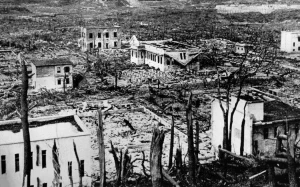
Image showing the devastation of Nagasaki (credits: US DEPARTMENT OF ENERGY/SCIENCE)
After leaving the destroyed building, he ran through Nagasaki searching for his wife and son. Part of their house had collapsed into rubble. Even so, both survived with only minor injuries. Hisako had gone out to look for ointment for her husband’s burns and, when the explosion occurred, managed to shelter with the baby inside a tunnel.
In the cruel logic of those days, it was precisely the fact that Yamaguchi had returned injured from Hiroshima that led his wife to leave the house — and that may have saved both their lives.
Living after the impossible
In the days that followed, the double exposure to radiation severely worsened his health. His hair fell out, his wounds deteriorated, his arms developed gangrene and the vomiting became relentless. On August 15, when Emperor Hirohito announced Japan’s surrender over the radio, Yamaguchi was too ill to feel either relief or defeat.
“I felt nothing,” he later told The Times. “I was neither sad nor happy. I was gravely ill, with a fever, barely eating and barely drinking. I thought I was about to cross over to the other side.”
Against all expectations, he slowly recovered. Unlike many others exposed to radiation, he managed to rebuild a relatively stable life. He worked as a translator for American occupation forces, taught school and later returned to engineering at Mitsubishi. He and his wife went on to have two more daughters.
But surviving did not mean escaping unharmed. Like many hibakusha — survivors of the atomic bombings — he lived with lasting physical consequences for decades.
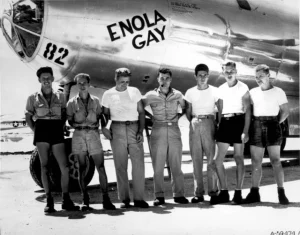
The crew of the B-29 Superfortress bomber Enola Gay pose for a photograph in the Mariana Islands in 1945. The pilot, Colonel Paul W. Tibbets of the United States Army Air Forces, stands at the centre of the group (credits: National Museum of the United States Air Force)
According to his daughter, Toshiko Yamasaki, speaking at a peace conference in 2011, “my father developed cataracts, became deaf in one ear, suffered from leukopenia [a reduction in white blood cells], lost his hair for 15 years after the war and lived with the after-effects of his burns.” The family itself also suffered long-term effects from radiation exposure: his wife and son would later die of cancer.
From silence to testimony
For many years, Yamaguchi avoided speaking publicly about what he had experienced. He wrote poetry and kept the memory largely private. His family feared that his image could even be used to downplay the horror of nuclear weapons. “Our whole family opposed it,” Toshiko Yamasaki explained, referring to the possibility of her father taking on a public role in anti-nuclear activism.
The reason for that fear was simple and painful. As his daughter explained, they worried people might think: “Even after being exposed to radiation twice, he is still healthy, so the atomic bomb is not that terrifying after all.”
Yet in the 2000s, he published his memoirs and joined the anti-nuclear movement. In 2006, he travelled to New York to speak at the United Nations on nuclear disarmament. During that speech, he declared: “Having experienced and survived two atomic bombings, I feel it is my destiny to speak about it.”
Tsutomu Yamaguchi was not the only person to survive both bombings. It is estimated that around 165 people lived through both attacks.
Some of his colleagues, including Akira Iwanaga and Kuniyoshi Sato, were also in Nagasaki when the second bomb exploded. Nevertheless, Yamaguchi became a singular case: in 2009, he was officially recognised by the Japanese government as a nijuu hibakusha – a person bombed twice. He died in 2010 at the age of 93, just one year after receiving that official recognition.
