

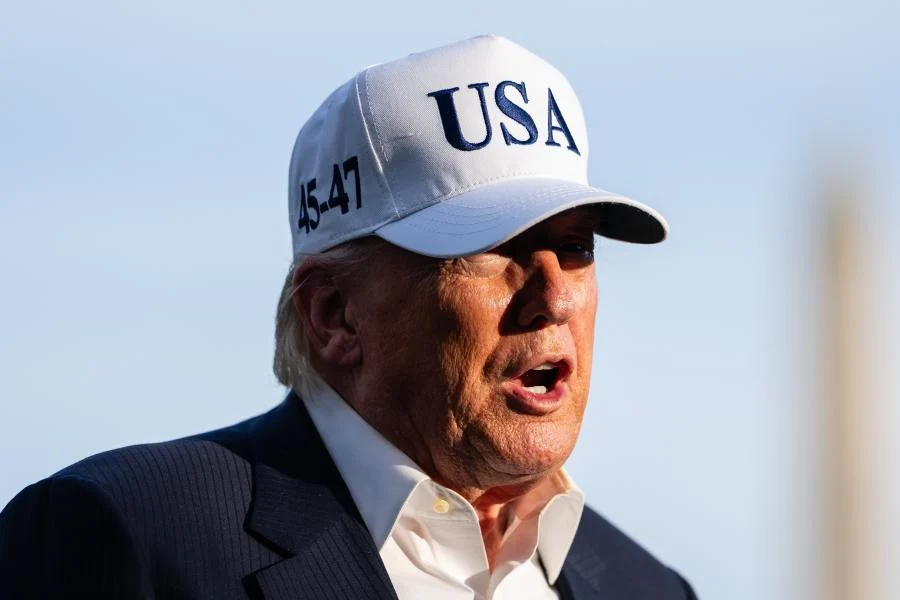
US President Donald Trump has firmly rejected making any concessions to Iran after reviewing Tehran’s latest counterproposal aimed at resolving the military conflict between the two nations.
In a brief phone interview with the New York Post, Trump maintained a hardline stance, warning that Iran “knows what’s going to be happening soon.” He declined to clarify whether his statement signaled an imminent resumption of US airstrikes against the Islamic Republic.
The US President has grown increasingly frustrated in recent weeks over what he deems disappointing responses from Tehran during indirect negotiations mediated by Pakistan.
Read more about this topic: Xi-Trump reach consensus on Hormuz and Iran nuclear power (with videos)
When pressed on specific terms, such as a proposed 20-year moratorium on Iranian uranium enrichment, Trump shut down the possibility of a compromise, stating:
“I’m not open to anything right now.”
Trump’s remarks followed Iran’s formal response to a Washington-vetted peace framework intended to break the months-long diplomatic stalemate.
Iranian Foreign Ministry spokesperson Esmail Baghai confirmed that Tehran’s specific concerns had been relayed through Pakistani intermediaries. While Baghai noted that talks remain active, he emphasized that Iran is “fully prepared for any eventuality,” downplaying Trump’s repeated threats of military force.
State-linked Iranian media networks, including the Fars and Tasnim news agencies, have characterized the US demands as excessive and uneven.
| Reported US Demands | Iranian Counter-Demands |
| Maintain only one active nuclear facility. | Permanent cessation of hostilities. |
| Transfer all highly enriched uranium stockpiles to the United States. | Immediate unfreezing of all offshore assets. |
| Implement a 20-year ban on domestic uranium enrichment. | Full lifting of international economic and oil sanctions. |
| Enforce strict limits on local nuclear development. | Payment of financial reparations for the “unfounded” war. |
While Tasnim reported that Washington had offered temporary oil sanction waivers and a dedicated reconstruction fund during the negotiation window, US officials quickly disputed these claims, asserting that no sanctions relief would be granted without reciprocal, verified actions from Iran.
Read more about this topic: Iran War: Trump says “nothing will be left” if Tehran rejects deal (with video)
As the diplomatic track falters, Tehran is shifting its strategy toward maritime and digital leverage in the Persian Gulf. Iran has formalized the creation of the Persian Gulf Strait Authority (PGSA) to tightly regulate and tax transit through the strategic Strait of Hormuz.
Furthermore, the Islamic Revolutionary Guard Corps (IRGC) has floated plans to assert sovereign control over the critical undersea fiber-optic cables running across the seabed of the strait. Iranian officials have threatened to levy infrastructure fees and licensing royalties on foreign telecom operators, warning that any intentional disruption to this global digital corridor would cost the international economy hundreds of millions of dollars per day.
In response to the escalating rhetoric, Israeli Prime Minister Benjamin Netanyahu stated that Israel is “prepared for any scenario” regarding Iran. Netanyahu held a scheduled phone consultation with Donald Trump on Sunday to align strategy. Shortly after the call, Trump took to social media to amplify his warnings, stating that “nothing will be left of Iran” if a deal is not reached quickly.
