

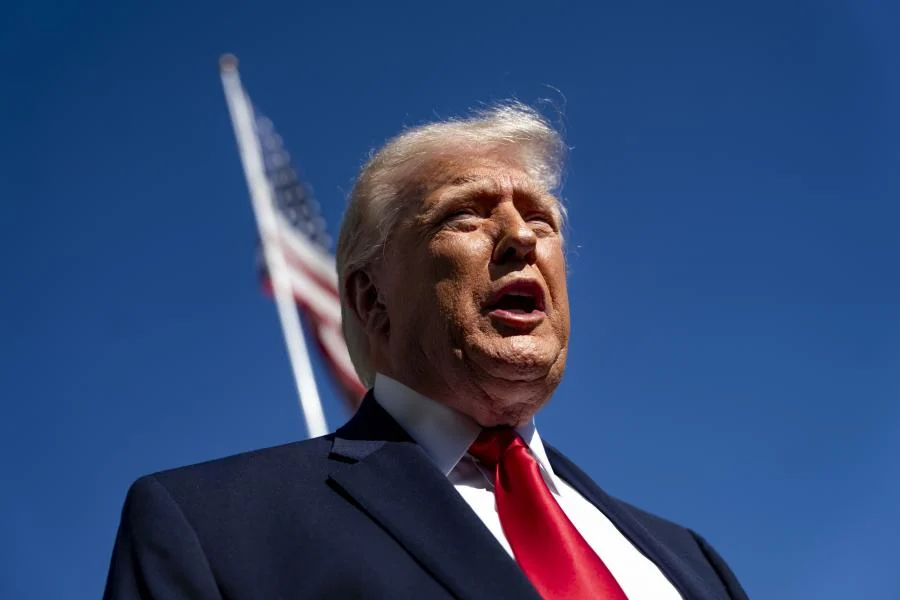
U.S. President Donald Trump warned today that he will only suspend the blockade on Iranian ports if there is an agreement in the peace negotiations with Iran, for which a new round is still uncertain.
“The blockade, which we will not suspend until there is an agreement, is completely destroying Iran. They are losing 500 million dollars [424 million euros] per day, an unsustainable amount for them, even in the short term,” wrote the leader of the White House on his social network.
In previous statements throughout the day, Trump threatened that if his demands are not met by the end of the ceasefire with Iran on Wednesday, “many bombs will explode,” adding that the goal to be achieved is an Iran “without nuclear weapons.”
Donald Trump also considered an extension of the truce between the two countries, which began on April 8, to be “very unlikely.”
Read more about this topic: Iran War: Trump says Lebanon-Israel ceasefire “will include Hezbollah” (with video)
According to the France-Presse (AFP) news agency, citing a source close to the negotiation process, a U.S. delegation is leaving “soon” for Pakistan with a view to resuming peace negotiations with Iran, after the U.S. leader indicated that Vice President JD Vance was already on his way, which has not yet been confirmed.
Tehran maintains, for its part, that it has not yet made the decision to send a delegation to Islamabad.
The Islamic Republic conditioned the resumption of dialogue on the lifting of the blockade on Iranian ports and ships, after the United States seized an Iranian vessel last Sunday.
The President of Iran has already warned on social media that “Iranians do not submit to force” and commented that “keeping commitments is the logic of any dialogue,” without mentioning the new round of negotiations.
Read more about this topic: China: Xi assuring Trump that it does not supply arms to Iran not confirmed
“Iran’s deep historical mistrust of the actions of the U.S. government persists, while contradictory and unconstructive signals from U.S. authorities convey a bitter message: they are seeking Iran’s surrender,” declared Masoud Pezeshkian.
The parties met in Islamabad on April 11, but did not reach an understanding to end the conflict started by an Israeli-American air offensive on February 28.
In retaliation, Iran launched attacks against Israel and neighboring Gulf countries and subjected the Strait of Hormuz to a blockade on the passage of commercial ships, causing the price of crude oil to soar worldwide.
After the failure of the talks in the Pakistani capital, Trump ordered a naval blockade of Iranian ports.
At the center of the discussions between the two countries are Iran’s nuclear and uranium enrichment program, as well as the production of long-range missiles and support for militias in the Middle East, and also the unfreezing of Iranian assets.
