

The director-general of Angola’s National Coffee Institute (INCA) said today that there is still work to be done to produce and export quality coffee, abandoning negative practices such as harvesting unripe green beans.
Vasco Gonçalves told reporters on the sidelines of a workshop on the “EU Regulation on Deforestation-Free Products and the Angolan Coffee Sector,” held today in Luanda, that Angolan coffee “is not yet being exported at the highest possible quality.” “In a universe of seven quality categories, we are at the second level — we still have four levels to go, but that is work we have to do,” he said.
Read more: Drop in exports leads Angola to look at Macau
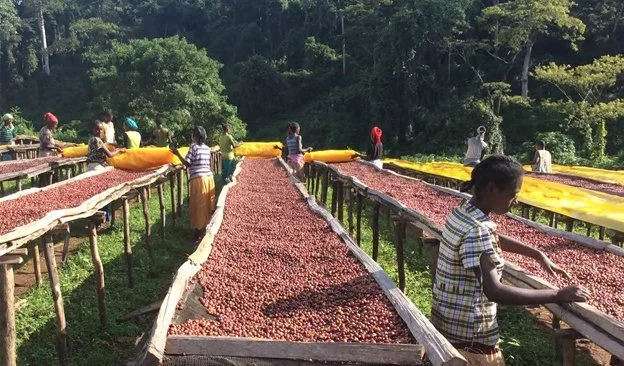
Gonçalves said improvement efforts are being made with operators, exporters and traders “to abandon practices such as spreading coffee on the ground, harvesting green coffee, and bagging coffee with products that may contaminate it.”
Angola produced around 10,500 tonnes of commercial coffee in 2024 — still “very far from the country’s capacities and climatic conditions,” he said.
During the colonial period, the country had around 600,000 hectares of coffee plantations; today it has only 55,000 hectares, “very far” from what was produced at that time. “We have very significant room for growth, even focusing only on the old coffee areas,” without the need for deforestation, Gonçalves stressed.
Read more: Portugal: exports fall 14% and imports 2.5%; Angola cracks top 10 as a destination
Angola produces arabica coffee in the provinces of Benguela, Huíla, Bié, Huambo and parts of Malanje and Cuanza Sul, while robusta is grown in Uíge, Cuanza Sul, Cuanza Norte, Bengo and parts of Malanje, with production already expanding into eastern regions. In 2024, Angola exported 3,288 tonnes of commercial coffee — primarily to Portugal and also to Poland and Italy — earning $12 million (€10.2 million).
On the EU deforestation regulation, Gonçalves stressed that compliance responsibility lies with importers, while Angola’s role is to ensure production follows good agricultural practices. Angola’s secretary of state for forests, João da Cunha, said at the workshop opening that the country has recently approved legal instruments such as the Good Agricultural Practice.
Regulation to help Angola meet international consumer requirements. He noted that the country’s production recovery process — including increasing the planted area using historical cultivation zones — should not be confused with deforestation, and that “for the specific case of Angola, coffee acts as a preserver of forest biodiversity, growing in an agroforestry model.”
