

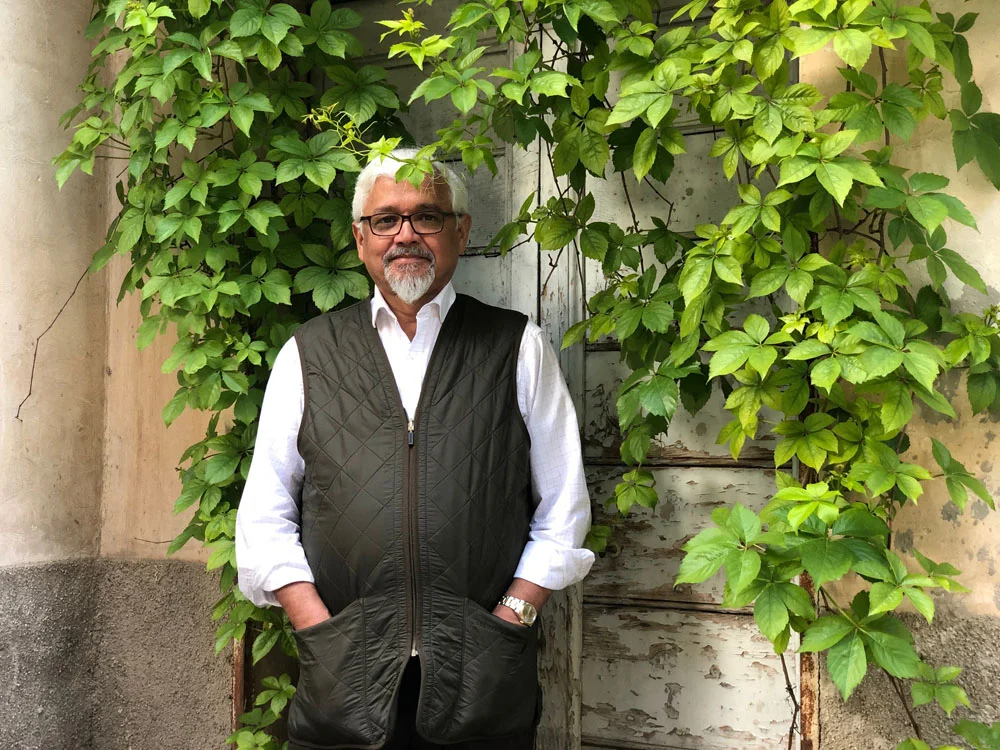
– Ten years after having written “The Great Derangement”, famous for environmental warnings, you now say that, probably, you would not focus again on the topic of climate change. Because you think the cause is already lost? Or because, in the face of wars, and so many other crises,at the same time, you no longer see any sense in focusing on the environmental drama?
Amitav Ghosh – You know, when I set out to write that book, I was actually very focused on the problem of climate change. However, since then, I recognize that the loss of biodiversity, for example, is probably an even greater tragedy. The extinction of numerous species, both animal and plant, is certainly a major problem. On the other hand, our food supply networks have become incredibly fragile; completely dependent on industrial fertilizers. At this moment in the Gulf, everyone is talking about the gas and oil crisis; however, with the blockage of the Strait of Hormuz, the greatest crisis of all will be that of fertilizers.
– Soon enough, water scarcity will also arrive, which several authors announce as the source of the next wars…
A.G. –Yes, this one seems inevitable as well. The issue is that there are so many other dimensions to these crises we are living through that it no longer makes sense for us to be focused on just one thing, such as climate change.
– At the root of all these crises will there be a civilizational deficit? Is the problem in the system of values and behaviors; or does it seem to you that the crisis is mainly political, in the sense that there is a lack of leadership, vision, legitimacy, and courage to change the course of events?
A.G. –Behind all these crises, whether we talk about water, food, or whatever… what is happening is a kind of acceleration of everything; a phenomenon that began in the 1990s. It is at this point that carbon gases start to accumulate in the atmosphere; it has been no more than 36 years.
If everyone lived like Americans, we would need five planets. That is the real underlying problem
– What is the reason for this turning point?
A.G. –What happened at that time was the collapse of the old Soviet Union; and with it, the establishment of a certain type of ideology, which came to be known as the Washington Consensus.
– What consensus is this?
A.G. –Basically, it is the illusion that everyone should – and could – live the American dream; with the consumption standards of Americans: two cars, one refrigerator, more of this, more of that… Well, what we know today is that the world cannot live like this. Perhaps we all want this, but to have everyone at the American standard of living, we need five planets. This is the real underlying problem.
– Does that mean that every single Indian, every single Chinese person, will eat beef, drive cars, and fly in airplanes… in other words, if they finally reach the standard of living they want and feel they are entitled to, we are heading for collective suicide?
A.G. –Exactly, we are on our way to a collective suicide.
– How do you tell millions and millions of people who have not yet had the opportunity to reach others’ lives in the West that they cannot or should not get there?
A.G. – That is precisely the problem; it is a fundamental dilemma. The truth is that the only way to change what is happening is to abandon a certain idea of wealth: if the most influential people in the richest countries begin to reverse their life ideals; if, instead of always being obsessed with growth and expansion, they shift their focus to reducing consumption and polluting behaviors. In fact, there are already many young people doing this; getting out of that trap, returning to the land and agriculture. If these kinds of movements become strong enough, perhaps it can still make a difference.
– Do you really think it’s possible? Looking at the world as it is today, it doesn’t seem like we’re on any path of retreat at all…
A.G. –By coincidence, I even think we are at this point of inflection. This ideology that was globalized since the 1990s is deeply delegitimized; I think because of the geopolitical tensions, because of everything we are seeing happen, because of the wars… I really think it is deeply delegitimized.
It will be bad; we can’t avoid that; but perhaps it won’t be the worst-case scenario. Let’s see what happens and keep hope
– Is there then space and time for alternative ways of thinking?
A.G. –Yes; I think these things will emerge.
– How can new ways of thinking and new political ideologies be accelerated? At the speed necessary to combat the ills of that American dream?
A.G. –In fact, it already seems impossible; one thing we can observe today is that the speed at which everything in the world is happening… very, very fast; much faster than we could have imagined. So… who knows?
– We have long been assaulted by the unimaginable; things we could not predict; or that we predicted would be impossible: wars, the crisis of values, loss of biodiversity, climate change… many of them worse than we could have imagined…
A.G. –At this point, we seem to be on a path where our choices are going from bad to worse; what is called the trajectory towards the abyss. We realize that major disruptions lie ahead; we know that. But it’s also not guaranteed that the worst-case scenario will come to pass. If crucial changes are made, perhaps there is still a chance, let’s say, to reverse something. It will be bad; we cannot escape that; but it may not be the worst-case scenario. Let’s see what happens and keep hope.
