

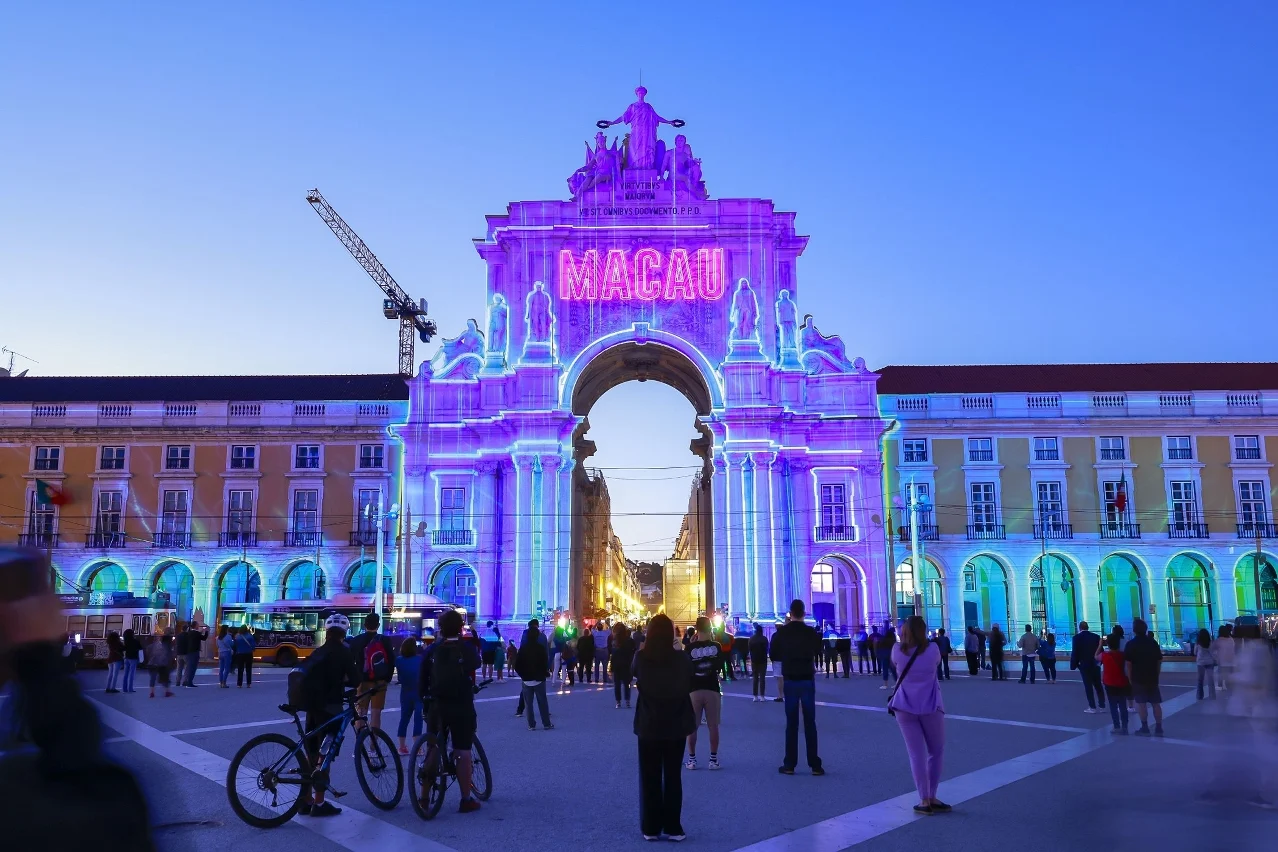
Although the official date has not yet been confirmed, the choice of Portugal as first official destination of the Chief Executive, Sam Hou Fai, is not just a mere ceremonial gesture, much less an isolated act: it is a strategic statement. In other words, it consolidates Macau’s mission to be a platform for Portuguese-speaking countries.
At the beginning of his term, the leader of the Macau Special Administrative Region (MSAR) prioritized relations with Lisbon; solidifying a priority aligned with Beijing: Macau as a bridge between China and Portuguese-speaking countries; an ambition now also extended to the Ibero-American space.
In official statements; and, by extension, in institutional visits to Portugal, the Executive of MSAR has repeatedly emphasized that “Macau will continue to play the role of a service platform for economic and commercial cooperation between China and Portuguese-speaking countries, promoting mutual benefits and shared development.” This formula is repeated in joint communiqués and politically frames the priority assigned to Lisbon.
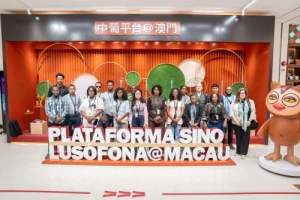
The basis of this relationship is historical. On one hand, after the transfer of Administration in 1999, the principle “One Country, Two Systems” preserves the legal and cultural matrix that distinguishes Macau in the Chinese context; on the other hand, Portugal remains the natural European interlocutor of the Macau Special Administrative Region, whether by the circumstance of their common legal heritage or by its centrality in articulating with the Lusophone space.
In this context, Sam Hou Fai’s first official visit to Lisbon is understood as a sign of institutional continuity and bilateral trust. More than just a consequence of historical memory, the diplomatic symbolism serves a concrete strategy centered on the Forum for Economic and Commercial Cooperation between China and Portuguese-speaking Countries.
Based in the Macao Special Administrative Region since 2003, the Macau Forum brings together representatives from China and all Portuguese-speaking countries under a logic of cooperation in the areas of trade, investment, finance, infrastructure, agriculture, and human resource development. In its multi-year action plans, the Macau Forum identifies the MSAR as a “services platform” and a multilateral coordination center.
The political legitimacy of this role has been repeatedly affirmed at the highest levels. In various interventions, President Xi Jinping has reaffirmed that the Macao Special Administrative Region should “fully leverage its unique advantages and strengthen its role as a platform between China and Portuguese-speaking countries.” During his most recent official visit to the region, Xi emphasized that Macau must consolidate itself as a “bridge for the country’s opening up”; an expression repeated in several central government communiqués and widely cited by local authorities.
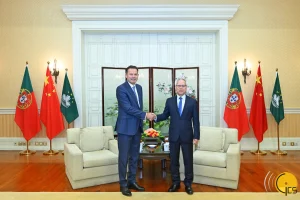
Sam Hou Fai has aligned his speech with this strategic orientation. In public interventions shortly after taking office, he has emphasized that Macau will “deepen cooperation with Portuguese-speaking countries and expand the reach of the platform, reinforcing integration into the national development strategy.”
In several official statements, the Chief Executive has defended the idea that Macau’s economic diversification depends on strengthening financial services, commercial mediation, and international cooperation – pillars directly linked to its role as a platform.
In practice, the Lusophone platform is based on three operational dimensions: the first is institutional – coordination of business missions, facilitation of investment, legal and economic translation services, and interaction with chambers of commerce and public agencies. The second is financial – promotion of yuan settlements, development of cross-border financial products, and support for professional services capable of connecting Chinese and Lusophone companies. The third is human and cultural – scholarships, bilingual training, and university exchanges that sustain a generation of professionals with skills in Portuguese and Chinese.
Portugal plays a pivotal role here: for companies interested in Africa or Brazil, Macau can serve as a contact point with Chinese investors; for Chinese companies that wish to enter Portuguese-speaking markets, coordinating with Lisbon facilitates legal frameworks and strategic partnerships.
Moreover, the Portuguese authorities, either on their own or in joint statements, have repeatedly stated that cooperation with Macau constitutes a privileged route for intensifying economic relations with China.
In recent years, this strategy that includes Macau as one of the axes of Chinese foreign policy has evolved: the opening up to Spanish-speaking countries. Although the core of the Macau Forum maintains its Lusophone composition, the MSAR has been promoting contacts and initiatives that also integrate Spanish-speaking partners, particularly in Latin America.
The logic that supports this geostrategic extension is primarily economic, as many regional value chains cross Lusophone and Hispanic markets. By expanding its scope, Macau also increases its potential relevance as an Ibero-American intermediary.
This expansion aligns with China’s priorities for international connectivity and reinforces the strategic utility of the Macau SAR. By combining historical heritage, its own legal framework, and central government support, Macau seeks to transform symbolic capital into tangible economic influence.
The inaugural visit to Portugal by Sam Hou Fai encapsulates this equation: it is a gesture of historical memory, but also a move of geopolitical positioning. By reaffirming Lisbon as the first stop, the Chief Executive projects institutional continuity and renewed ambition: to consolidate Macau as a credible bridge between China, the Lusophone world, and, progressively, the Ibero-American space – with explicit political backing from Beijing and a multilateral framework in the Macau Forum.
