

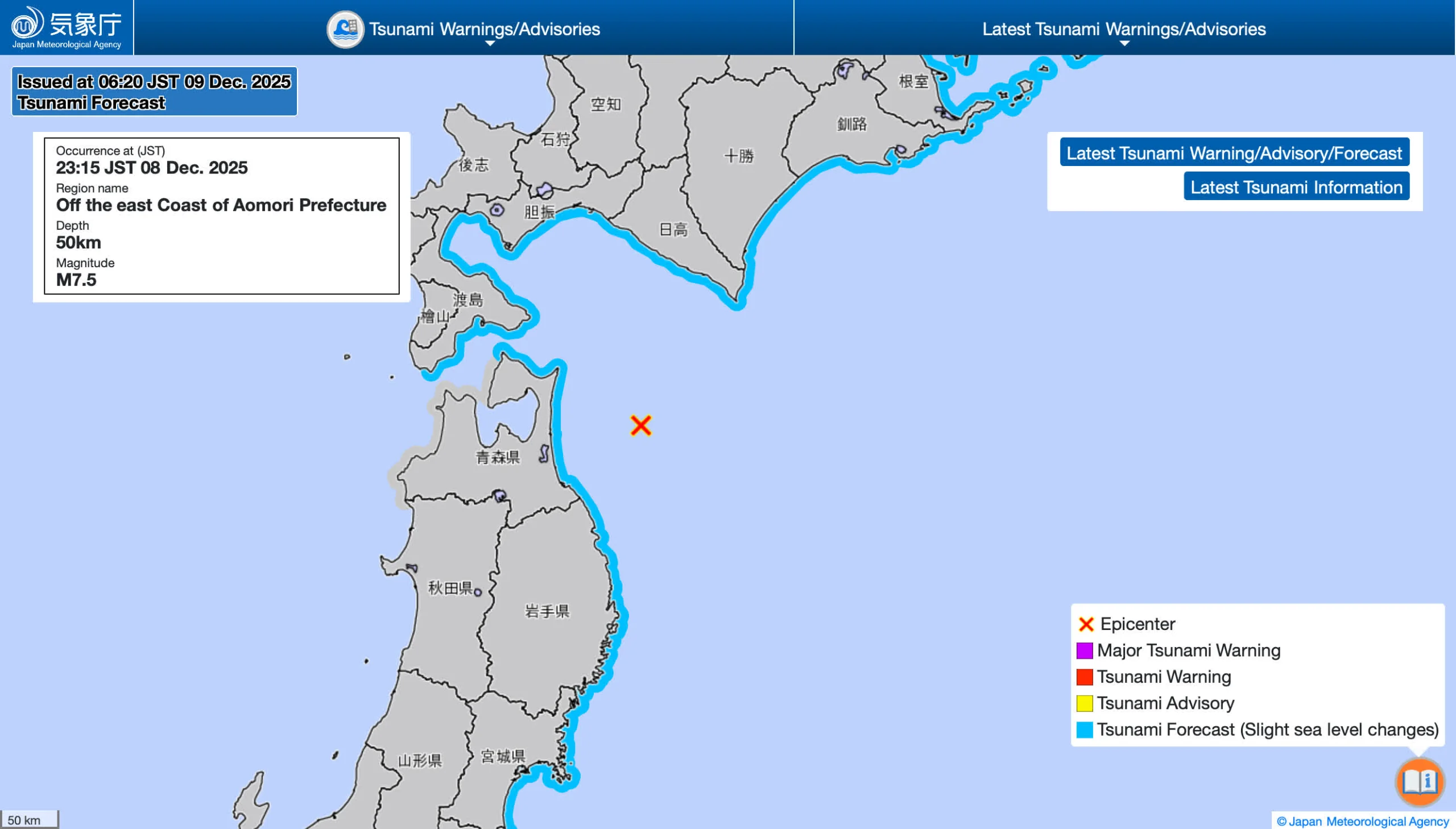
The Japan Meteorological Agency (JMA) has warned that the 7.5 magnitude earthquake on the Richter scale—initially estimated at 7.6—occurred offshore near Aomori at 11:15 PM local time (14:15 in Lisbon) and could be followed by additional tremors over the coming days.
“Listen to information from the JMA and local authorities throughout the week, check that your furniture is properly secured, and be prepared to evacuate if you feel a tremor,” Takaichi advised.
Among the injured, one person was critically injured on Hokkaido, the northernmost island of the archipelago. The Japan Fire and Disaster Management Agency has recommended evacuating 28,000 people. Live footage shows broken glass scattered across roads and items on the floors of shops.
Approximately 2,700 homes in Aomori lost electricity, with several dozen still without power by this morning as winter is setting in. The JMA initially issued a tsunami warning, indicating waves could reach three meters and advising thousands of residents near the epicenter to seek shelter.
High-speed Shinkansen train services have been suspended in some areas while the condition of the tracks is assessed. Tohoku Electric Power stated that no abnormalities were detected at the two nuclear plants closest to the epicenter: Higashidori in Aomori and Onagawa in Miyagi.
The region still remembers the consequences of the magnitude 9 earthquake in March 2011, which triggered a tsunami, causing around 18,500 deaths or disappearances. This disaster also led to the meltdown of three reactors at the Fukushima nuclear plant, the worst of its kind since the Chernobyl disaster in April 1986.
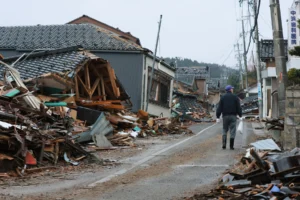
A man walks along a street where collapsed houses still remain at Horyu Town in Suzu, Ishikawa Prefecture on February 1, 2024, one month after a major 7.5 magnitude earthquake struck the Noto region in Ishikawa prefecture. (Photo by JIJI Press / AFP) / Japan OUT / JAPAN OUT
Japan is located at the junction of four tectonic plates in the Pacific’s “Ring of Fire,” making it one of the most seismically active countries in the world. The archipelago, home to 125 million people, experiences about 1,500 earthquakes a year, most of which are minor, though damage can vary based on location and depth.
In January, a group of government experts slightly increased the probability of a major quake in the Nankai Trough, offshore Japan, over the next thirty years to between 75% and 82%.
The Japanese government released a new estimate in March indicating that a “mega-earthquake” and the subsequent tsunami could result in up to 298,000 deaths and damages reaching two trillion dollars (1.7 trillion euros).
Platform with Lusa
