

On 24 October, the Exhibition of Visual Arts from Portuguese-Speaking Countries opened at the Gallery of the Municipal Affairs Bureau (IAM) as part of the 17th Cultural Week. At the same event, the Chinese edition of Angolan writer João Melo’s book *Será Este Livro Um Romance?* (*Is This Book a Novel?*) was launched.
Organized by the Permanent Secretariat of the Forum for Economic and Trade Co-operation between China and Portuguese-speaking Countries (Macao) and jointly published by Os Macaenses Publications and Lijiang Publishing, the book was translated into Chinese by Chen Qian and simultaneously released in Mainland China and Macau.
According to the publisher’s introduction, the author “explores the struggles and reflections inherent to his creative process, with humor and depth, portraying the realities and emotions of Angola — and, by extension, of all Africa.” The narrator and the author alternate throughout the book, highlighting the intimate relationship between literature, narrative, and self-awareness. The protagonist engages in reflective dialogues about the structure of the novel, often delving into philosophical contemplations and critiques of literary traditions, especially those rooted in Western-centric perspectives.
João Melo, also active in politics, is a journalist, university professor, and founding member of the Angolan Writers’ Union, widely recognized as one of the leading voices in Angolan literature. According to the *Angola Daily*, the 70-year-old writer has been active for over five decades, publishing across various media in Angola and other Portuguese-speaking countries, with works released in Africa, South America, Europe, and the United States. This year, additional editions are planned for India and Poland.
Originally published in 2022 by the Portuguese publisher Caminho, this marks the first time one of João Melo’s books has been translated into Chinese and published in China. Speaking via video conference at the launch, the author explained that his goal was “to reflect on the process of writing a novel as an African author who writes in Portuguese.” He added, “The challenge for non-Western writers is how to explore the genre without giving in to, let’s say, a temptation or a vision shaped by a Western-centric model. That’s essentially what I reflect on in this book.” João Melo also expressed his hope that “the book will reach as many readers as possible in China.”
Luso-Chinese Traditions
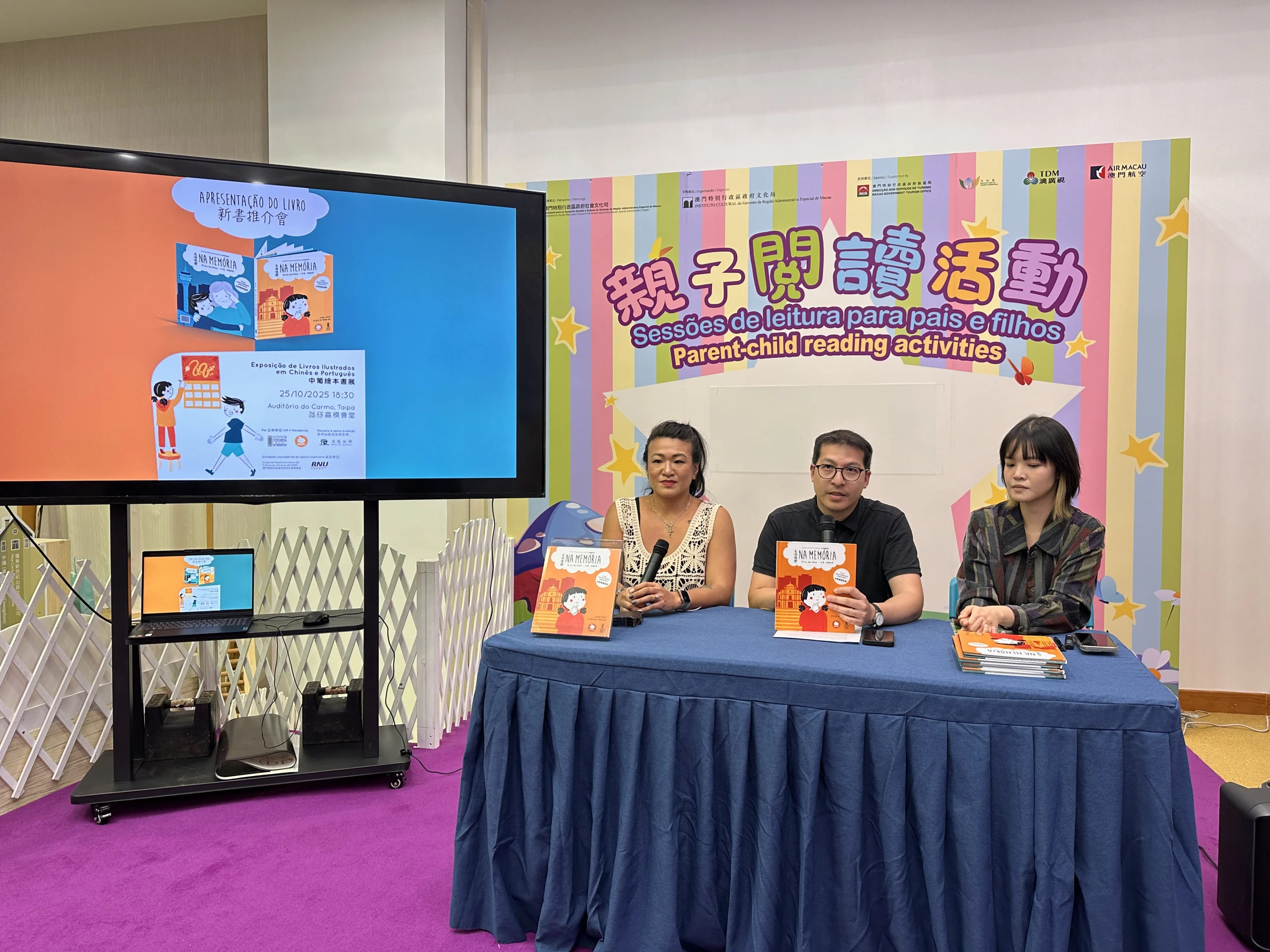
On 25 October, at the Carmo Auditorium in Taipa, during the 7th Encounter in Macao, the bilingual illustrated children’s book Na Memória (In Memory) was presented.
Written by Catarina Mesquita and published by the International Institute of Macau (IIM) in collaboration with Mandarina Books, the project was supported by the Cultural Development Fund and the Banco Nacional Ultramarino (BNU).
The story follows a “one book, two stories” format, presenting the perspectives of Pou, a Chinese boy, and Júlia, a Portuguese girl, as they explore Chinese and Portuguese traditions and the intangible cultural heritage of Macau. Written in both Chinese and Portuguese, the book includes vocabulary stickers in Chinese, Portuguese, and Macanese Patuá, helping young readers deepen their understanding of local culture.
The launch event was attended by António Monteiro, Secretary-General of the IIM; Paula Carion, representative of the Macanese Youth Association; and Adelina Chou, coordinator of special projects at the IIM.
In a message read by António Monteiro, the author emphasized that “memory is a place I revisit often and consider very important, as it helps us understand who we are and what our places are made of.” She added, “For me, this book marks what I don’t want to forget about Macau — the importance of each day in shaping our individual and collective stories. After all, what good are memories if we can’t share them?”
Monteiro highlighted the importance of teaching Macau’s history to children from an early age. This year marks the 20th anniversary of the Historic Centre of Macao’s inscription on the UNESCO World Heritage List, making the launch especially timely. “The idea is for parents and children to read together about Macau — a way of learning together,” he said.
Meanwhile, Paula Carion underscored the value of sharing personal family stories with children: “I think it’s important for every family to tell their own stories to their children. This book isn’t about one specific chapter of Macau’s history; it’s about encouraging families to share their own memories and stories. That’s the message we want to convey.”
