

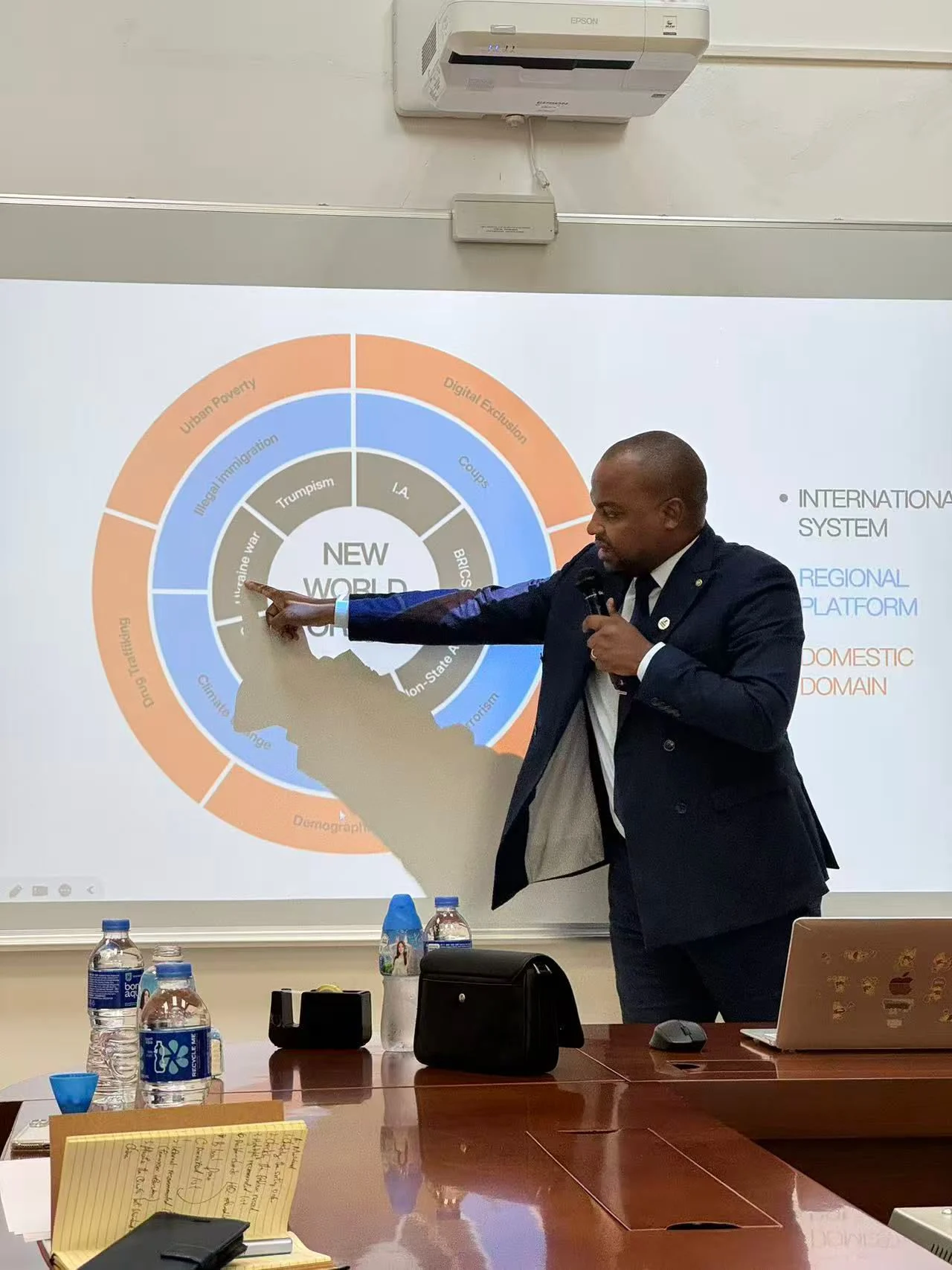
– What do you take from your brief experience at the University of Macau?
Frederico Congolo – The Institute for Global and Public Affairs at the University of Macau has a training programme, including master’s and doctoral degrees, focused on research into cooperation between China and Portuguese-speaking countries. Professor Francisco Leandro — to whom I offer my highest respect and gratitude — is doing a remarkable job in supporting academia, but above all young Chinese scholars. In my case, I was invited to give a lecture on cooperation between China and Mozambique, which is my area of research. I was not expecting the scale of the University of Macau — not only in terms of infrastructure, but also its faculty, research output, up-to-date literature, laboratories… It is a pedagogical ecosystem that clearly shows the Government treats education as a top priority.
– Can university networks act as a beacon for Sino-Lusophone cooperation?
F.C. – That is evident. First, I would venture to say — although I cannot be certain — that we may not have programmes of this kind outside China. Second, the University of Macau hosts students from Portuguese-speaking countries and creates conditions for cooperation in education. Another important aspect is that researchers and lecturers have been brought in not only from China, but also from Lusophone countries. It is effectively an ecosystem that fosters deeper interaction and research. Now, it is up to us, as cooperation partners, to add value and share knowledge and perspectives. It was very interesting to see that interest among young people in Africa and the Lusophone world has grown exponentially. I am seeing Chinese students producing dissertations and theses specifically on cooperation between China and the Lusophone world.
– This interview is conducted before President Daniel Chapo’s visit to China and published afterwards. With that in mind, and from a theoretical perspective, what is Mozambique’s current priority in its relationship with China?
F.C. – China’s relationship with Mozambique goes back a long way; it was very important in supporting independence movements, but also in trade exchanges, even during the colonial period. Much time has passed, and the world is now different. Mozambique is undergoing a new phase of governance, and we do not yet have major processes underway within this new framework. However, I can frame my answer as a suggestion: there is room for multidimensional cooperation.
Our greatest challenge is human capital – skilled labour aligned with the opportunities that Mozambique’s natural resources provide
– In what sense?
F.C. – The range of opportunities — and challenges — that China presents is broad; it is not limited to infrastructure. Even there, technology transfer can be included. Continuing to focus solely on infrastructure is insufficient and creates prolonged dependency. Cooperation with China must be redefined toward strategic autonomy.
– Beyond exchanging infrastructure for commodities?
F.C. – History has shown that having significant volumes of raw materials, even strategic ones, is important but not sufficient. Our greatest challenge is human capital — skilled labour in areas aligned with the opportunities that Mozambique’s natural resources provide. We need specialists in mining, logistics, agronomy, the blue economy, tourism, civil construction, chemical engineering, and so on. Conditions must be created for training in STEM fields — science, technology, engineering and mathematics. For me, that is what should be strategic. At the same time, there is an urgent need regarding National Road Number One. We have been affected by climate change, and the current infrastructure model is not resilient enough. The road needs to be rebuilt — or rather, a new one constructed.
Read also: Mozambique wants 25% of nationally produced LNG for consumption
– So Chinese investment in infrastructure remains important…
F.C. – Not only in roads, but also in railways. With these two systems, Mozambique would have the engine to accelerate economic growth. We have many areas of production and consumption, but they are not interconnected. There is an economic dysfunction: one region has production going to waste while demand in major cities remains unmet. We are forced to import goods that are actually produced domestically but cannot reach markets at competitive prices. Infrastructure can remain a priority, but negotiations must go beyond that: training national professionals for maintenance and construction, so that in 15 to 20 years we can build similar infrastructure ourselves. This is essential for strategic autonomy.
– Do Trump-era conflicts weaken the United States’ international image and bring Mozambique closer to China?
F.C. – To some extent, yes. We have seen a strong narrative — not necessarily an attack, but a coordinated effort — to discredit China’s role in Africa. Despite this narrative war, politics has undermined Western discourse by exposing diplomatic and political hypocrisy within the international system. Without needing to do much, China becomes an option — not only for Africa, but for the world.
Continuing to rely solely on infrastructure is insufficient; it creates prolonged dependency. Cooperation with China must be reframed toward strategic autonomy
– Is anti-China rhetoric losing strength?
F.C. – The anti-China narrative promoted by the West is losing traction. If we set aside historical pride and civilisational biases, objectively China is becoming a solution for the world. That does not mean it is a perfect actor — it is not. But compared to the alternatives, particularly the United States, it is demonstrating greater stability and predictability. That is crucial to avoid erratic, personality-driven decision-making. We are seeing a situation where an individual (Trump) dominates the state and pulls it along. Without going into details, China becomes the option. But engaging with China is like a marriage: you say yes, but you must maintain clarity. African states need to accelerate cooperation with China.
