

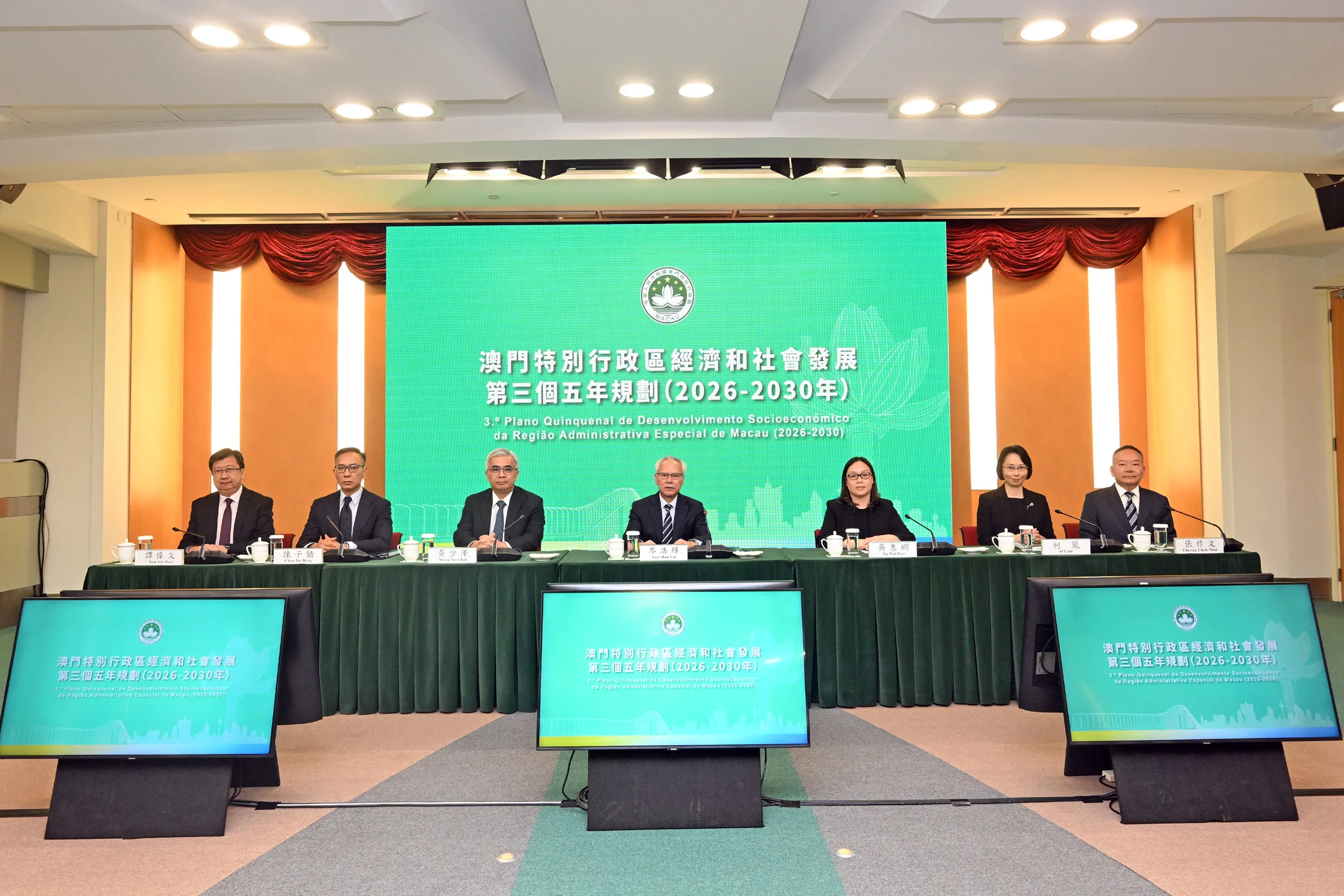
The release of Macau’s 3rd Five-Year Plan for Socioeconomic Development of the Macao Special Administrative Region (2026-2030) marks a new stage in the city’s strategic planning. Rather than redefining priorities, the document organizes and deepens directions that Macau has been consolidating in recent years: economic diversification, integration with Hengqin, urban renewal, and closer alignment with national development and opening up to the outside world.
In this sense, the new Plan presents an integrated vision for Macau’s development over the next five years. The economy, territory, regional integration, and internationalization are no longer presented as parallel dimensions, but as parts of the same transformation process.
Chief Executive Sam Hou Fai summarized this approach by saying that “success consists of one part planning and nine parts implementation.” Implementation therefore takes center stage in this new phase, supported by three instruments: a list of priority projects, a list assigning responsibilities for key tasks, and a third list devoted to major reform measures.
This structure seeks to turn broad strategic objectives into progressive implementation programs, allowing different areas of government to be coordinated and the execution of measures to be monitored throughout the 2026-2030 period.
Appropriate economic diversification remains one of the main pillars of Macau’s development, but it now comes with a particularly significant quantitative benchmark. “Our goal is to achieve added value from non-gaming industries equivalent to around 60% of local GDP by 2030,” Sam Hou Fai said.
The target reflects an intention to consolidate a more diversified economic structure, making use of existing strengths while creating new sources of growth. The four major projects and the Government Guidance Fund are expected to support this transformation, in coordination with the development of the “1+4” industries.
The principle is not to replace the gaming sector, which will continue to play an important role in the local economy, but to strengthen other activities capable of generating value and broadening the city’s economic base.
In this process, sectors such as technology, healthcare, modern finance, culture, tourism, and conventions and exhibitions could benefit from closer coordination among public investment, private enterprise, higher education, and research.
Macau’s ability to develop these sectors is also linked to its position within a broader economic space. This is precisely where Hengqin is becoming increasingly important.
Deepening Macau-Hengqin integration is presented as the Plan’s second major task. Technology and education are identified as drivers of this closer relationship, alongside greater coordination of regulations, infrastructure, and economic activities.
The Cooperation Zone allows Macau to overcome some of the natural limitations associated with its territorial size while participating in larger-scale economic and innovation networks. The complementarity between the two territories creates opportunities to develop projects combining resources, talent, research, services, and industrial capacity.
Sam Hou Fai said the government intends to “promote synergies between Macau and Hengqin industries,” while also deepening integration in social areas such as healthcare and elderly care.
This development reinforces the idea of a functional Macau-Hengqin space, in which economic development is accompanied by growing connections between services and communities. Integration is therefore no longer limited to infrastructure or cross-border mobility, but extends to different aspects of economic and social life.
For Macau, this complementarity could become one of the main tools for expanding the scale of diversification policies while preserving the SAR’s distinctive institutional characteristics.
The third pillar introduces an equally important dimension: transforming Macau’s urban environment itself.
The Plan calls for accelerating urban renewal through improvements to the legal framework, coordination of funding, resources, and public policies, and the creation of a sustainable intervention system.
The Ruins of St. Paul’s and older buildings in Iao Hon are among the areas specifically identified. However, the approach goes beyond individual projects. Urban renewal can help improve quality of life, revitalize historic neighborhoods, and create new conditions for economic, cultural, and community activities.
Within this framework, heritage and modernization do not necessarily have to be opposing forces. Macau’s experience as both a historic and contemporary city allows it to explore models in which preservation, revitalization, and urban development reinforce one another.
The fourth major task reinforces a role that Macau has increasingly assumed within the national strategy: integrating more deeply into China’s development while using its own strengths to connect with the outside world.
The Plan calls for deeper participation in the Guangdong-Hong Kong-Macao Greater Bay Area, stronger cooperation with Hong Kong, and greater participation in the Belt and Road Initiative.
Ao mesmo tempo, Sam Hou Fai anunciou que Macau irá “alargar as funções e o conteúdo da plataforma sino-lusófona/hispânica”, reforçando uma vocação internacional construída sobre características históricas, culturais, linguísticas e institucionais próprias.
Esta dimensão permite complementar a integração regional com uma função externa diferenciadora. A plataforma pode evoluir progressivamente para áreas como serviços financeiros, jurídicos, científicos, culturais e empresariais, alargando a capacidade de Macau para facilitar contatos entre a China e mercados internacionais.
Neste contexto, a expansão ao universo hispânico acrescenta escala à função tradicional da plataforma sino-lusófona, preservando simultaneamente a centralidade das relações históricas com os Países de Língua Portuguesa.
O 3.º Plano Quinquenal estabelece 35 indicadores principais e oito grandes objetivos para 2030. Mais do que um conjunto de metas isoladas, o documento procura articular diferentes dimensões do desenvolvimento de Macau num percurso comum.
Como afirmou Sam Hou Fai, trata-se do “roteiro e o documento orientador para a RAEM avançar numa nova fase de desenvolvimento de alta qualidade”.
O horizonte definido para 2030 combina, assim, continuidade e evolução: uma economia mais diversificada, uma relação mais integrada com Hengqin, uma cidade progressivamente renovada e uma função internacional mais ampla. A próxima etapa será precisamente a de transformar estas diferentes dimensões numa trajetória coordenada de desenvolvimento, consolidando as vantagens específicas de Macau no contexto nacional e internacional.
