

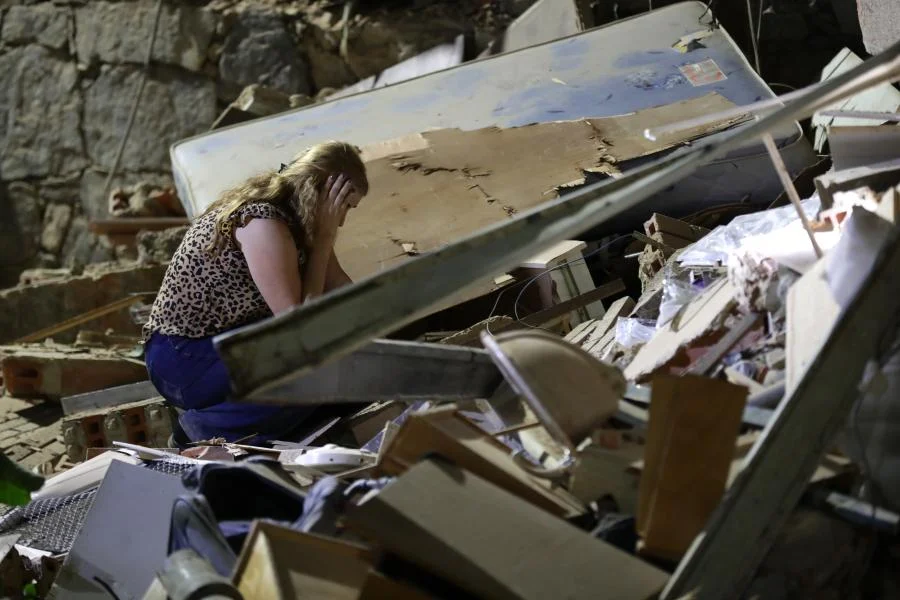
Assistência Médica Internacional (AMI) told Lusa it has identified Portuguese and Luso-Venezuelan people in need of economic support and mental health care, in La Guaira, the region most affected by the double earthquake that struck Venezuela in June.
“There is a Portuguese, and Luso-Venezuelan, community with many economic needs and needs for financial support, but also for mental health support,” AMI’s project coordinator and representative in Venezuela told Lusa this Saturday, during an initiative promoted by the Portuguese Embassy in Caracas in Naiguatá, La Guaira, offering social, cultural and educational support to those affected by the double earthquake.
“It’s also very important to highlight that this population is open to talking with psychologists (…) We have effectively managed to reach, to get close to the community and gain the trust for people to be with us,” noted Daniel Viegas Rocha.
The coordinator explained that AMI arrived in Venezuela on July 9, to conduct a survey, identify what the population’s greatest needs were, and in less than a week moved forward with an intervention project in the area of mental health and psychosocial support.
Read more about this topic: Venezuela: 134 Portuguese dead in double earthquake, 12 still missing
“There are many needs (…) the earthquake was a cherry on top of a cake of various traumas over the years, over the decades. Many members of the Portuguese community, like the Venezuelan community, lost a lot of things [in the floods] of 1999. So there is an ongoing trauma and many people end up feeling somewhat helpless,” he noted.
Rocha said he had heard accounts from Luso-Venezuelans who say they feel Venezuelan, but sometimes not entirely, and that as a result they often feel they lack support. As they also don’t feel entirely Portuguese, they also say they feel a lack of support from the Portuguese side.
Asked about warnings from several NGOs regarding the existence of depressive situations and suicide attempts, he explained that regarding Portuguese people he could not provide concrete data.
“But, indeed, it is noticeable and it has already reached us (…) about two weeks ago we were here in this square when a mother arrived with a teenage son on a motorcycle. When they arrived the son ran off and we went to try to talk to him. It was a child who had already attempted suicide twice,” he said.
Read more about this topic: Venezuela: NASA estimates over 58,000 buildings damaged or destroyed (with video)
The coordinator also reported that a Red Cross representative had told him she had “an estimate of more than 60 people” who had taken their own lives in La Guaira.
“It’s really very important and central to have an awareness that mental health is a need,” Rocha noted.
“And that is one of the great risks when it comes to donations. Many people look at donations as something material and only like to give donations to something that is built, to something that is visible. And mental health is unrewarding in that respect. We can’t take a photo of the impact we have on someone’s life. So it’s very difficult to reach and manage to convince a group of people, a funding entity, that it is necessary,” he said.
Rocha explained that AMI’s local intervention will run until the end of August, but that the organization would like to continue the work being done.
Read more about this topic: Venezuela: Pope Leo expresses gratitude for those assisting in relief (with video)
“We want to stay, we want to continue providing a response, but we effectively only depend on donations for the project to continue having the impact it has had. In three weeks we have already had more than a thousand participations in our activities. That’s a very significant number,” he said.
To Portuguese and Luso-Venezuelan people, he left the message that there are Portuguese institutions that want to continue offering support, without distinction of nationality.
“AMI is here to give the support it can, within its limitations, to the needs, mainly, for psychosocial support in the affected areas such as Naiguatá and Caraballeda,” he said.
