

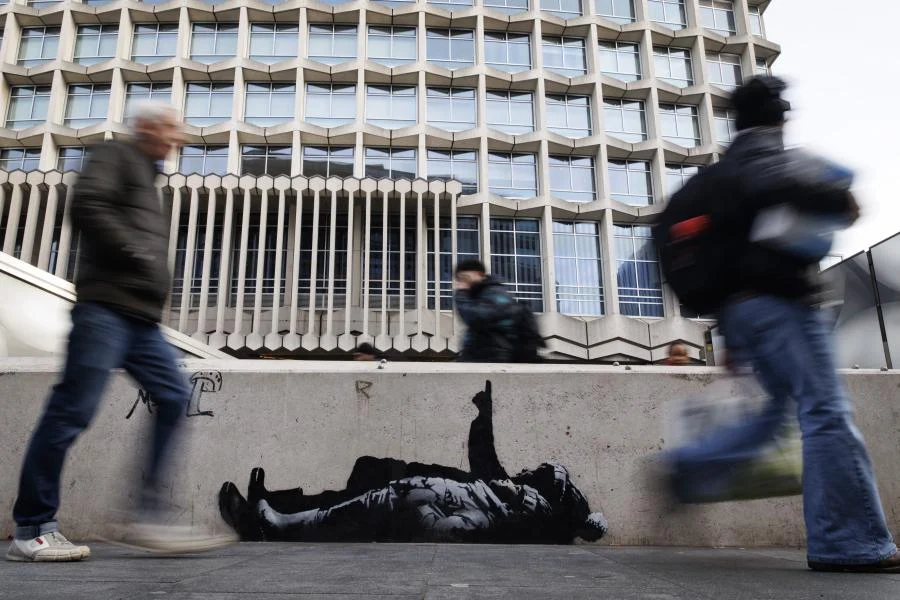
Three of the most recent works created in London by British street artist Banksy have cost UK taxpayers around €175,000 in cleanup and security operations, the British public broadcaster BBC revealed today. The largest individual cost relates to a mural painted at London’s Royal Courts of Justice in September 2025, in which Banksy depicted a judge raising a gavel above a protester holding a sign.
Removal and security work for this mural cost more than £85,000 (€99,203), the UK’s Ministry of Justice confirmed, following a freedom of information request submitted by the BBC.
Since the building is classified as Grade II listed, preserving its original appearance is a legal requirement. As a result, a complaint of “criminal damage” was filed with police shortly after the work was completed, and the area was sealed off with cleanup work beginning immediately.
Banksy’s most recent work, a statue of a man holding a flag about to fall from a pedestal, located near Trafalgar Square since April, cost Westminster City Council around £60,000 (€70,000), covering security barriers, maintenance and payment for a guard to watch over the site. According to the council, ownership of the statue, which remains on display, “now belongs to the Council, as owner of the land,” with “short, medium and long-term options” currently being studied.
Read more: Toni Braxton resolves $600,000 tax lien years after bankruptcy battles
In August 2024, as part of a series of daily works with animal themes dubbed “the London Zoo,” Banksy transformed a City of London Police sentry box into a piranha aquarium. The sentry box was removed at a cost of around €2,500. Starting next November, it will be displayed at the new London Museum, according to the Spanish news agency Efe.
Banksy’s work, considered one of the most influential in contemporary street art despite the artist’s identity remaining unknown, consistently generates significant attention and has previously been stolen, painted over or auctioned for millions, repeatedly raising the question of whether it constitutes art or vandalism.
Conservative Party justice spokesperson Nick Timothy called it “outrageous” that taxpayer money must be spent cleaning up “the damage” caused by Banksy, who, he said, “appears to believe he has the right to damage public buildings with impunity.”
Art critic Estelle Lovatt, on the other hand, argued that the graffiti artist’s work attracts an enormous number of tourists, “brings people together” and “makes art accessible, because you don’t need to pay for entry to a gallery.”
