

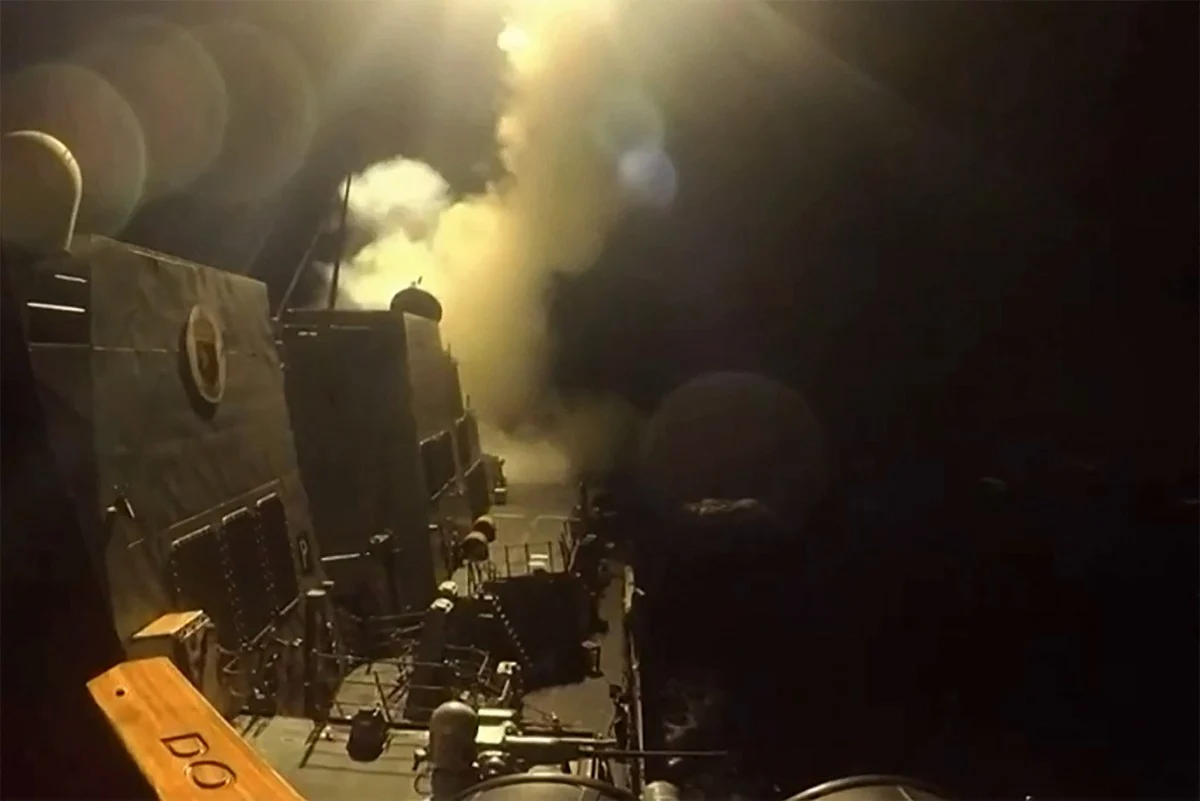
The United States launched a massive wave of airstrikes against targets inside Iran early Thursday, prompting Tehran to retaliate with missile and drone strikes across the Middle East. The intensifying exchange of fire severely threatens an interim ceasefire agreement designed to end the months-long war.
While sporadic back-and-forth attacks have strained the fragile truce since it was signed last month, Thursday’s operations marked a major escalation. Air defense sirens sounded across multiple U.S.-allied countries, including Jordan, Qatar, and Bahrain—home to the U.S. Navy’s 5th Fleet headquarters.
The escalation follows an announcement by U.S. President Donald Trump, who declared that recent Iranian attacks on commercial vessels in the Strait of Hormuz effectively ended the ceasefire. Trump warned of severe military escalation if the maritime disruptions did not cease.
U.S. Central Command (CENTCOM) confirmed that its forces struck 90 distinct military targets along Iran’s southern coastline, including air defense and coastal surveillance systems, missile and drone storage facilities, naval assets and logistics infrastructure, key transportation bridges and railways used to move weapons
Read more about this topic: As Trump seeks an exit from the Iran conflict, a fresh Israeli warning of a specific plot on his life threatens to force his hand (with video)
According to the U.S. military, the strikes aim to degrade Iran’s capability to threaten freedom of navigation in the critical waterway, where approximately one-fifth of the world’s traded oil and natural gas passed prior to the outbreak of the war on February 28.
Iran’s Health Ministry reported that the two days of American bombardments killed at least 14 people and wounded 78 others, primarily members of the Iranian armed forces.
In response, Iran’s paramilitary Revolutionary Guard launched ballistic missiles, cruise missiles, and drones targeting U.S. bases and allied facilities throughout the Persian Gulf region:
-
Kuwait: The military reported intercepting three ballistic missiles, a cruise missile, and 10 drones. Falling debris wounded one person.
Read more about this topic: “They’re scum!”: Trump terminates Iran ceasefire at NATO summit, triggering overnight air strikes (with video)
-
Jordan: Government spokesperson Mohammad al-Momani stated that all incoming projectiles aimed at a local U.S. military installation were successfully intercepted.
-
Bahrain & Qatar: Air defenses were active, though no immediate casualties or severe infrastructure damage were reported.
Iranian state media also accused the U.S. of conducting a late-afternoon strike near Bushehr, home to the country’s sole nuclear power plant. Local officials claimed explosions went off near the complex around noon, though CENTCOM’s official target list made no mention of the facility.
