

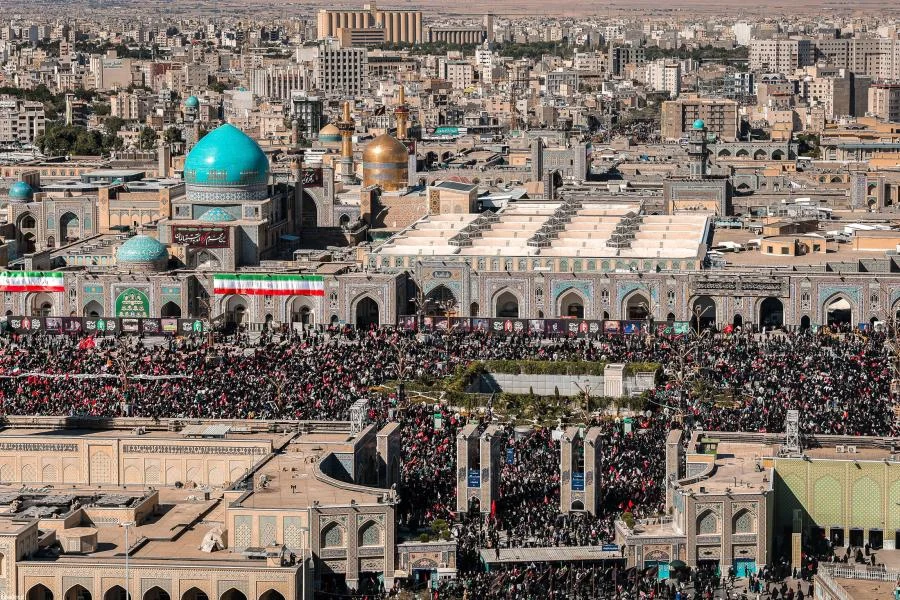
An estimated 41 to 43 million people participated in the seven-day funeral ceremonies for Iran’s former Supreme Leader, Ali Khamenei. The multi-city processions spanned five locations across Iran and Iraq, culminating in his burial on Thursday in the holy city of Mashhad.
The Fars news agency, which is linked to Iran’s Islamic Revolutionary Guard Corps (IRGC), reported the total turnout estimate based on data from official sources. The calculation utilized public transportation logs, mobile phone activity tracked at Tehran’s Grand Mosalla Mosque—where the coffin remained for two days—and density mapping along the procession routes in Tehran, Qom, and Mashhad.
In neighboring Iraq, an estimated 10 million people gathered on Wednesday to join the funeral processions in the holy provinces of Najaf and Karbala. The figures were released as preliminary statistics by the office of Iraqi Prime Minister Ali al-Zaidi.
While the Iranian government has not published an official national tally, immense crowds consistently packed public spaces throughout the week to mark the death of the religious leader.
Read more about this topic: Iranian mourners demand vengeance against US and Israel before Khamenei’s coffin. Millions gather in Tehran under heavy security as reclusive successor Mojtaba assumes power
Khamenei was killed on February 28 during the opening day of the war launched by the United States and Israel against Iran. His death ended a 36-year rule over the Islamic Republic.
The extensive funeral processions also carried the coffins of four of his family members killed in the same military strike. Among the victims were a 14-month-old granddaughter and the wife of his son and newly appointed successor, Mojtaba Khamenei.
Notably, Mojtaba Khamenei did not attend any of the public funerals. The new Supreme Leader has not made a public appearance or broadcasted a video message since his appointment on March 8.
Through these massive state-organized funerals, the Islamic Republic is seeking to project regional power and domestic unity in the aftermath of the war. The show of solidarity follows a period of intense domestic instability, including widespread popular protests in January driven by public discontent over the country’s severe economic crisis.
