

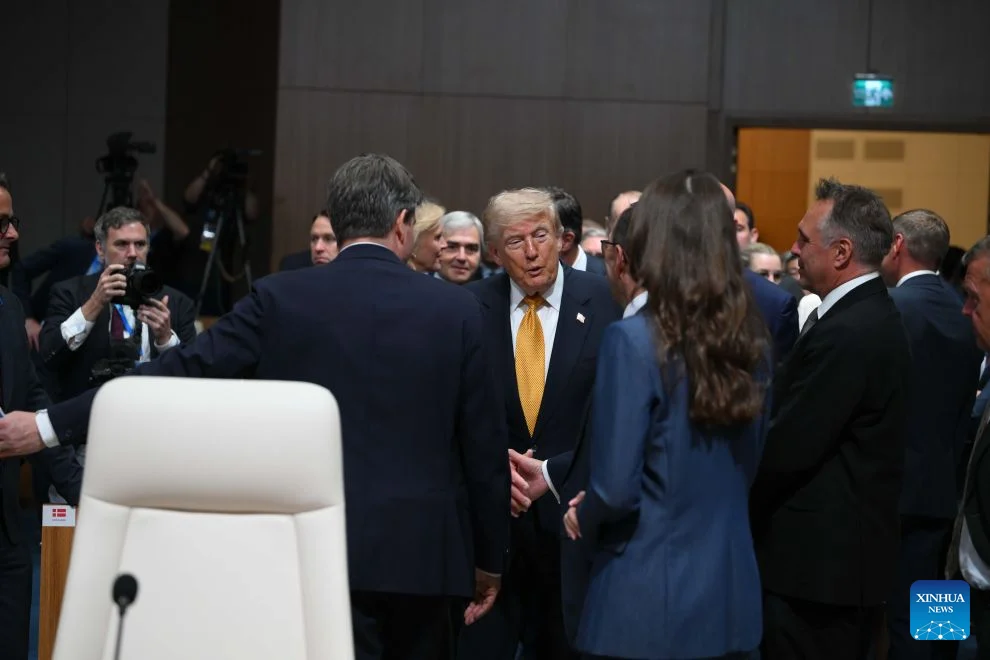
NATO Secretary-General Mark Rutte deployed a strategy of intense flattery to manage U.S. President Donald Trump during a highly volatile alliance summit in Turkey this week. While the charm offensive earned Rutte personal praise from the American president, it triggered sharp criticism from defense experts and European leaders who question whether the submissive approach yielded any real benefits for the military alliance.
The two-day summit in the Turkish capital exposed deep fractures, says CNBC. President Trump repeatedly clashed with key allies, threatening to cut off all trade with Spain over its defense spending levels, slamming NATO’s response to the ongoing U.S. war with Iran, and reigniting his territorial feud with Denmark by doubling down on his desire for U.S. control over Greenland.
Despite the friction, Trump offered nothing but praise for Rutte, labeling the former Dutch prime minister a “great leader” and the alliance’s “biggest asset.”
Rutte’s diplomatic strategy was on full display during a bilateral meeting on Wednesday, where he repeatedly addressed the U.S. leader as “dear Donald.” Rutte credited Trump with pushing European nations and Canada to invest an additional $1.2 trillion in defense across his two presidential terms—a milestone Rutte coined the “Trump trillion.”
Read more about this topic: As Trump seeks an exit from the Iran conflict, a fresh Israeli warning of a specific plot on his life threatens to force his hand (with video)
Rutte had previously pitched this narrative directly to Trump during an Oval Office visit in late June, presenting charts highlighting the spending spike.
During Wednesday’s session, Rutte intervened to validate Trump’s criticism of his predecessors. When Trump blasted past U.S. presidents for failing to force allies to pay more, Rutte interjected: “But you did what Eisenhower started trying to do… And all the other presidents, none of them were successful. You were the first one. It’s your win.”
“That’s why I like him,” Trump replied.
The display follows a pattern established at last year’s NATO summit in the Netherlands, where the alliance passed a historic target requiring members to commit 5% of their GDP to defense by 2035. During that gathering, journalists questioned Rutte’s deferential tone after he referred to the U.S. president as “Daddy”—a remark Rutte later dismissed as “a question of taste.”
Read more about this topic: Arctic sovereignty vs. Transatlantic defense: How Trump’s revived push for Greenland pushes NATO to a breaking point in Ankara
Rutte’s flattering overtures did not sit well with all attendees. Confronted by a reporter during an Ankara press conference about his “self-respect” and his apparent failure to defend targeted allies, Rutte doubled down, stating it was vital to “acknowledge when praise is due” and that a stronger Europe makes the continent a “more relevant” strategic partner to Washington.
However, other European leaders chose defiance over flattery:
-
Denmark: Danish Prime Minister Mette Frederiksen struck a firm note against Trump’s renewed rhetoric regarding Greenland, a self-governing Danish territory. Asked if Denmark was prepared to defend the territory militarily, Frederiksen vowed, “We are ready to defend every inch of NATO, including our own territory.”
-
Finland: Finnish President Alexander Stubb sought to lower the temperature, urging allies to “be more Arctic, be more cool,” pointing out that Finland has 1 million soldiers trained in Arctic conditions ready to secure the region.
Read more about this topic: Trump blasts Europe over migration and threatens 100% tariffs ahead of pivotal NATO summit. What’s at stake?
Security analysts remain skeptical of Rutte’s long-term containment strategy. Marion Messmer, international security program director at Chatham House, warned that Rutte’s submissiveness has failed to translate into structural wins, as Trump remains openly dissatisfied with the alliance.
“There is a concern that Rutte’s approach… might send the wrong message to Russia, that European states feel weak without the U.S. and are willing to bind the U.S. to Europe no matter what,” Messmer noted.
Conversely, some Eastern European allies defended the secretary-general’s focus on keeping Washington engaged at all costs.
“Mark Rutte is secretary-general of NATO… his only job is to keep the alliance running,” Latvian President Edgars Rinkēvičs told CNBC. “His only job is to do whatever it takes to have this alliance working, and he does a great job.”
