

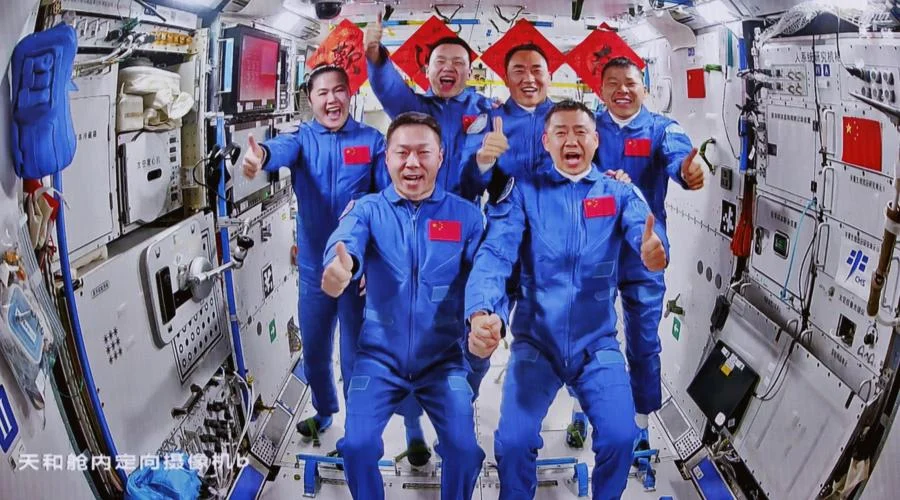
China plans to initiate a new phase of expansion for its Tiangong space station, transforming its current T-shaped configuration into a cross-shaped structure to significantly increase its scientific and logistical capacity, Chinese state television CCTV reported.
According to the broadcaster, the expansion is part of China’s manned space program planning and comes in response to the growing number of experiments, scientific payloads, and operational demands accumulated since the station became operational.
Tiangong, which currently consists of the Tianhe core module and the Wentian and Mengtian science laboratories, has so far hosted or executed 267 scientific and application projects. Last year, the station received 86 new in-orbit experiments along with approximately 1,179 kilograms of scientific materials, returned roughly 105 kilograms of samples to Earth, and generated more than 150 terabytes of data.
In the initial phase, the plan outlines the addition of a new multifunctional module that will increase docking ports, facilitate the simultaneous presence of multiple spacecraft, and expand areas designated for experiments, storage, and extravehicular activities.
Read more about this topic: China’s Tianzhou 10 successfully docks at Tiangong space station (with video)
Experts cited by CCTV indicated that the surge in scientific activity has led to a gradual saturation of available space and equipment, while the rise in supply missions and crew rotations requires a larger operational margin and emergency response capacity.
The expansion also aims to make the living and working conditions for astronauts more comfortable as China moves toward longer stays in orbit and prepares missions with a greater human presence.
The Shenzhou-23 mission, currently aboard Tiangong, includes the first experiment of the Chinese manned space program designed to keep a crew member in space for an entire year, though authorities have not yet specified which of the three astronauts will be chosen.
In a later stage, the station could incorporate new modules to form a six-section structure, reaching a total mass of up to 180 tons compared to its current 90 tons, according to Yang Hong, a designer for the Chinese space station system.
Read more about this topic: China launches Shenzhou-23 mission with Hong Kong astronaut (with videos)
The expansion aligns with China’s broader strategy to consolidate Tiangong as a long-term scientific platform and a technological validation base for future missions, including the national goal of landing Chinese astronauts on the Moon before 2030.
