

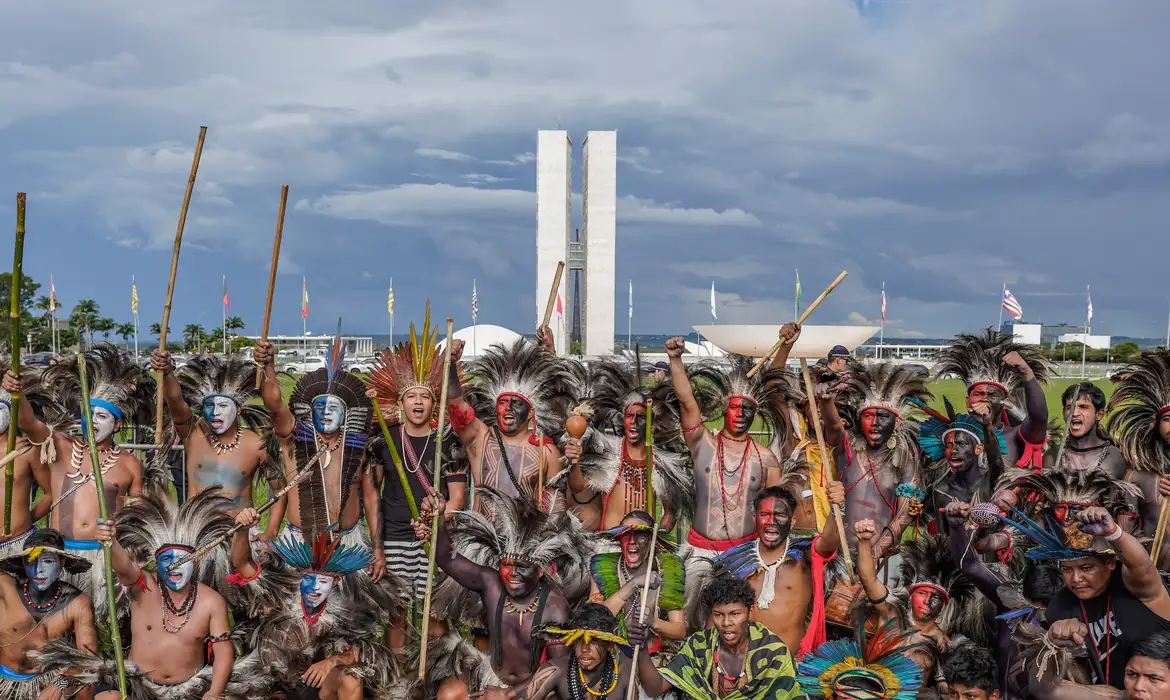
Come rain or shine, more than 300 indigenous people took part in a march of about five kilometers to the Esplanada dos Ministérios as part of the Acampamento Terra Livre (ATL), Brazil’s largest indigenous mobilization.
Among the participants were indigenous university students, many from the Amazon region in the north, who study in the country’s major cities, thousands of kilometers from their communities.
“It’s not enough just to get Indigenous people into universities; it’s also important to help them stay,” sociology student Genival Laranhaga, 26, of the Ticuna people, told Lusa, alongside 50 other classmates from the same college in the interior of São Paulo.
Another student, Emerson Chaves de Oliveira, a member of the Baré people and a graduate student in indigenous languages at a public university in Rio de Janeiro, defended the importance of retention policies in higher education and the occupation of these spaces by indigenous peoples.
Read also: Lula accuses Bolsonaro’s of wanting to sell Brazil to the US (with video)
In his view, indigenous rights are the result of their ancestors’ struggle and must be preserved. “We have to be present in these spaces, because otherwise we lose our leading role and the opportunity to ‘claim’ the university through our voice and our presence,” the educator emphasized.
In addition to posters denouncing violence against Indigenous people, the mobilization included speeches by leaders along the route, with calls for the demarcation of territories and the strengthening of Indigenous presence in Brazilian politics.
Federal Deputy Célia Xakriabá, from Minas Gerais, in a conversation with Lusa, drew attention to the lack of Indigenous re-elections in Congress and defended these candidacies as a form of climate action. “Voting for an Indigenous candidate is voting for a real climate candidate in Brazil,” declared Xakriabá.
During the march, protesters delivered a seven-page letter of demands to the Brazilian Presidency and the Ministry of Mines and Energy, denouncing threats to Indigenous rights and demanding an end to policies that allow the exploitation of natural resources in Indigenous territories without prior consultation.
Read also: Amazon fires in Brazil rise 13.2% in March
At the Ministry of Foreign Affairs, a document was also presented outlining a comprehensive proposal for the phase-out of fossil fuels, in line with the discussions at ATL 2026 and focused on the protection of Indigenous territories and climate justice.
In a statement, the executive coordinator of the Articulation of Indigenous Peoples of Brazil (Apib), Dinamam Tuxá, affirmed that there can be no just energy transition without safeguarding indigenous territories.
“These are concrete measures to address the climate crisis. When the world ignores this, it chooses to maintain a model that destroys life,” he emphasized.
This year’s edition of the ATL is taking place under the slogan “Our future is not for sale: we are the answer,” focusing on the 2026 elections and the expansion of mining on indigenous lands.
During the protest, there were also references to Brazilian President Lula da Silva, with praise for measures such as the creation of the Ministry of Indigenous Peoples, but criticism of his support for the exploitation of fossil fuels, particularly oil, in the Amazon.
Singer Chico César, who was present at the march, emphasized in statements to Lusa the importance of the indigenous cause for environmental preservation and called for support from Brazilian society.
“I am also of indigenous descent and I am also related to them. I believe that marching for the indigenous people is marching for life. The very existence of the planet is threatened, and the main defenders of the environment and nature are the indigenous peoples,” declared the artist from the state of Paraíba.
The mobilization, which began on Sunday, continues through Saturday, featuring assemblies, forums, and political actions, intensifying pressure on the Brazilian government to protect indigenous peoples and their territories.
