

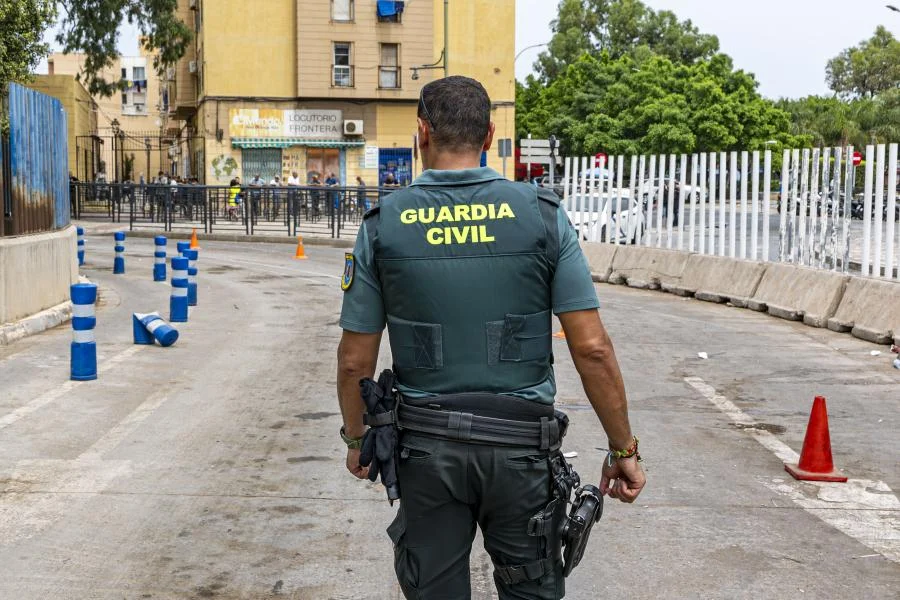
Residents of Ceuta are attempting to return to normal life today amid an ongoing migration crisis in the Spanish enclave, while Melilla has now passed a second consecutive calm night, according to official sources and Spanish media.
The autonomous city of Ceuta is beginning to stabilize as migrants gradually move back toward Morocco, security is stepped up at key locations, and tension eases around demonstrations held in recent days at Plaza de los Reyes in the city center, according to the news agency EFE. Residents are trying to resume their normal routines, though many remain hesitant to leave their homes, and restaurants and beaches remain quieter than usual for this time of year.
The arrival of roughly 80,000 migrants from Morocco, which began Thursday, coincided with what would have been the opening days of the city’s annual fair, which had to be canceled. Ceuta’s government has raised the number of people found dead near the Tarajal border breakwater to 88.
Ceuta’s president, Juan Jesús Vivas, said today that between 3,000 and 5,000 migrants remain in the Spanish autonomous city, four days after the massive influx from Morocco began. Speaking to Telecinco, in comments carried by the Europa Press news agency, Vivas said Spain’s territorial integrity had been violated in Ceuta through what he described as an avalanche of 80,000 people, a figure roughly equivalent to the city’s own population.
Read more about this topic: Spain: What to know about Ceuta as illegal crossings from Morocco surge (with videos)
The city’s president stressed that the situation is no longer what it was on Thursday and Friday, but said measures need to be taken across several areas to ensure the crisis doesn’t repeat itself.
Meanwhile, the border of the Spanish enclave of Melilla, which also borders Morocco, has now passed its second consecutive calm night since the migration crisis began last Thursday. The Beni Enzar border crossing continues to gradually reopen. Sources from the Government Delegation in Melilla told EFE that no incidents have been recorded along the length of the border.
At that crossing, the situation is nearly back to normal, according to police sources cited by EFE, with traffic gradually resuming in groups of 20 vehicles at a time. The measure is aimed at avoiding another border shutdown and a repeat of the humanitarian crisis experienced by roughly 2,000 foreign nationals during a 36-hour closure between Thursday night and Saturday morning, during which around 700 vehicles backed up near the crossing.
