

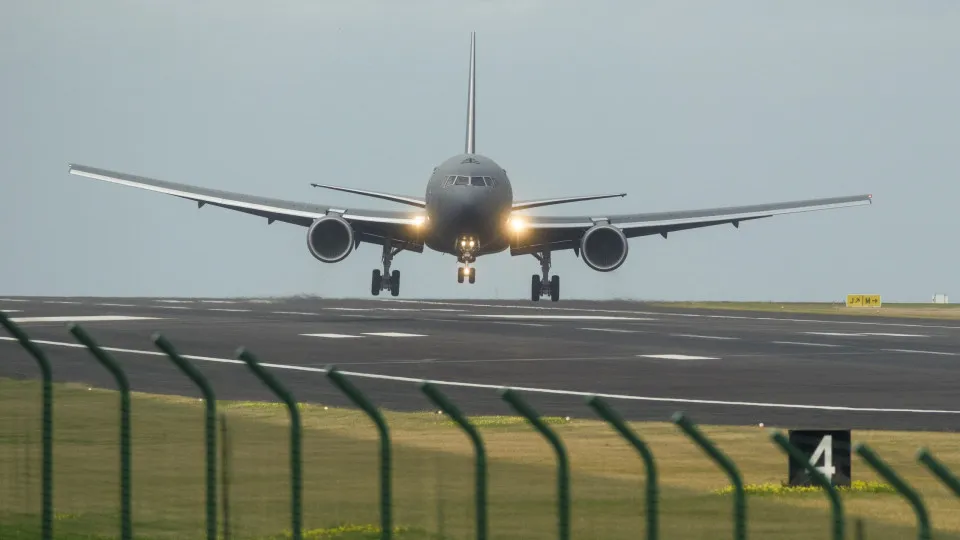
On the morning of March 2, only four of the 15 KC-46 Pegasus refueling aircraft left Lajes Air Base, where they had been stationed for over a week. However, on Sunday, March 1, 13 sorties were flown by these aircraft, which can refuel military aircraft in flight.
In the morning, five refueling aircraft took off, returning in the early afternoon, and in the late afternoon, eight aircraft took off in two groups, returning to base in the evening.
Although there is no official information, these aircraft may be refueling U.S. military aircraft traveling between the United States and the Middle East or vice versa. Since February 18, the movement of U.S. aircraft at Lajes Air Base has intensified.
In addition to the 15 refueling aircrafts – 12 F-16 Viper fighter jets, a C-17 Globemaster III military cargo plane, and a C-5M Super Galaxy cargo plane, the largest strategic transport aircraft in the United States Air Force, passed through the infrastructure.
On Friday, February 27, the eve of the attack on Iran, two refueling aircraft took off from Lajes in the early afternoon and returned in the evening.
On Saturday, February 28, five refueling aircraft took off from Lajes and returned in the evening. A P-8 Poseidon, a military aircraft developed for the US Navy and designed for anti-submarine warfare, also took off and returned in the evening.
Some C-130 aircraft, normally used for transporting troops and cargo, belonging to the US Air Force and Navy, have also been passing through Lajes Air Base.
Read also: China strengthens support for Iran and calls for an end to the conflict
A week earlier, even before the attack on Iran, Portuguese Foreign Minister Paulo Rangel stated that the Cooperation and Defense Agreement between Portugal and the United States provided for “tacit authorizations,” “given in a relatively short period of time,” for the use of Lajes Air Base.
On Sunday, March 1, the president of the Regional Government of the Azores, José Manuel Bolieiro, stated that the Agreement “was fulfilled” and that the importance of the region “was reaffirmed” by the recent attack on Iran.
In a political statement without questions from journalists, Bolieiro said that “in the current international context of war,” the Government of the Azores and the Government of the Republic “maintained contact and exchanged information” through the prime minister, the minister of foreign affairs, and the president of the Azorean Executive.
