

One hundred years after his death, Camilo Pessanha remains a towering figure in Portuguese Symbolist poetry, and one of the literary world’s most compelling stories of displacement, reinvention, and belonging.
To mark the centenary, IPOR organised a commemorative session in Macau, also participating in The Script Road — Macau Literary Festival.
As part of The Script Road — Macau Literary Festival, on 1 March 2026, the session “Ir assim, a bordo de um navio, sem destino” — a verse drawn from Pessannah’s own poetry — took place at Casa Garden, starting at 16:00. The session brought together speakers António Carlos Cortez, Carlos Morais José, Christopher Chu, Diego Giménez, Maggie Hoi, and Yao Feng, moderated by Sérgio Sousa.
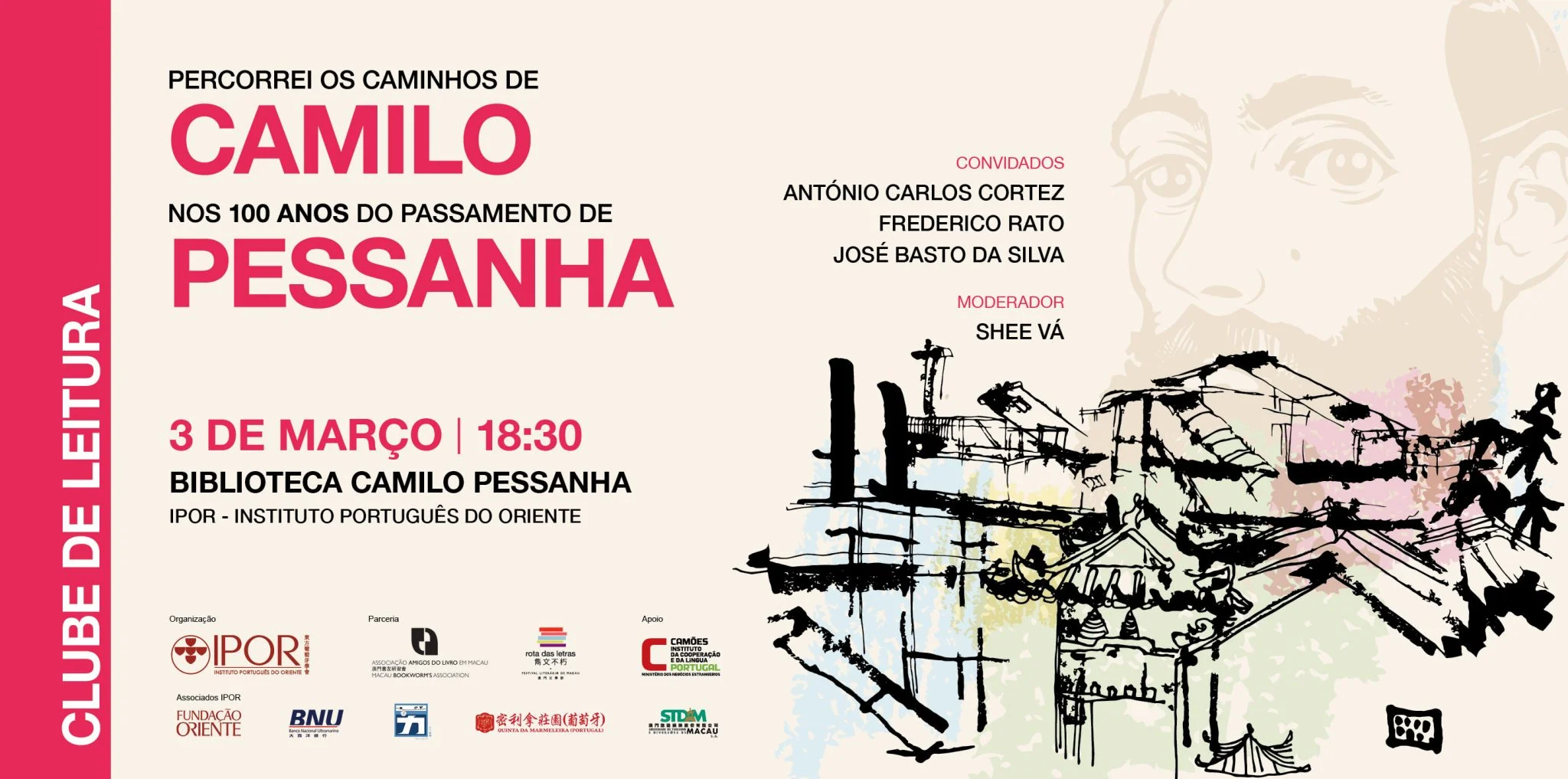
The session organised by IPOR, “Percorrei os Caminhos de Camilo Pessanha”, took place on 3 March 2026, at 18:30, at the Biblioteca Camilo Pessanha, within IPOR’s premises. Guests António Carlos Cortez, Frederico Rato, and José Basto da Silva joined moderator Shee Vá for a reading club format conversation retracing the poet’s path through Macau.
A Life Shaped by Macau
Born in Coimbra in 1867, Camilo Pessanha arrived in Macau in 1894, initially as a private tutor before serving as a judge. What began as a temporary posting became a permanent home.
The city’s landscapes, its cultural duality, and its atmosphere of quiet melancholy left an indelible mark on his verse.
In Macau, Pessanha immersed himself deeply in Chinese culture. He became a dedicated collector of Chinese porcelain and antiquities, authored scholarly essays on Chinese art, and developed a profound connection to the territory that would never leave him.
His masterwork, Clepsidra, first published in 1920, is regarded as one of the finest achievements of Portuguese Symbolism, suffused with themes of exile, the passage of time, and longing.
He died in Macau on 1 March 1926, having never permanently returned to Portugal. A century later, the city continues to honour his memory, most visibly through the library that carries his name within IPOR’s walls.
