

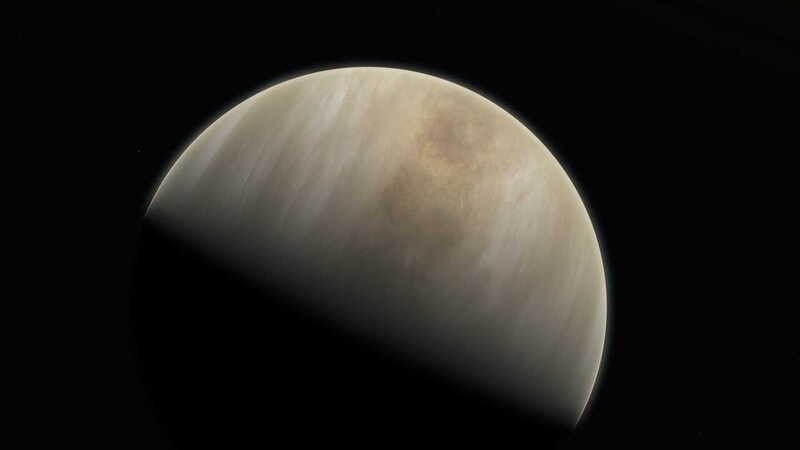
Venus is surrounded by a carbon dioxide atmosphere with a pressure 90 times higher than Earth’s, causing a runaway greenhouse effect with surface temperatures near 470ºC.
A new study presented the first global map of Venus’s heat flux, revealing that the planet dissipates proportionally much less heat than Earth.
The research was conducted by scientists from the Complutense University of Madrid, Rey Juan Carlos University, University of Cádiz, the Technical University of Denmark, and the University of Ottawa, according to Europa Press.
Venus’s carbon dioxide atmosphere, with 90 times Earth’s pressure, leads to extreme greenhouse heating at the surface. However, differences extend beyond the surface; geological structures on both planets also differ, indicating divergent internal dynamics.
Read more: Europe invested €45 billion in wind power but deployment falls short of targets, study finds
Currently, Earth’s interior cools efficiently due to plate tectonics, with surface heat loss two to three times higher than that produced by radioactive decay. This indicates the planet is losing internal energy actively and continuously.
Unlike Earth, there are no direct measurements of heat flux on Venus. Estimates are derived from properties of its lithosphere, since rock behavior depends on temperature. Previous studies analyzed specific regions, but the new research provides the first global heat flux map of Venus, allowing an estimate of the planet’s total heat loss.
Read more: USA grants funding to study rare earth extraction in Mozambique
Results show that Venus’s total heat loss is roughly equal to the heat generated by radioactive decay in its interior, explained Javier Ruiz Pérez, lead author and researcher at the Department of Geodynamics, Stratigraphy, and Paleontology at the Complutense University of Madrid.
This implies Venus is cooling very slowly or may even be experiencing slight internal heating. Compared to Earth, Venus dissipates proportionally much less heat.
These findings improve our understanding of Venus’s geological history and the processes that govern the habitability and evolution of rocky planets, including Earth.
