

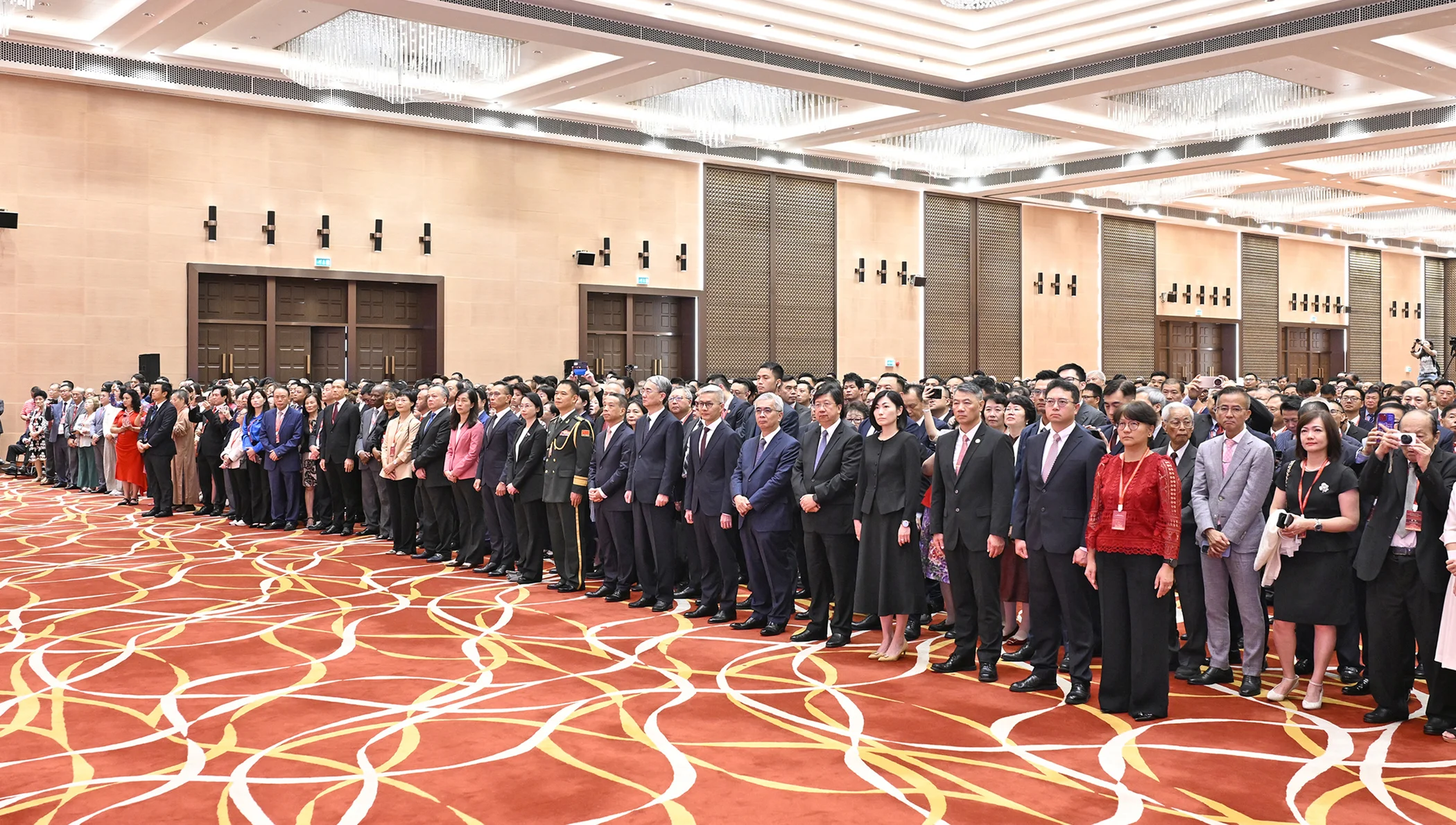
Sam Hou Fai, without hesitation, admitted that it was his decision to invite André Cheong to become a legislator, focusing this strategy on the need to guarantee greater “coordination” and “communication” between the Legislative Assembly and the Government. With this move, he removed his former number two from the center of power; but never mentioned that side of the story. In essence, the message was that, once this decision was made, “it was then necessary to proceed with the consequent appointments.” Not one, but two new secretaries, due to Wong Sio Chak’s transition. The surprise was that André Cheong also spoke, right after the man who had just mapped out his fate, delivering a speech aligned with the same tune played by both branches of power. Still, with the obvious but relevant nuance of someone leaving the Executive, who reminded that the Executive holds “primacy.”
There was more… Wong Sio Chak followed, replacing Cheong at Administration and Justice; then Chan Tsz King, replacing Wong at Security. And also… Raymond Tam, unrelated to the reshuffle, spoke about the light rail, urban renewal, and public housing. Finally, Tong Hio Fong, prosecutor replacing Chan Tsz King at the Public Prosecution Office, also made his first public appearance in the role.
Cooling the Crisis
Cheong’s fall — and Wong’s rise — was the hot topic on the scorching morning of October 1. But much ice was poured over a tension that was barely visible: a profusion of short, syncopated messages; many themes, multiple actors, different questions, and some dispersion…
The essential message remained, with total alignment: the coming cycle is one in which the Legislative Assembly is there to follow the Government. “I chose the seven appointed legislators thinking of the Assembly as a whole, with the intention of filling the most lacking profiles,” explained Sam Hou Fai, arguing that this “greater coordination is what the population demands and feels is missing.” In fact, the thesis comes directly from Xia Baolong, Director of the Hong Kong and Macau Affairs Office, during his visit to Macau before the legislative elections.
Presidency Announced
The next step is now expected to be André Cheong’s election as President of the Legislative Assembly. It is not official, nor is it up to Sam Hou Fai to say so, but all sources contacted by PLATAFORMA are convinced it will indeed happen. An unprecedented move, placing legislators in the strange position of informally voting under executive decree. This, when names of veterans such as Ho Ion Sang — elite of the Kai Fong — and Chui Sai Peng, brother of Chui Sai On, were being discussed behind the Assembly’s scenes.
Directly asked about this, André Cheong neither confirmed nor denied: “The president of the AL is elected by the legislators”; and so… What is certain is that he shows himself “willing” to “contribute” in the best way to ensure “coordination” and “communication” between the Palace and the Assembly. Using the exact same terms spoken minutes earlier by the CE.
André Cheong projected calm — and dignity — thanking Sam Hou Fai, but also “all the Chief Executives — and the Central Government — who so often placed their trust” in him, in “all the public posts” he has held to this day.
A Steady Star
The new star, Wong Sio Chak, took the podium with the confidence of someone prepared for any portfolio. He spoke of “changes” in cycle and “innovative” processes, language Sam Hou Fai has brought to the public discourse. But he is aware of the “added responsibility” that comes with his new portfolio. It was the day’s most proactive speech, in which he laid out a series of priorities: Administrative Reform, Organic Statute, E-Government, Legislative Reform, Food Safety; External Relations, Integration with Hengqin, deepening the “One Country – Two Systems” principle, etc.
In the mere eight months he was in this Government, André Cheong had also overseen the Hengqin plan. But Wong Sio Chak cannot yet take that on: “As you know, I am part of one of the commissions that is studying Hengqin’s future; a very important process for Macau. But there are still a series of issues under review, and meetings we will hold with entities from the Greater Bay.” In other words, he does not yet know — or cannot yet say — whether he will also take on Hengqin.
