

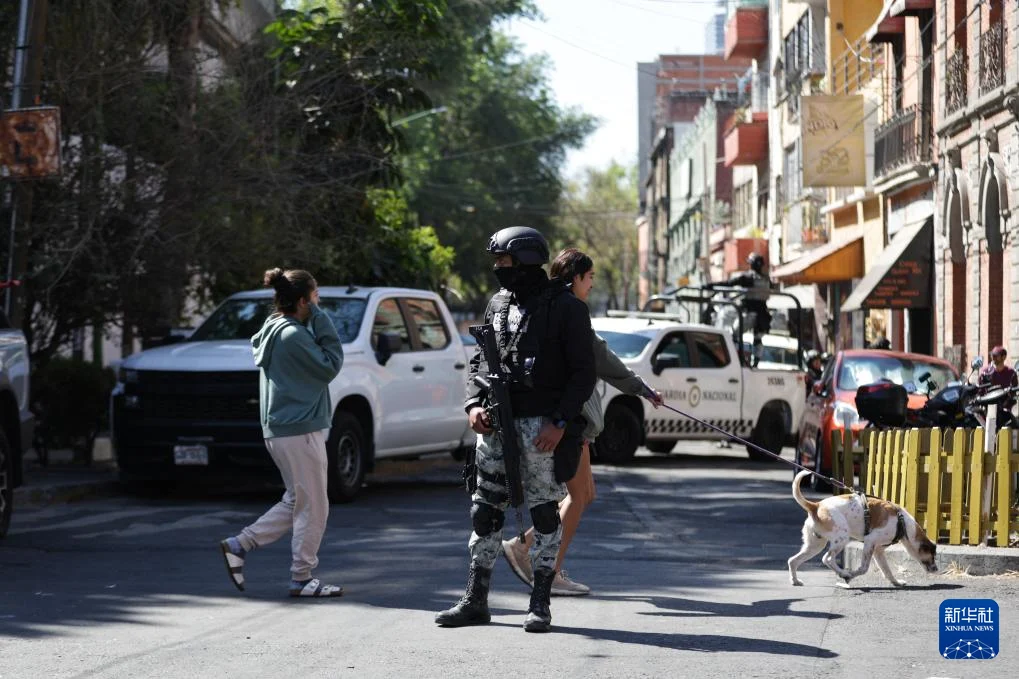
Mexico pledged today to mobilise around 100,000 personnel to guarantee security at the 2026 World Cup, which it is co-hosting with Canada and the United States.
With the aim of presenting the international community with a “reliable, safe and organised” country, the Mexican government outlined a strategy involving state forces and the private security sector to protect the three host cities — Mexico City, Monterrey and Guadalajara.
According to the head of the Coordination Centre for the 2026 World Cup, general Ramón Barrios, three joint task forces will be formed — one per host city — comprising 20,000 members of the armed forces, primarily from the National Guard, and 55,000 agents from the Secretariat of Public Security, along with private security personnel, bringing the total to around 100,000.
In terms of equipment, 2,100 military vehicles and 378 civilian vehicles will be deployed for the escorts of heads of state and foreign football delegations, along with 24 aircraft for aerial surveillance. The operation will also include 33 surveillance and monitoring drones, decontamination tents and 88 dogs specialised in explosives detection.
During the tournament in June and July, military forces will coordinate flights to ensure “free surveillance” airspace zones are available to prevent “unwanted incursions.”
“We will have anti-drone systems to neutralise any flying device not on our whitelist. We therefore appeal to fans who own drones to refrain from using them if they are not registered on the whitelist to operate these devices,” the general added.
Locations of particular interest — such as airports, hotels, training facilities and stadiums — will have dedicated security arrangements.
Read more: Messi kicks off MLS season in key World Cup year
The security debate was reignited following a wave of violence that struck several regions of Mexico after the death of the leader of the Cartel Jalisco Nueva Generación, known as El Mencho, in a federal operation.
Mexican president Claudia Sheinbaum has reiterated in recent days that Mexico maintains its status as a host country and that coordination with FIFA on logistics and security in the host cities is ongoing.
Mexico will host the World Cup for the third time, following the 1970 and 1986 tournaments, and will stage 13 matches.
