

The Portuguese Prime Minister met with the Chief Executive, Sam Hou Fai, underlining the importance of the MSAR as a platform connecting China and Portuguese-speaking countries. The meeting confirmed that the Portugal–Macau Joint Commission will be held from February 4 to 6, 2026—the first since 2019, before the pandemic.
In the morning, at Government Headquarters, Chief Executive Sam Hou Fai welcomed the Portuguese delegation and emphasized Macau’s role under the “One Country, Two Systems” principle, highlighting the preservation of cultural diversity and the promotion of the Portuguese language.
In turn, Luís Montenegro praised the progress achieved since Macau’s return to the Motherland and expressed readiness to strengthen joint efforts, stressing the need to deepen economic, social, and cultural ties, according to a statement from the Government Information Bureau.
After the meeting, Montenegro visited the Portuguese School of Macau (EPM), where he stressed the institution’s central role in preserving cultural identity and connecting Portugal, Macau, and China. “It is a hugely important asset, strategic for the promotion of our language, but also for providing training and qualification opportunities to hundreds of young people every year,” he said.
The Prime Minister emphasized that the school is a symbol of Portugal’s “universal vocation,” opening pathways for students to continue their studies in Macau, China, Portugal, or other Lusophone countries.
Jorge Neto Valente, president of the EPM Foundation, highlighted pedagogical autonomy as a key pillar. “Only the school can decide who are the competent and qualified teachers to teach the Portuguese curriculum in Macau,” which is compatible with universities in Europe, the Lusophone world, and China. Although there are no immediate financing issues, Neto Valente reminded that the school faces legal challenges due to the need to reconcile Portuguese and MSAR regulations.
Au Kam San and Residency
After visiting the Portuguese Consulate-General and the Ruins of St. Paul’s, Montenegro proceeded to the Consul’s residence, where the Portuguese community awaited him for a brief gathering. Montenegro congratulated the Portuguese living in the MSAR, calling them “ambassadors” of Portugal in the world.
In a brief session with journalists, Montenegro admitted he had not discussed with Sam Hou Fai the detention of former lawmaker and Portuguese citizen Au Kam San, stating that the case should be handled with “the necessary discretion” and “some reserve.” The Prime Minister assured, however, that “it is not forgotten” and that Portugal will follow the case closely.
Another key topic was the restriction on residency permits for Portuguese nationals in Macau, in force since August 2023. Previously, Portuguese nationals could obtain residency based on family ties, previous links to the city, or employment in specialized technical roles. In 2023, the latter option was removed, leaving only the so-called “blue card”—a work visa without the same health and education benefits as residency. Montenegro expressed optimism about a solution: “I believe matters are on track for us to secure the establishment of a more agile, simpler, and faster regime.” For the Prime Minister, the issue “is crucial for those considering professional activity in Macau,” and he assured that Lisbon and Macau are working together to “facilitate this positive mobility.”
According to the 2021 Census, more than 2,200 people born in Portugal live in Macau, while the Consulate-General estimates around 155,000 Portuguese passport holders between Macau and Hong Kong.
Portugal a “Good Friend of China”
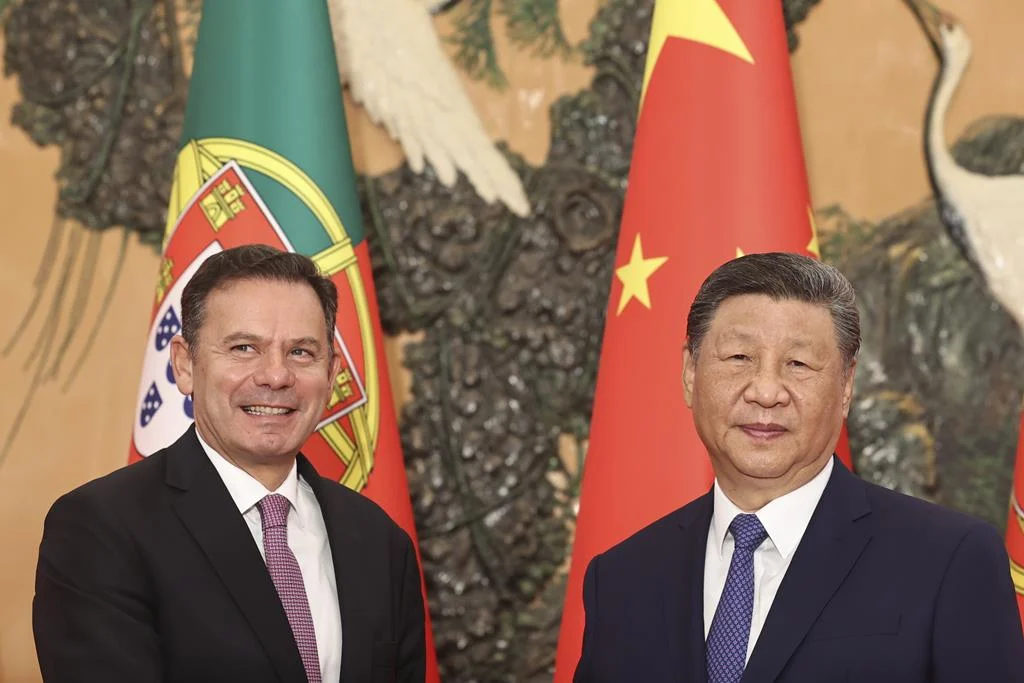
Before arriving in Macau, Montenegro was received at the Great Hall of the People in Beijing by the President of the People’s Republic of China, Xi Jinping, on September 9. The Chinese leader stated that “Portugal is a good friend of China” and highlighted how both countries had “properly handled” the Macau issue.
Xi recalled his 2018 state visit to Lisbon and praised the international roles of António Guterres, António Costa, and Durão Barroso. He further noted that Portugal was a pioneer in Western Europe in cooperating under the “Belt and Road” initiative and the first Eurozone country to issue debt in Chinese currency.
In Beijing, Montenegro acknowledged that Macau’s handover of sovereignty, “despite some vicissitudes,” was an exemplary process that safeguarded cultural values and ensured social and economic development.
