

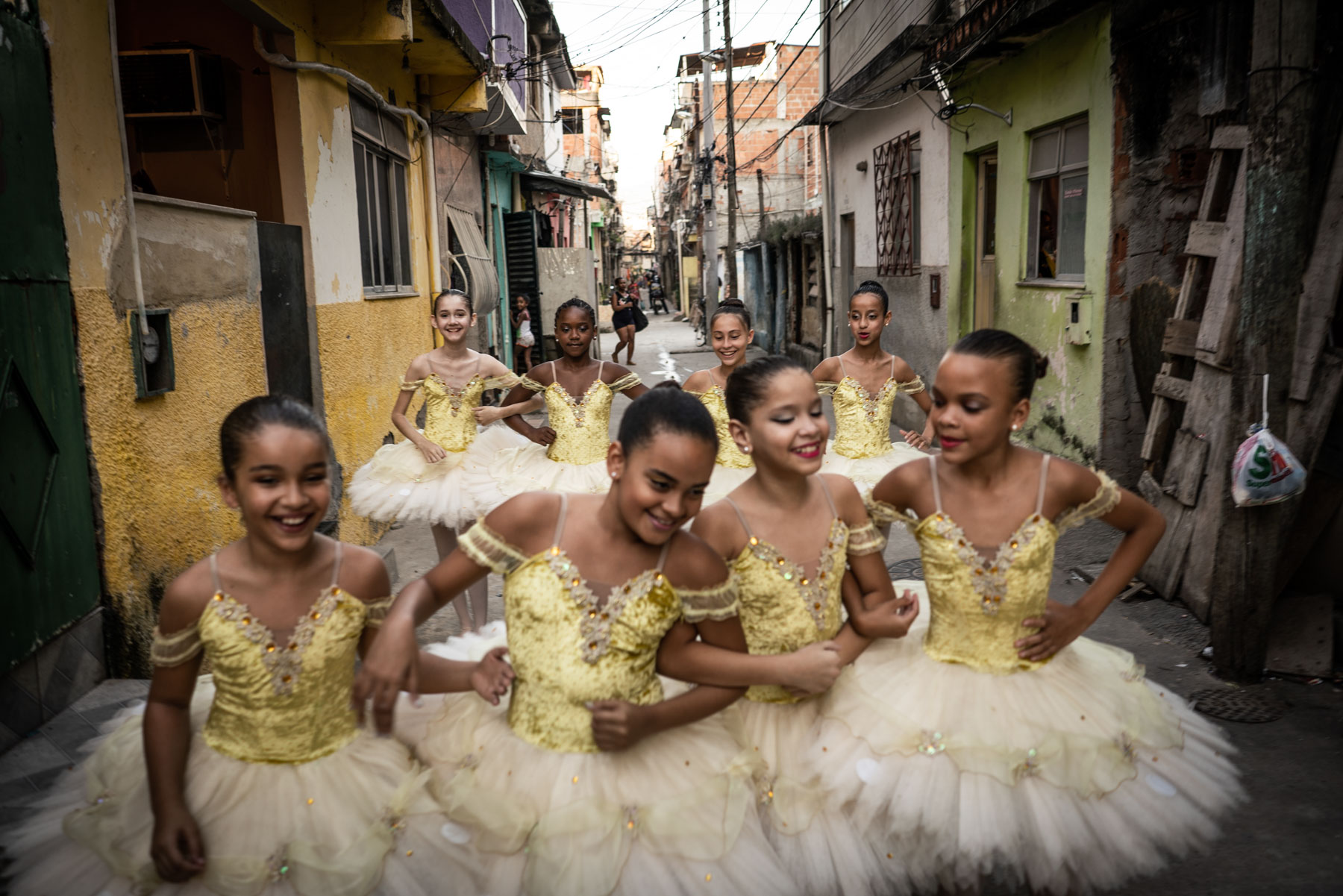
“I don’t know what I would be without ballet. It’s my second home,” says 16-year-old Vitória Gomes de Carvalho, who fears that the classical dance school she attends in the Manguinhos favela, in Rio de Janeiro’s North Zone, will close due to financial difficulties. Concern is visible in her eyes through her wide-rimmed glasses as, dressed in a red leotard, she stretches her leg on the bar in front of the dance hall’s large mirror.
Like her, 410 students between the ages of 6 and 29 take free dance classes in Manguinhos, while another 700, mostly girls, are on the waiting list. In this favela with heavy drug traffic, and where classes are regularly interrupted by gunfire during police operations, the Ballet Manguinhos association is a kind of oasis.
“Here in Manguinhos, it is very common to see teenagers who are pregnant or already have several children. Among our students, the teen pregnancy rate is only 1%,” Carine Lopes, 32, president of the association, whose dance school has been running for a decade, told AFP.
Read also: Brazil sets new six-month Amazon deforestation record
But its continuity is threatened. The pandemic has left its mark, with the tragic death by covid-19 of the association’s founder, Daiana Ferreira, in January 2021.
Months later, it suffered another blow: the three-year funding contract with the American philanthropic foundation The Secular Society (TSS) ended, as provided for in the contract, and Ballet Manguinhos lost an important source of income.
“Adopting” dancers
“With the global crisis we are experiencing, it is increasingly difficult to get support for an institution like ours,” Lopes laments.
The resources from TSS allowed the association to become the owner of a 600m2 four-story building at the entrance of the favela, where the school is located. However, the maintenance costs are very high, with electricity bills and local taxes, added to staff costs.
“We had a sponsor, who as of 2018 started giving 45,000 reais per month, and now we have to cover all the costs with about 10,000 reais,” explains the president of the association of 15 employees, including teachers. If it continues like this, “maybe the activities will only continue until the end of the year,” she warns.
Facing difficulties in finding sponsors and public support, Ballet Manguinhos launched a sponsorship campaign called “Adopt a Ballerina” at the beginning of the year.
Read also: Will we be able to live without culture?
With this program, each sponsor pays at least 90 reais (about US$ 17) a month, the estimated cost for the students considering the payment to the teachers and necessary purchases, such as ballet shoes that need to be changed regularly.
More than a dance
“Ballet helped me a lot, because I had depression for two years, I tried suicide, but dance helped me to empower myself, to have my place to speak, to understand myself as a person,” says Gomes de Carvalho.
Ballet Manguinhos also helped Ana Júlia Martins, 15, to overcome a difficult moment: “During the pandemic, my daughter lost her great-grandfather and was also very affected by the death of Daiana (Ferreira). Ballet has saved her, keeps her focused so she doesn’t go down other paths,” says her mother, Rosilene Sousa da Silva.
“Her self-esteem has improved a lot because before she thought she wouldn’t get anywhere because she was black. Her grades also improved at school,” comments her wife. Ana Júlia, who has been dancing since she was six and dreams of becoming a professional ballerina, smiles and says that at Ballet Manguinhos she can “distract herself from other things. The association’s objective goes beyond dance: “Our mission is that our students leave here as citizens. It is gratifying to see a girl say that she is leaving because she is in a biochemistry or medical school, or that she auditioned for a ballet company abroad”, Lopes is proud.
