

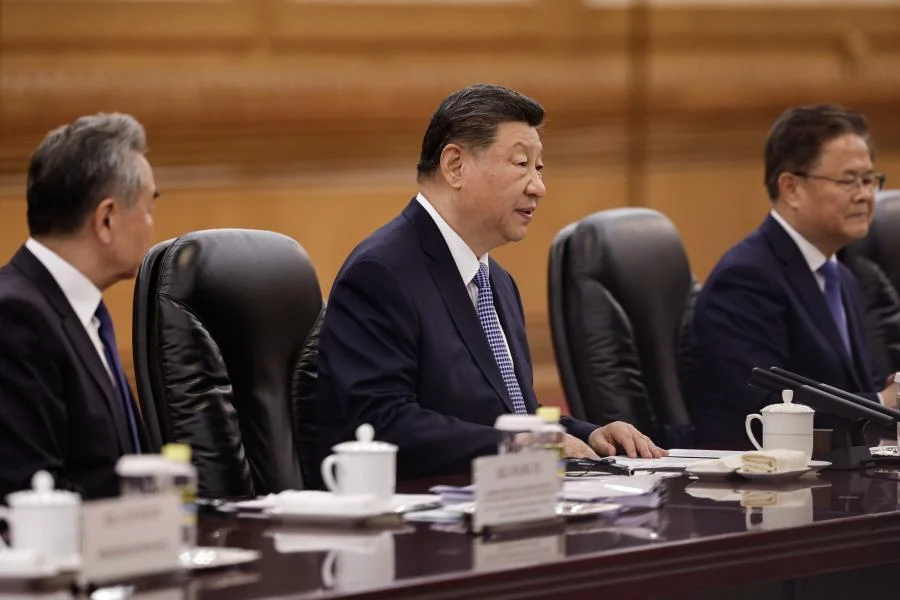
Chinese President Xi Jinping’s anti-corruption campaign reached a new high-water mark in 2025, with 65 senior officials falling under investigation—more than triple the 19 targeted during its inaugural year in 2013, according to a recent analysis.
The study, published by the Hong Kong-based newspaper South China Morning Post (SCMP), examined data covering approximately 457 high-ranking officials—cadres holding ranks equivalent to or exceeding vice-minister—who were investigated between 2013 and 2025 by the Central Commission for Discipline Inspection (CCDI), the highest anti-corruption body of the Chinese Communist Party (CCP).
Known colloquially in China as “tigres” (tigers)—in contrast to “moscas” (flies), which refers to lower-level officials—these senior cadres have remained a primary target of the crackdown launched shortly after Xi assumed party leadership in late 2012.
The volume of anti-corruption probes initially surged to a peak in 2014 before gradually declining. That trajectory reversed in 2020, culminating in last year’s record high of 65 cases.
Read more about this topic: Xi Jinping wants faster military AI development. He’s also still purging corruption from the ranks that would build it in China
According to the data, 59 percent of the high-ranking officials investigated served in local governments, while 20 percent belonged to central government or CCP organs in Beijing.
The campaign has extended to the party’s own disciplinary ranks: 16 officials attached to oversight bodies were probed, representing 3.5 percent of the total sample analyzed. The analysis highlighted notable geographic disparities in enforcement:
High-Probe Regions: The eastern province of Jiangxi, northeastern Liaoning, and the Inner Mongolia Autonomous Region in the north registered the highest absolute number of targeted senior officials.
Low-Probe Regions: Wealthier eastern and coastal provinces and municipalities recorded fewer investigations.
Read more about this topic: China investigates ex-party chief over corruption allegations
According to the SCMP analysis, this variance may stem from higher administrative transparency, stronger information flow, and a more market-driven environment in economically advanced coastal regions. Age demographics reveal that the campaign primarily targets officials nearing the end of their careers: 34.6 percent of those investigated were aged 60 to 64, while 33.5 percent were aged 55 to 59.
Retirement no longer offers immunity from disciplinary action. Under the principle of “lifetime accountability,” incorporated into party doctrine in 2016, officials can be held liable for past misconduct at any point, even long after stepping down.
While nearly half of the targeted “tigers” were actively holding operational posts when investigated, 32.6 percent occupied mostly ceremonial positions ahead of retirement, and 19.7 percent had already left public service entirely. The most long-standing case involved Gao Yichen, a former vice-minister of State Security, who was detained in 2025—15 years after retiring from office.
The data indicates that disciplinary investigations encompass violations far beyond simple bribery:
Read more about this topic: Purge hits China’s coal heartland: How the arrest of Shanxi’s top safety regulator exposes systemic bribery behind deadly industrial disasters
Approximately 55 percent were accused of attempting to impede investigations. 43 percent failed to report required personal matters under party rules, and 29.1 percent lied to investigators. Nearly half were cited for failing to uphold proper family values, 24.3 percent were accused of accepting sexual favors or maintaining extramarital relationships, and 19.3 percent engaged in activities classified as superstitious.
Recent years have seen an increase in allegations concerning lavish banquets, monetary gifts, and improper interference in judicial proceedings and financial markets, alongside a relative decrease in explicit charges of political disloyalty.
The typical profile of a senior cadre targeted by the CCDI, according to the findings, is a male holding a rank equivalent to at least a provincial vice-governor, around 60 years old, and actively serving in office. In approximately 90 percent of all formal cases, accepting bribes formed part of the primary charges.
President Xi has repeatedly framed the anti-corruption drive as essential to the survival of the CCP, promising to target both “tigers and flies” simultaneously, while external critics continue to observe that the campaign also serves as a mechanism to eliminate political opposition.
