

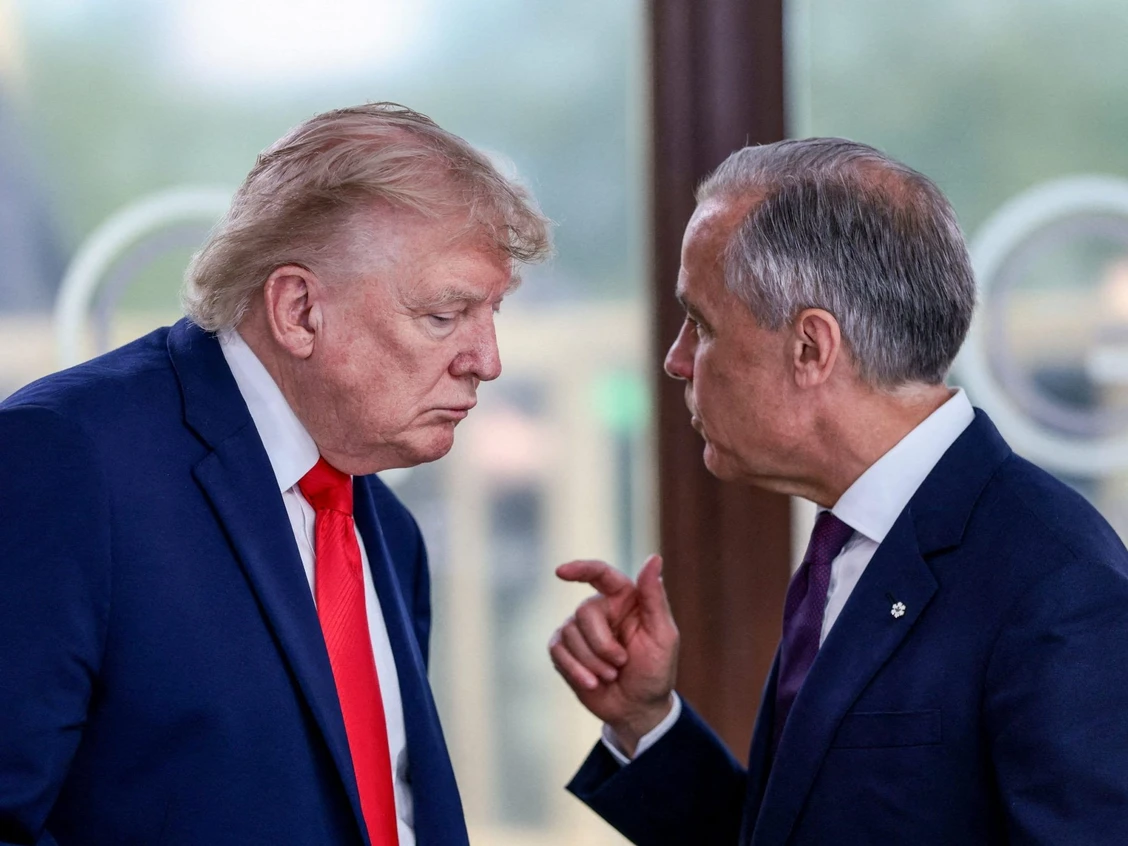
President Trump said Canada wants “the benefits of being a state, without being one,” after trade negotiations between the two countries collapsed late Friday, triggering a fresh round of 50% U.S. tariffs on a range of Canadian goods.
Trump also claimed American farmers had been paying “massive amounts of Tariffs” for years. Canadian Prime Minister Mark Carney described the new tariffs as a “miscalculation” intended to “hurt and divide” the two countries, and confirmed Canada would match Trump’s tariffs “dollar-for-dollar” starting September 8, including levies on steel, dairy, appliances and electronics. Carney said the two nations are now effectively in a trade war.
Both sides had expressed optimism about reaching a deal earlier in the week, but talks broke down after each accused the other of introducing last-minute changes to the terms. “They asked too much and they offered too little,” Carney said Saturday. “You’re at war when you get attacked. We got attacked.”
Trump’s latest remarks echo comments he has made repeatedly since returning to office about making Canada the “51st state,” a suggestion that has drawn frustration from Canadian leaders and residents alike. The breakdown leaves a deeply integrated trading relationship in limbo, with no clear path forward. “We cannot accept what they’ve offered and we will not give what they’ve asked,” Carney said.
Read more about this topic: The White House says more than 40 countries are helping China dodge U.S. tariffs. Canada, India, Mexico, Japan and South Korea are all named (with video)
Speaking to Fox News on Sunday, Trump called the Canadians “foolish” for engaging in a trade war with the U.S. and suggested they were mistaken to think they could win.
The new 50% tariffs apply on top of existing U.S. tariffs on Canadian steel, aluminum, automobiles and lumber. Their scope is relatively limited, covering roughly $20 billion of Canadian imports, or about 5% of the total, including wine, dairy, cement, clothing and hockey equipment. Carney said Canada was retaliating reluctantly to protect its own interests, with details of countermeasures expected in the coming days.
Leaders from other Canadian federal parties, including the Conservative opposition, voiced support for Carney’s stance, as did several provincial leaders. Tariffs have remained central to Trump’s broader trade strategy, with the president arguing they strengthen American manufacturing and create domestic jobs, while critics counter that they’ve driven up consumer prices and disrupted the global economy.
Carney’s Saturday address marked his first public remarks to Canadians since announcing late Friday that no deal had been reached, accusing the U.S. side of introducing unfair and uneconomic changes at the last minute. American negotiators, for their part, accused Canada of walking back previously agreed terms and introducing new demands.
Read more about this topic: What to know about Trump’s new tariffs on Canada? (with video)
U.S. Trade Representative Jamieson Greer told Fox News Saturday there are currently no plans to resume negotiations, adding that Washington had been prepared to lower some tariffs on Canada as part of the now-collapsed agreement.
Carney said the terms the U.S. proposed were unacceptable and overly restrictive, including provisions that would have limited Canada’s ability to negotiate new trade agreements with other countries. He also disputed the claim that Canada had introduced last-minute demands, saying, “We clarified what was on offer and were continually disappointed by the answers.”
Ontario Premier Doug Ford, leader of Canada’s most populous province, backed Carney’s position and said Trump “can’t be trusted.” British Columbia Premier David Eby said the U.S. demand to restrict Canada’s trade dealings with other nations “would reduce us to the economic equivalent of the 51st state,” adding:
“It was never acceptable to Canadians.” Conservative opposition leader Pierre Poilievre also appeared to side with Carney, describing the new U.S. tariffs as “unjustified.” Quebec Premier Christine Fréchette warned the tariffs would likely cost jobs, saying:
Read more about this topic: Carney embraced Trump’s “nasty” jab at Canada. A 50% tariff deadline is now two weeks away (with videos)
“Behind these numbers are real people,” and pledged measures to support affected sectors. Alberta Premier Danielle Smith, whose oil-rich province has worked to build ties with the Trump administration, urged both sides to return to the negotiating table.
The collapse follows more than a year of intermittent trade talks that intensified in recent weeks ahead of a U.S.-imposed deadline to reach an agreement or face additional tariffs. The two countries had also been engaged in a mandatory review of the broader North American free trade agreement, known as USMCA, which also involves Mexico.
The pact, signed by Trump during his first term to replace the 1994 North American Free Trade Agreement, underpins roughly $1.6 trillion in annual trilateral trade among the three countries. Earlier this summer, Canada and Mexico had formally requested a 16-year renewal of USMCA, though the U.S. declined to renew the agreement in its current form.
Asked how the breakdown in talks might affect the broader USMCA agreement, Carney said it was “certainly not good news.”
