

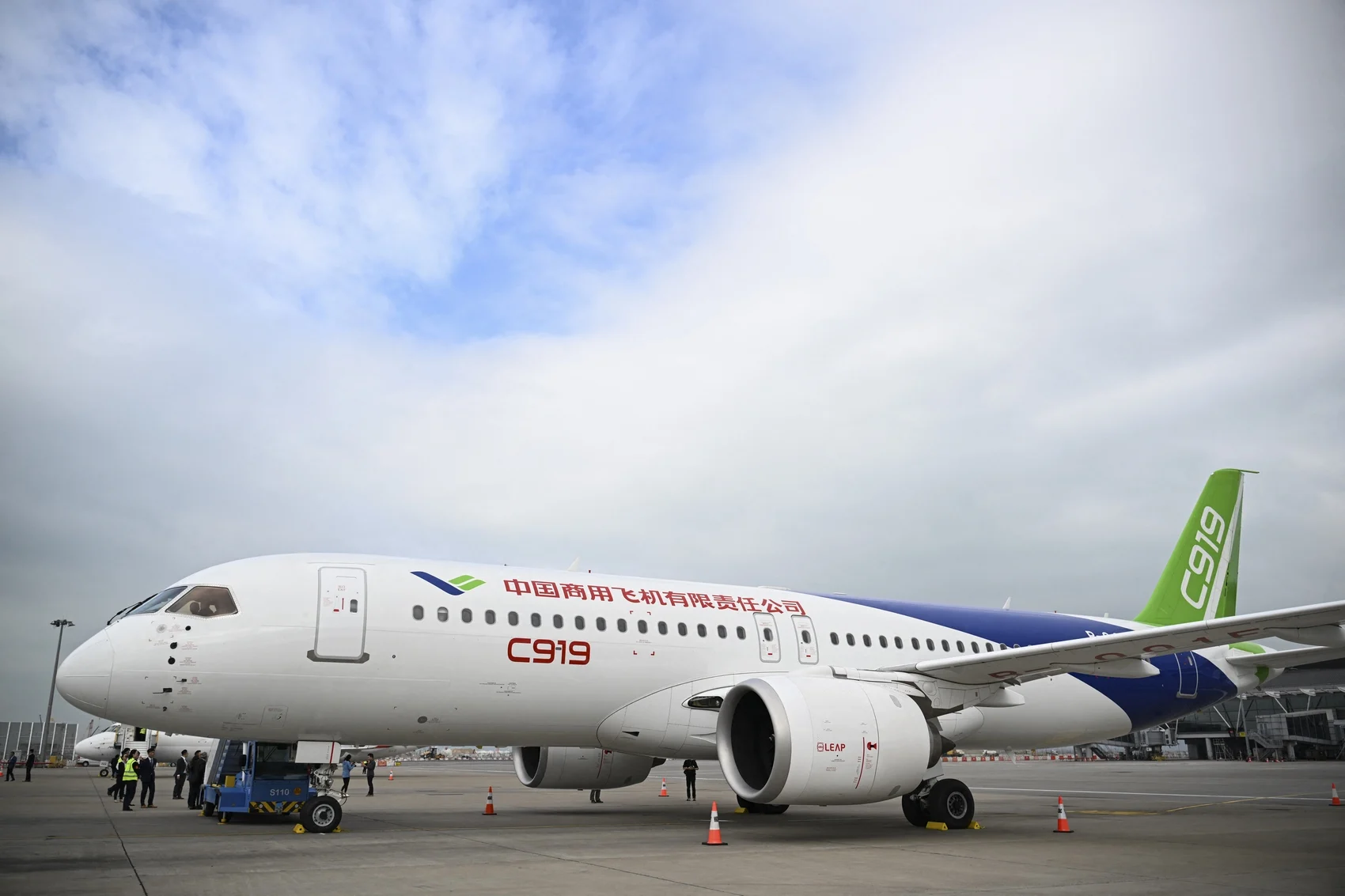
China is set to take its first step into international commercial aviation on Wednesday, with a Chinese-made passenger jet scheduled to fly outside the country for the very first time, according to The Guardian.
The Comac C919 will depart Beijing Capital International Airport at 3 p.m., landing in Ulaanbaatar, the capital of Mongolia, just over two hours later. Positioned as China’s answer to the Boeing-Airbus duopoly that dominates global aviation, particularly across Asia, analysts caution that it could take generations before a Chinese-built aircraft meaningfully challenges that dominance.
Built by China’s state-owned Commercial Aircraft Corporation of China, or Comac, the C919 is roughly comparable in size to the Boeing 737. It has been flying domestic routes for Chinese carriers since 2023, but Wednesday’s Air China flight to Ulaanbaatar marks the first time the narrow-body jet will operate on an international commercial route.
Scott Kennedy, a senior adviser at the Center for Strategic and International Studies, described the flight as essentially a public relations move, noting that Ulaanbaatar was likely chosen largely for its proximity to Beijing. He said the milestone doesn’t change the underlying reality that the aircraft arrived years behind schedule, relies heavily on Western-made components, and remains less efficient than its Boeing and Airbus counterparts.
Read more: European aviation safety agency orders inspection of 16 Airbus A380s
China has harbored ambitions of building its own commercial jet for years. When the C919 was first unveiled in 2015, Li Jiaxiang, then head of the country’s civil aviation authority, declared that a great nation must have its own large commercial aircraft. Progress has nonetheless remained slow, even as China has advanced rapidly in other high-tech sectors like robotics and electric vehicles.
That’s largely because aircraft manufacturing demands the integration of numerous advanced engineering disciplines, along with components sourced globally. A 2020 analysis by the Center for Strategic and International Studies found that more than half of the C919’s suppliers were based in the United States.
Kyle Chan, a fellow at Brookings focused on China’s industrial policy, said building large passenger aircraft and jet engines ranks among the most complex manufacturing challenges in the world, requiring precision components, intricate electro-mechanical systems, and coordination across a vast global supply chain.
He noted that there are essentially only two major commercial aircraft manufacturers worldwide for good reason, since building safe, reliable passenger jets is dramatically more difficult than producing electric vehicles.
Read more: New Flight Routes from China to Vietnam Sees 90% Boost in Travel Interest
Comac reportedly delivered just 15 units of the C919 to customers last year, well short of its target of 75. The company did not respond to a request for comment.
Comac’s business remains centered primarily on Chinese domestic carriers. In 2023, Brunei-based airline GallopAir signed a $2 billion agreement to purchase 30 aircraft from Comac, including 15 C919s, though the airline has yet to begin commercial operations.
The C919 also has not received approval from European or American aviation regulators. Last year, the U.S. reportedly suspended exports of certain components used in the C919 amid the broader trade restrictions exchanged between Washington and Beijing during their trade dispute, a conflict the two countries later agreed to pause under a truce set to expire in November.
When President Trump visited Beijing in May, one of the few concrete outcomes of the trip was China’s agreement to purchase 200 jets from Boeing, with the U.S. in turn providing supply guarantees for aircraft engine parts and components used in its own manufacturing.
Read more: Boeing announces deals with Central Asia carriers
China regards the ability to build its own commercial aircraft as a matter of national security. In a recent interview with Chinese state media, Zhang Yanzhong, an academic at the Chinese Academy of Engineering and a leading aviation expert who worked on the C919, said dependence on foreign countries for large aircraft technology would threaten national strategic security, while acknowledging there remains a long path ahead before achieving genuine commercial success.
Experts note that Comac’s reliance on foreign suppliers extends beyond individual parts, with international partners also having provided guidance on integrating complex components and software into airworthy commercial aircraft.
Kennedy argued it’s somewhat misleading to describe the C919 as a purely Chinese plane given how many of its parts are imported, and said it remains very unlikely that Comac becomes a serious rival to Boeing and Airbus, even a generation from now. Chan similarly said Comac still faces a long road toward earning the trust of airlines and passengers alike.
Despite the challenges ahead, Zhang urged China’s young engineers to contribute their talents to the country’s aviation ambitions, saying that although the journey may be fraught with difficulties, a fledgling eagle can soar faster than its parent.
