

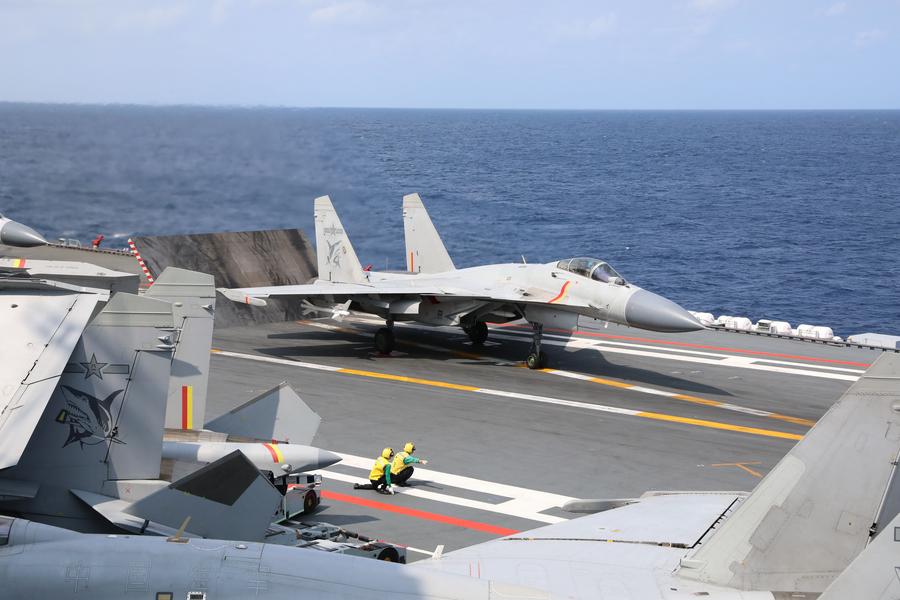
Influential military analyst Zhou Bo believes China wants to have armed forces on par with the United States by 2049, while still prioritizing peaceful reunification with Taiwan.
In an interview with the South China Morning Post, the former colonel of the People’s Liberation Army and researcher at Tsinghua University’s Center for International Security and Strategy argued that Beijing’s goal is to build world-class armed forces by the centenary of the People’s Republic of China in 2049.
According to the analyst, if the concept of world-class armed forces allows for more than one country to hold that status, China is probably already one of them. If only one military power can occupy that category, the goal is to position the Chinese military alongside the U.S.
Zhou noted that the intermediate target of 2027, marking the centenary of the Chinese military, does not represent the completion of military modernization, since Beijing has set 2035 as the deadline to broadly achieve that process.
Read more about this topic: US is preparing several hundred million dollars to counter China’s global influence. It comes months after gutting the programs that did the same thing
“China has set two major military goals: one for the centenary of the People’s Liberation Army in 2027, and another for the centenary of the People’s Republic of China in 2049. Between those two dates, the country intends to broadly achieve the modernization of national defense and the Armed Forces by 2035. That means that, by China’s own standards, the PLA will not yet be fully modernized in 2027,” he noted.
Asked about doubts raised by Western analysts regarding the combat readiness of a military without recent conflict experience, Zhou acknowledged that the absence of war prevents testing military systems under real conditions, but described this as China’s dilemma. “The greatest dividend of China’s peaceful rise was precisely peace,” he stated, adding that the absence of conflict should not be interpreted as a sign of military incapacity.
The former colonel pointed to successful missile tests and the performance of Chinese weaponry used by Pakistan as demonstrations of the country’s evolving military capabilities.
On Taiwan, Zhou rejected interpretations suggesting that 2027 represents a deadline for potential military action against the island. “The Chinese Government continues to sincerely hope for peaceful reunification,” he stated, adding that Beijing has never set a timeline for that goal and that predictions made by American military officials have been contradictory and irresponsible.
Read more about this topic: Trump says the U.S. does “things” to China too, days after accusing Beijing of major election interference. He won’t say what (with video)
He noted, however, that Chinese legislation still allows for the use of force under certain circumstances, while insisting that peaceful reunification remains the priority.
Zhou also acknowledged that American arms sales to Taiwan could become increasingly difficult, arguing that Beijing has economic, diplomatic and military tools available to respond to future decisions made by Washington. Among these measures, he mentioned possible restrictions on American products and an increase in the frequency of military exercises around the island.
In the interview with the Hong Kong newspaper, the analyst also maintained that the relationship between China and the U.S. will remain essentially competitive, despite the understanding reached between Presidents Xi Jinping and Donald Trump to promote a relationship of constructive strategic stability.
On artificial intelligence, Zhou stated that the U.S. maintains a technological edge, but suggested China could stand out in the large-scale application of these systems, and advocated for the creation of international rules to limit the use of AI in military decision-making.
Read more about this topic: Xi Jinping promotes China as a responsible AI leader amid Trump’s accusations of theft (with video)
The former colonel also expressed reservations about the U.S. ability to quickly rebuild its naval and defense industry, arguing that Washington has lost industrial capacity, while China maintains a significant advantage in shipbuilding.
