

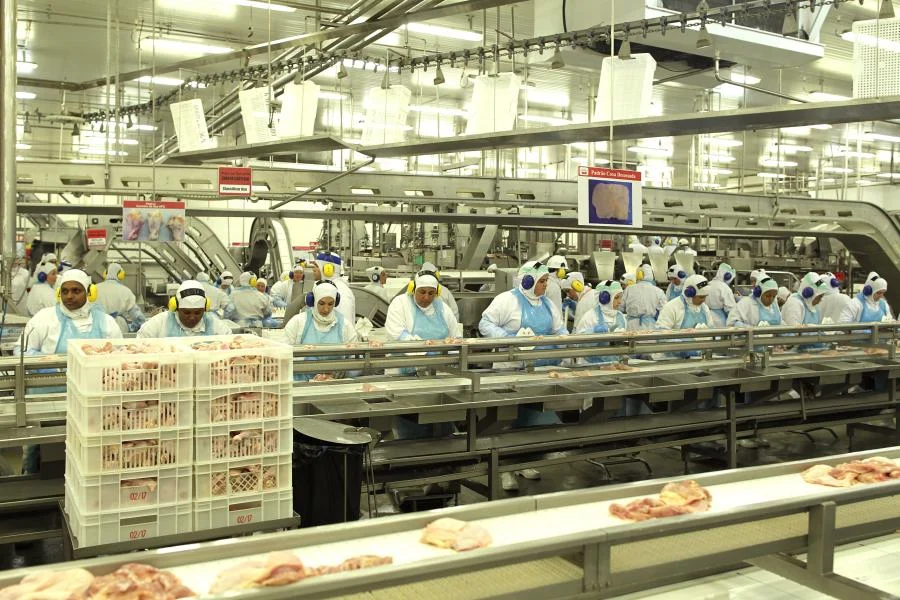
Brazilian meatpacking plants have begun implementing collective mandatory leave and scaling back operations after hitting the nation’s beef export quota to China, the sector’s primary trade organization announced today.
According to Roberto Perosa, president of the Brazilian Beef Exporters Association (ABIEC), companies are tailoring their operational pullbacks based on market diversification. While meatpackers with broader international footprints are simply reducing overall output, facilities highly dependent on the Chinese market have been forced to suspend operations and place workers on collective leave.
“Last year, we shipped about 1.7 million tons of beef to China, but for this year, we were designated a quota of 1.106 million tons,” Perosa stated, highlighting a sharp 35% reduction in allowable trade to the Asian nation.
The halt in production comes as shipments already on the water effectively claim the remainder of the country’s duty-free allocation. Because maritime transit between Brazil and China takes 40 to 60 days, official Chinese customs data does not yet reflect the filled limit. However, domestic processing for China has ground to a complete halt due to the financial penalties triggered by exceeding the quota.
Read more about this topic: Brazil’s trade surplus jumps 47.6%; China primary driver of export growth
The economic viability of continuing shipments outside the designated limits is virtually non-existent:
-
In-Quota Tariff Rate: Approximately 12% import duty.
-
Out-of-Quota Tariff Rate: Spikes to roughly 67% due to an additional 55% safeguard surcharge requested by local Chinese producers.
Perosa called for calm among domestic cattle ranchers, noting that while the price of the arroba (the standard Brazilian weight unit for cattle) has registered recent declines due to the packer slowdown, the market is expected to stabilize at a new equilibrium. “Frigoríficos and exporters are reorganizing production. It is a time for caution, not panic,” he added.
Read more about this topic: Brazil sees risk of collapse in the meat sector and proposes export quotas to China
In 2025, Brazil exported a total of 3.5 million tons of beef, with nearly half (1.7 million tons) heading to China. That trade segment alone generated $8.8 billion (€7.56 billion) in revenue.
To mitigate the massive supply bottleneck left by the restricted Chinese quota, ABIEC is working alongside Brazil’s Ministry of Agriculture and Livestock to open up or expand market access in alternative destinations, including Vietnam, Japan, South Korea, and Turkey.
Concurrently, diplomats in Brasília are attempting to negotiate a reallocation deal with Beijing. The Brazilian government is pushing for a commercial arrangement that would allow Brazil to utilize unused beef export quotas originally assigned to other countries, which could throw a lifeline to the slowing domestic meat industry.
