

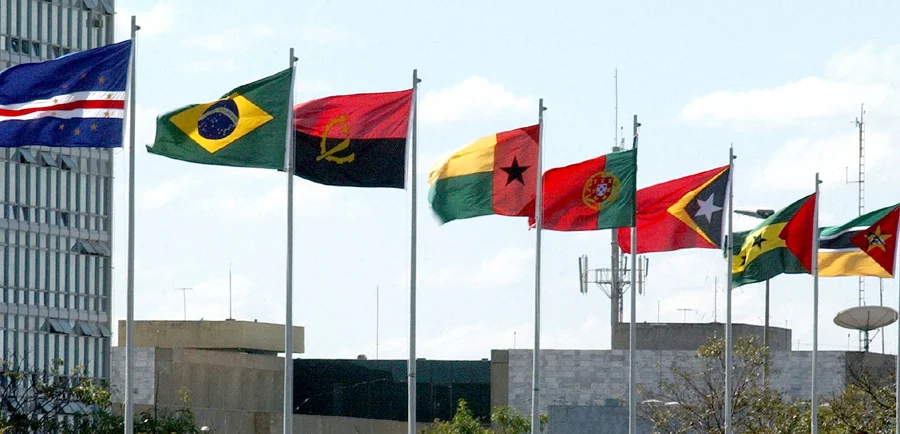
Analysts interviewed by Lusa in light of the CPLP’s 30th anniversary have stated that Equatorial Guinea routinely flouts the community’s statutes. However, they note that joining the organization successfully legitimized the Obiang family regime and allowed the nation to break its international isolation.
“Equatorial Guinea is in no position to be part of an organization defined by the very values that other member states’ constitutions seek to elevate,” argued Elísio Macamo, a Mozambican professor at a university in Switzerland.
“From the standpoint of values and principles, that country should not be part of this Community of Portuguese Language Countries [CPLP],” the academic added.
For Tutu Alicante, an Equatoguinean activist living in exile after being declared persona non grata in his home country, “joining the CPLP helped legitimize the Equatorial Guinea regime,” which has been led by Head of State Teodoro Obiang since 1979.
Read more about this topic: CPLP: East Timor will assume next presidency
Furthermore, the US-based lawyer believes the Obiang family leveraged the organization to shatter the regime’s international isolation.
However, according to the activist, Equatorial Guinea failed to fulfill several of the tasks outlined in the roadmap imposed on it by the CPLP upon accession, such as investing in the Portuguese language and completely abolishing the death penalty.
“Portuguese is still not spoken on the streets, except by a small minority of people who managed to study in Brazil, Portugal, or perhaps even Angola,” he indicated.
Regarding capital punishment, “although the government approved a moratorium in the civil code, the penalty continues to exist in military codes,” Alicante explained.
Read more about this topic: CPLP: Cape Verde gives positive assessment despite “ups and downs”
“What the government does when it wants to apply the death penalty is try civilians in military courts. Furthermore, many prisoners continue to be tortured to death or simply disappear while in custody,” he emphasized.
On a social level, the lawyer mentioned that regular citizens hoped the CPLP would help spearhead the creation of democratic institutions and improve access to education and healthcare, but those expectations ultimately fell short.
For Tutu Alicante, “ordinary citizens in Equatorial Guinea have seen zero impact from the country’s admission to the CPLP.”
“For us, maneuvers like bringing in the Pope, hosting international conferences, and now potentially leading or presiding over the CPLP are exactly the kind of things that make Equatoguineans doubt the seriousness of an organization,” he highlighted when asked about the possibility of his country assuming the rotating presidency of the Lusophone bloc.
Read more about this topic: CPLP approves ocean cooperation plan for the 2026-2030 period
Stating that “Obiang paid money to belong” to the CPLP, the lawyer believes that allowing Equatorial Guinea to take over the presidency would “strip away the legitimacy of the organization itself.”
Following this line of thought, Cape Verdean sociologist Redy Lima stated that “the CPLP is already so moribund that Equatorial Guinea taking over the presidency won’t change much of anything.”
The Cape Verdean analyst noted that its integration into the bloc was driven “by money” and that, since it is a full member, it technically has the right to preside over it, though he emphasized it would project a terrible image for the organization.
For Liberato Moniz, a Santomean academic, such an outcome would be a “highly negative milestone” and “perhaps even one of the final tipping points toward the ultimate discredit of the CPLP.”
Read more about this topic: Mozambique hosts CPLP researchers to promote African science
“If they end up coordinating operations, it means people are not genuinely concerned about the CPLP itself, but rather about the individual advantages each country can extract from the organization,” reflected the president of the Lusíada University of São Tomé and Príncipe.
Adriano de Freixo, a Brazilian specialist in the history of international relations, stated that Equatorial Guinea’s membership is far more beneficial to the country than to the organization itself, as it allowed the nation to “break its international isolation.”
The historian recalled an episode where samba schools in Brazil were funded by Equatorial Guinea, describing the strategy as an “image-whitening process.” Conversely, Angolan political scientist Almeida Henriques defends that the rotating presidency must be respected.
“We cannot view Equatorial Guinea as an obstacle,” he declared, though he acknowledged that the organization needs to create “enforcement mechanisms to monitor compliance” with accession commitments.
Read more about this topic: CPLP: Lusophone embassies celebrate 30th anniversary with cinema showcase
For Portuguese analyst Fernando Jorge Cardoso, the issue should be viewed from a alternative perspective: “We can legitimize a regime by admitting it into an organization, but we can also force that regime to become bound to a set of rules it isn’t used to.”
Furthermore, he continued, “the reason why there isn’t a more positive effect regarding greater openness and political improvement in Equatorial Guinea is the fact that some of the CPLP’s founding members—Angola, Guinea-Bissau, and Mozambique—have ‘glass houses’ themselves” and do not want to be confronted with their own democratic deficits.
The CPLP, which marks its 30th anniversary on July 17, comprises Angola, Brazil, Cape Verde, Guinea-Bissau, Equatorial Guinea, Mozambique, Portugal, São Tomé and Príncipe, and East Timor.
