

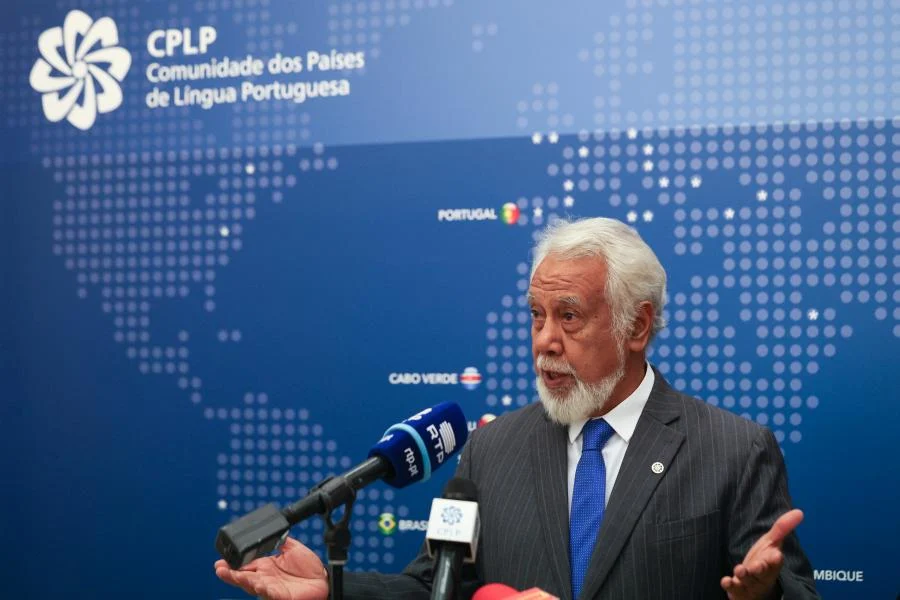
East Timor’s Prime Minister announced today at the CPLP headquarters that his country will be the next to lead the organization, clarifying that the current presidency covers the period originally intended for Guinea-Bissau.
“The Pro Tempore [presidency period] is the timeframe that would have belonged to Guinea-Bissau. After Guinea-Bissau, it is our turn. Therefore, we are next,” East Timorese Prime Minister Kay Rala Xanana Gusmão told reporters in Lisbon, when questioned about the succession of the rotating presidency of the Community of Portuguese Language Countries (CPLP).
Regarding Guinea-Bissau—which chaired the organization between August and December 2025 before being suspended from the CPLP and other international bodies following a military coup on November 26—Xanana Gusmão noted that the organization is working hard to help the country, though he emphasized respect for the principle of non-interference.
“There is the principle of non-interference, but there must also be the principle of obeying and following the universal principles of human rights and democracy,” the former President of East Timor declared. “I cannot say when, but I believe the Bissau-Guineans will understand how much it hurts us to see, and how much it costs them to live in a society where human rights are not a rule or a norm.”
Read more: CPLP approves ocean cooperation plan for the 2026-2030 period
The leader described the crisis as a “complicated issue” that is difficult to forecast. “What we have to say is that every effort will be made so that we can help change the situation there,” he concluded. Asked about the recent death of former East Timorese President Francisco Guterres, he simply reflected that the only certainty in life is death, though we never know “when, where, and how.”
During the press conference following a solemn session with CPLP Executive Secretary Maria de Fátima Jardim and permanent representatives of the member states, the historic East Timorese leader stated that his visit to the headquarters was especially vital as the organization prepares to mark its 30th anniversary on July 17.
“On this anniversary, we reaffirm our commitment to unity in diversity and reinforce the historical, cultural, and political ties that bind our Portuguese-speaking peoples,” he stated during his speech. “Today, we also had the opportunity to reflect on the importance of multilateralism, dialogue, and cooperation for the development of our peoples within an international context marked by uncertainty and instability.”
Finally, Gusmão noted that discussions touched upon core issues for Lusophone citizens, particularly mobility within the CPLP space, the desire to deepen economic integration and union, the strengthening of ocean cooperation, and efforts to bridge the CPLP with other strategic global regions—most notably the Association of Southeast Asian Nations (ASEAN), of which East Timor is a member.
Read more: CPLP: Cape Verde gives positive assessment despite “ups and downs”
The political crisis in Guinea-Bissau erupted on November 26, 2025, on the eve of the announcement of general election results from the November 23 vote, when a military coup took place. The military junta subsequently proclaimed General Horta Inta-a as the head of a one-year transitional government, with new elections penciled in for December of this year.
Following the coup, Guinea-Bissau was promptly suspended from the CPLP, the African Union, and the Economic Community of West African States (ECOWAS), all of which are demanding a swift return to constitutional normalcy.
Domingos Simões Pereira, the leader of the historic African Party for the Independence of Guinea and Cape Verde (PAIGC) and former CPLP executive secretary (2008–2010), was detained and remains under house arrest.
The CPLP is currently comprised of nine member states: Angola, Brazil, Cape Verde, Equatorial Guinea, Guinea-Bissau, Mozambique, Portugal, São Tomé and Príncipe, and East Timor.
