

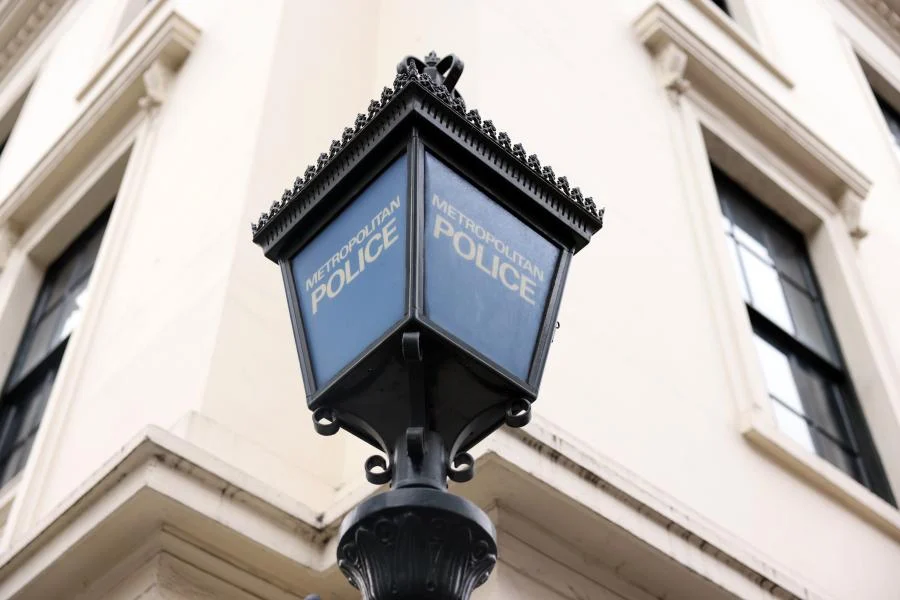
The London police will intensify the use of drones, facial recognition, and artificial intelligence to combat criminality in the British capital, its chief, Mark Rowley, announced today. The strategy should allow the police to “stay one step ahead of criminals,” the official argued, at a time when some of these technologies are criticized as a violation of the right to privacy.
“The private sector uses data and sophisticated technologies to anticipate needs and protect customers in real time. The public expects the same from the police,” Rowley argued.
The London Metropolitan Police launched a test in October to use two drones and currently possesses nine, activated to monitor around 200 incidents per week. These are frequently the first to arrive at the scene, in about two minutes, identifying suspects and providing support to officers on the ground, who take up to nine minutes to arrive.
Their utilization will now be generalized across the whole capital, to develop a “city-wide drone network.” In parallel, the Met will extend the use of real-time facial recognition, namely through fixed cameras in neighborhoods like the West End, highly popular among tourists due to shops, restaurants, and theaters.
Read more about this topic: Second night of violent protests in Northern Ireland amid stabbing by immigrant (with video)
This technology contributed, since the beginning of 2024, to more than two thousand arrests of suspects involved in serious crimes, the police highlighted. Artificial intelligence will also be increasingly utilized to analyze video surveillance footage.
London counts around one million cameras. According to Mark Rowley, a pilot project developed in collaboration with the American data analytics giant Palantir has already allowed the police to make better use of its data. However, the mayor of London, Sadiq Khan, recently blocked a 50-million-pound contract between the Met and Palantir, citing concerns regarding the procurement process.
The reliance of the police on these tools sparks criticism, with the civil rights defense organization Big Brother Watch denouncing “the expansion of a surveillance state” and a violation of privacy. The organization also points to the risks of misidentification and discrimination.
In April, the High Court of London considered that the Met had implemented the “appropriate protection measures” to prevent abuses, after a man erroneously identified as a suspect filed a complaint against the police.
