

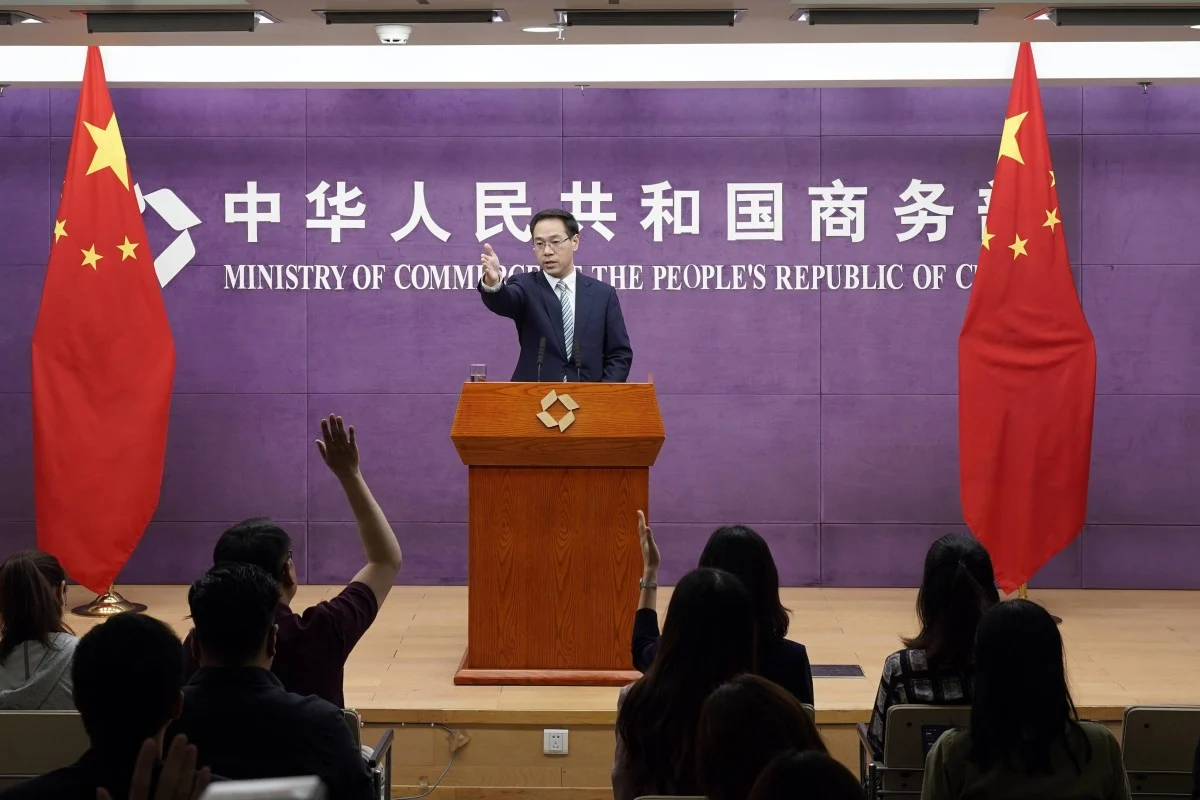
China has prohibited government agencies and public bodies from purchasing products from 46 American companies, including major defense and aerospace manufacturers. The move expands upon the commercial restrictions against United States entities announced by Beijing just hours prior, in a swift escalation of retaliatory measures between the world’s two largest economies.
The Chinese Ministry of Finance announced the public procurement restrictions targeting 46 U.S. corporations, prominently featuring major defense contractors such as Lockheed Martin, Raytheon, General Dynamics, and Boeing Defense.
According to an official statement, Chinese public institutions are completely barred from procuring goods manufactured by these entities, though the ministry specified that the ban will not apply to American-capital companies physically established and operating within China.
The extensive blacklist primarily targets companies tied to defense, aeronautics, unmanned aerial vehicles (drones), military systems, and security technologies, including Anduril, BAE Systems, Teledyne, and Cubic Global Defense.
Read more: China: “All parties must honor commitments after US-Iran deal”
This latest decree significantly widens the scope of the economic restrictions announced earlier today by the Chinese Ministry of Commerce, which placed ten U.S. entities on its export control list.
In that initial move, Beijing prohibited the export of dual-use products to firms linked to defense, drones, aerospace technology, maritime services, and rare earths—including Aveox, Red Cat Holdings, Teal Drones, Ball Aerospace, Oshkosh Defense, L3Harris Maritime Services, MP Materials, and USA Rare Earth.
The Commerce Ministry justified its action under the guise of “safeguarding national security and interests” and meeting non-proliferation obligations, ordering an immediate halt to all ongoing export operations with those entities.
Both announcements come directly after China pledged to implement “firm and vigorous countermeasures” following Washington’s decision to add several high-profile Chinese corporations, including tech giants Alibaba, Baidu, BYD, and Unitree Robotics, to the U.S. list of “Chinese military companies.”
Read more: China announces aid package for Iran and Lebanon
This aggressive round of restrictions materializes despite a high-stakes state visit by U.S. President Donald Trump to Beijing in May. During the summit, both administrations publicly advocated for a new “relationship of constructive strategic stability” to anchor bilateral ties.
While Beijing and Washington have since established dialogue mechanisms regarding trade, investment, agriculture, aviation, and military communications, deep systemic friction remains unresolved over customs tariffs, technological blockades, rare earth supply chains, Taiwan, and corporate blacklists.
Beijing continues to criticize the United States for overextending the concept of national security to suppress the growth of competitive Chinese enterprises. In tandem, China is rapidly accelerating its domestic push for technological self-sufficiency across critical sectors like semiconductors, artificial intelligence, robotics, advanced materials, and strategic supply chains.
