

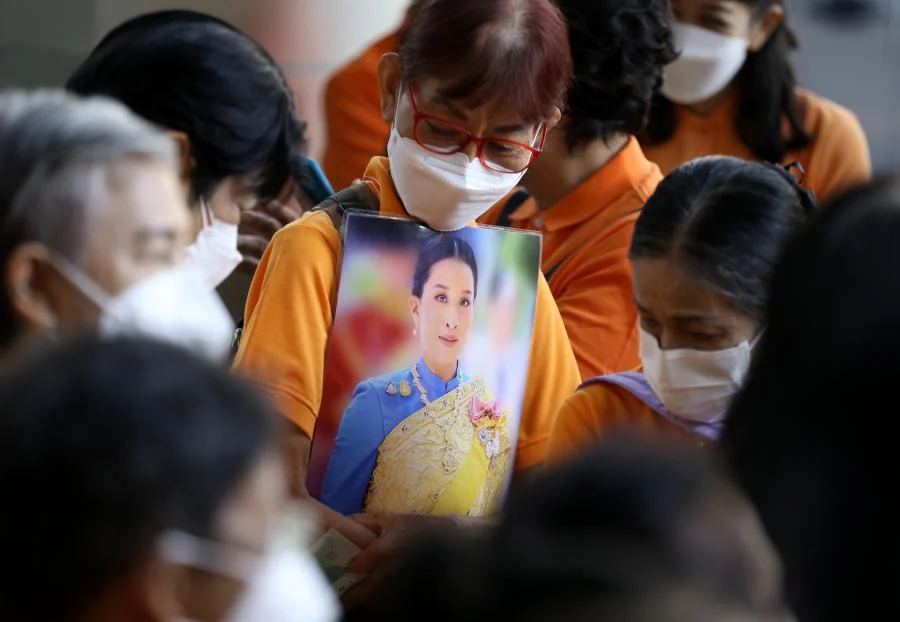
Thai Princess Bajrakitiyabha Mahidol, a prominent lawyer and the eldest child of King Maha Vajiralongkorn, has died at the age of 47, the Bureau of the Royal Household announced today.
Princess Bajrakitiyabha passed away peacefully on Thursday evening at a Bangkok hospital, where she had been receiving continuous medical care since falling unconscious due to an illness three years ago, according to the official statement.
The princess was deeply active in judicial reform and was best known for her “Kamlangjai” (or “Inspire”) project, a initiative dedicated to supporting the rehabilitation and societal reintegration of incarcerated women ahead of their release.
Bajrakitiyabha was hospitalized in December 2022 after collapsing while training her dogs for an army exhibition. The palace initially disclosed that she had suffered a heart condition complicated by a mycoplasma infection, a bacterial illness commonly associated with pneumonia.
Read more: From Bangkok to the Nation: Central Pattana Unites Communities in Thailand’s Largest Pride Movement
A 2023 New Year’s greeting card issued by her father showed King Maha Vajiralongkorn and Queen Suthida dressed in somber black attire—a gesture interpreted by many Thais as a silent confirmation of the gravity of her condition. Limited updates released in the following years indicated a progressive deterioration in her health.
Born on December 7, 1978, Bajrakitiyabha was the daughter of Vajiralongkorn, who was the crown prince at the time, and his first wife, Princess Soamsawali. King Vajiralongkorn has seven children across three of his four successive marriages. In formal state settings, the princess was also known by her official royal title, Bajrakitiyabha Narendira Debyavati.
Prince Dipangkorn Rasmijoti, the youngest of the king’s children, remains the presumptive heir to the throne, as male lineage takes precedence in Thailand’s line of succession. However, Princess Bajrakitiyabha’s extensive experience in public service had fueled long-standing speculation that she was destined to play a vital role in the future of the monarchy, potentially serving as regent to a young ruler.
The princess pursued higher education in law at Thammasat University before attending Cornell University in the United States, where she earned a Master of Laws (LL.M.) in 2002. She completed her Doctor of the Science of Law (J.S.D.) at Cornell in 2005, focusing her doctoral dissertation on the protection of defendants’ rights. Cornell Law School subsequently established scholarships and legal scholar exchange programs with Thailand in her honor.
Read more: China: external pressures challenge Lusophone infrastructure projects
Following a brief tenure at the Permanent Mission of Thailand to the United Nations in New York, she returned to her home country to work as a public prosecutor. She later resumed her diplomatic career upon being appointed Thailand’s Ambassador to Austria from 2012 to 2014, eventually returning home to specialize in criminal justice reform. In 2017, she was designated a Goodwill Ambassador for the United Nations Office on Drugs and Crime (UNODC).
Beyond her work with female convicts, she championed efforts to elevate general living conditions within women’s prisons and actively led campaigns to combat violence against women as an honorary UN Women Goodwill Ambassador.
Her advocacy and dedicated diplomatic efforts ultimately inspired the UN General Assembly to adopt the landmark “Bangkok Rules,” which established international standards for the treatment and care of women prisoners.
“Society cannot grow if there is instability and injustice,” Princess Bajrakitiyabha remarked during a 2013 interview with the Associated Press.
Read more: Global Times: China’s merchandise trade expands 15.3% in first 5 months
“Without the rule of law, without a good justice system, it’s always chaos,” she stated. “I think the rule of law is a very important pillar for development, for economic growth, and of course, for human rights.”
