

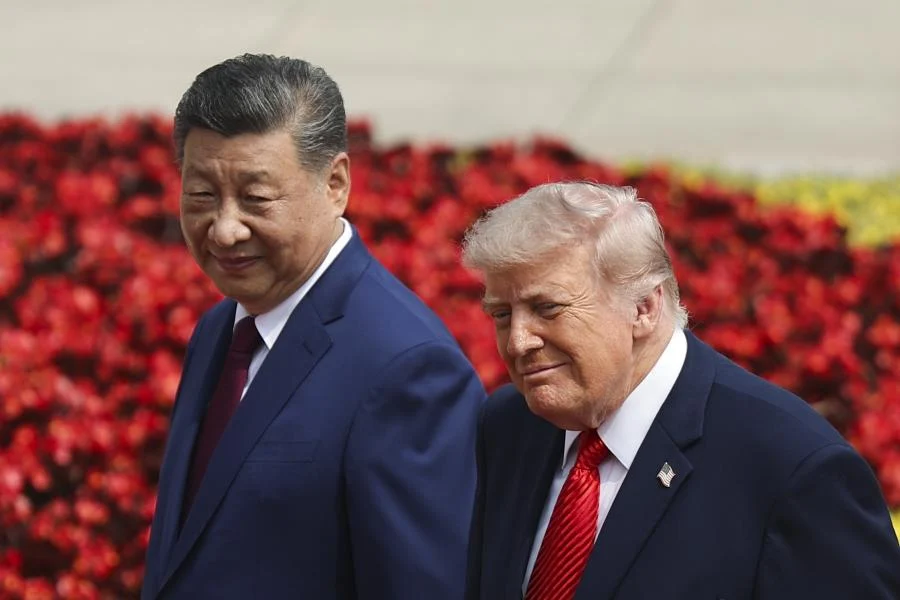
Chinese President Xi Jinping harshly criticized Japanese Prime Minister Sanae Takaichi over the “remilitarization” of Japan during his mid-May summit with U.S. President Donald Trump, the Financial Times (FT) reported.
Citing multiple unidentified sources familiar with the proceedings, the newspaper noted that Xi became particularly vocal and agitated when discussing Japan. This caught U.S. officials by surprise, as the topic had not been raised during preparatory meetings between the two sides ahead of the summit.
Several sources told the FT that Xi’s verbal outburst was the most heated moment of the two-day summit, which took place from May 14 to 15 in Beijing.
After Xi condemned Takaichi and the recent surge in Japanese defense spending, Trump pushed back. The U.S. President countered that Tokyo needed to adopt a more assertive security posture due to the growing nuclear and missile threat posed by North Korea.
Read more about this topic: Lula urges Trump to end dispute with Xi Jinping
Christopher Johnstone, a former White House official responsible for Japan, told the FT that Xi’s “caustic approach”—alongside his clear effort to exploit Trump’s desire for stable U.S.-China relations—only reinforced Tokyo’s determination to achieve greater security self-reliance.
“Xi’s lack of self-awareness is remarkable,” Johnstone remarked. “His own actions are accelerating the emergence of a much stronger Japan.”
The analyst added that China’s anti-Japan rhetoric finds little resonance outside its own borders. He noted that Tokyo is actively strengthening security ties with regional partners—including Australia, the Philippines, and even South Korea—all of whom are “more concerned about an aggressive China than a remilitarizing Japan.”
Since 2023, Japan has categorized China’s military activities as its “greatest strategic challenge,” placing it ahead of the North Korean threat, and has expressed deep concern over the deepening military cooperation between Beijing and Moscow.
Read more about this topic: Trump insists Xi relation is strong despite policy differences (with video)
Tensions between Beijing and Tokyo deteriorated sharply last November. China reacted with fury after Prime Minister Takaichi stated in the Japanese parliament that a Chinese assault on Taiwan could constitute an “existential threat” to Japan, potentially justifying a military deployment.
Since then, Beijing has maintained a steady stream of diplomatic attacks against Japan, pairing the rhetoric with tangible measures such as unannounced restrictions on rare-earth mineral exports.
Last Friday, the Chinese Ministry of Foreign Affairs stated that Japan boosted its military spending by 9.7% in 2025.
“Even though the Japanese defense budget has increased for 14 consecutive years, right-wing forces continue to demand more spending,” a ministry spokesperson added, asserting that Japan’s “mask as a ‘peaceful country’ is slipping away as it slides into neo-militarism.”
Read more about this topic: China says cooperation between Japan and the Philippines “aggravates” tensions
According to the Stockholm International Peace Research Institute (SIPRI), China—the world’s second-largest military spender—increased its defense budget by 7.4% in 2025 to $336 billion, marking its 31st consecutive annual increase. Japan’s defense spending for the same year stood at $62 billion.
An anonymous senior U.S. official told the FT that during the meeting, Trump “emphasized his profound respect for the Japanese people and his close personal relationship with Prime Minister Takaichi.” The American delegation also reminded their Chinese counterparts of the massive U.S. military footprint maintained in Japan.
The FT also reported that Washington informed Tokyo earlier this month of significant logistical delays in delivering 400 Tomahawk cruise missiles, which Japan originally ordered back in 2024.
When contacted by the FT, the Chinese Embassy in Washington declined to comment directly on Xi’s alleged remarks but stated that “Japanese right-wing forces” are actively attempting to “shake the foundations of regional peace.”
The Japanese Prime Minister’s office declined to comment on the incident.
