

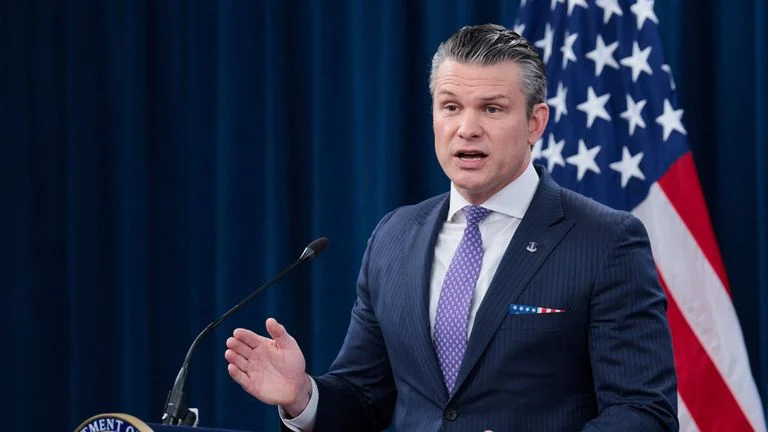
The US Secretary of Defense, Pete Hegseth, stated today that the coming days of the war waged by the United States and Israel against Iran “will be decisive,” while refusing to rule out the deployment of U.S. troops on Iranian soil.
“The next few days will be decisive. Iran knows this, and there is practically nothing they can do militarily in response,” Hegseth said during a press conference at the Pentagon.
Hegseth, who recently visited U.S. troops deployed in the conflict, reported that “over the last 24 hours, there have been the fewest drones and enemy missiles launched by Iran.”
According to the Defense Secretary, negotiations with Iran to end the war are intensifying.
Read more about this topic: Iran War: US attack hits city housing nuclear facility (with video)
“These talks are very real, ongoing, active, and I believe gaining momentum,” he stated.
The U.S. indicated that there is a dialogue with Iran on the terms of these negotiations, calling it a “new productive development.”

“The next few days will be decisive. Iran knows this, and there is practically nothing they can do militarily in response,” Pete Hegseth, US Secretary of Defense, said during a press conference at the Pentagon. Photo :Mark Schiefelbein/AP
“We don’t want to have to do more militarily than necessary. But I did not say lightly that, in the meantime, we negotiate with bombs,” he emphasized. Hegseth also refused to exclude the possibility of sending U.S. troops into Iranian territory.
“We will not rule out any option. You cannot fight and win a war if you tell the adversary what you are prepared to do—or not do—including ground forces,” he said.
Read more about this topic: Iran War: Trump says countries without oil must “find their own fuel”
“Our adversary currently believes there are 15 different ways to attack them with ground troops. And you know what? They are right,” he added. Standing beside him, General Dan Caine, chairman of the Joint Chiefs of Staff, said the U.S. has struck “more than 11,000 targets” in the past 30 days.
Regarding navigation through the Strait of Hormuz, Hegseth noted that an increasing number of ships are passing through following threats from President Donald Trump to Iran. He warned countries dependent on this vital oil route to prepare to “take a stand” and assume responsibility.
“There are far more ships transiting today than before, as ordered by the President. The President was clear with Iran: open the shipping lane for commerce, or we have other options—and clearly, we do,” Hegseth said.
Since the start of the war alongside Israel, Hegseth emphasized that U.S. operations have focused on “wearing down and defeating” Iran’s naval ballistic missile capabilities to “limit their options.”
Read more about this topic: Iran War: Trump “will blow up power plants, oil wells, and Kharg Island” if deal isn’t reached
Trump, earlier on his social media platform Truth Social, urged countries that have not joined the U.S. military offensive against Iran to act “with courage” and “take the Strait of Hormuz.”
“Iran has essentially been annihilated. The hardest part is over. Go get your oil,” Trump wrote, suggesting that the U.S. has less interest in reopening the Strait because it is less dependent on crude from the region.
Hegseth stressed that the world must pay attention and be prepared to stand firm, noting, “this is no longer exclusively a U.S. problem,” even though Washington has taken the majority of measures “to keep the strait open.”
The Defense Secretary also highlighted the success of the joint military operation with Israel against Iran, which began on February 28, noting that about “200 dynamic strikes” were carried out on Monday alone.
“The latest information from Central Command is clear: our strikes are undermining the morale of the Iranian Armed Forces, causing mass desertions and shortages of key personnel, and generating frustration among senior commanders,” Hegseth said.
