

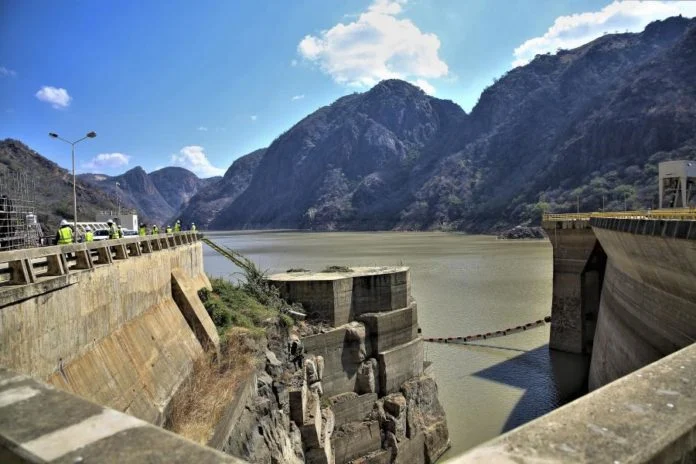
The current rainy season in Mozambique has already allowed Cahora Bassa Hydroelectric (HCB) — one of Africa’s largest — to more than double water storage levels in the reservoir after record lows caused by drought.
“We are now recovering. We are approaching 50% of capacity — probably by the end of the rainy season at the end of this month we will be very close to 50%, and we are coming from 20%,” said HCB board chairman Tomás Matola on the sidelines of the RENMOZ — Renewables in Mozambique conference in Brussels, which runs until March 18 and today featured Mozambican president Daniel Chapo presenting the country’s renewable energy projects to attract European investment.
Matola said the recovery was driven primarily by rainfall “upstream of the reservoir,” with tributaries being “decisive for this recovery.” “We will then, throughout the year, produce using that storage. We will reduce by year-end, but we believe that in the next rainy season we will have another recovery until we again reach the desired storage levels,” he said.
Matola expressed confidence that Cahora Bassa and other projects in the energy hub — including the neighbouring new Mphanda Nkuwa dam, also on the Zambezi river in Tete province with 1,500 MW capacity — will meet the needs of ongoing projects and neighbouring countries including Zambia, Zimbabwe, Malawi and Eswatini, and above all South Africa, which has the highest demand in the region.
Read more: Lusophony: Mozambique seeks Brazil’s support for development bank and debt restructuring
“With these projects we understand that we will indeed be an energy hub in the region. For HCB alone, our vision to 2034 is to achieve a capacity of up to 4,000 MW [currently 2,075 MW],” he said, referencing plans for a new power station and a solar park.
Electricity production in Mozambique fell 25% in 2025, influenced by low water levels at the HCB reservoir following the “worst rainfall in 43 years.” The government’s 2025 budget execution report states that total electricity generation was 14,408,381 MWh — 76.7% of the annual plan and 25.4% below 2024 — with hydroelectric plants performing particularly poorly, declining 30.7% due largely to El Niño effects on the HCB since 2023 and the worst Zambezi basin rainfall in 43 years.
The energy shortage also contributed to a dispute that led Mozal — the country’s largest industrial operation — to suspend activity from March 15, affecting more than 4,000 direct and indirect jobs.
