

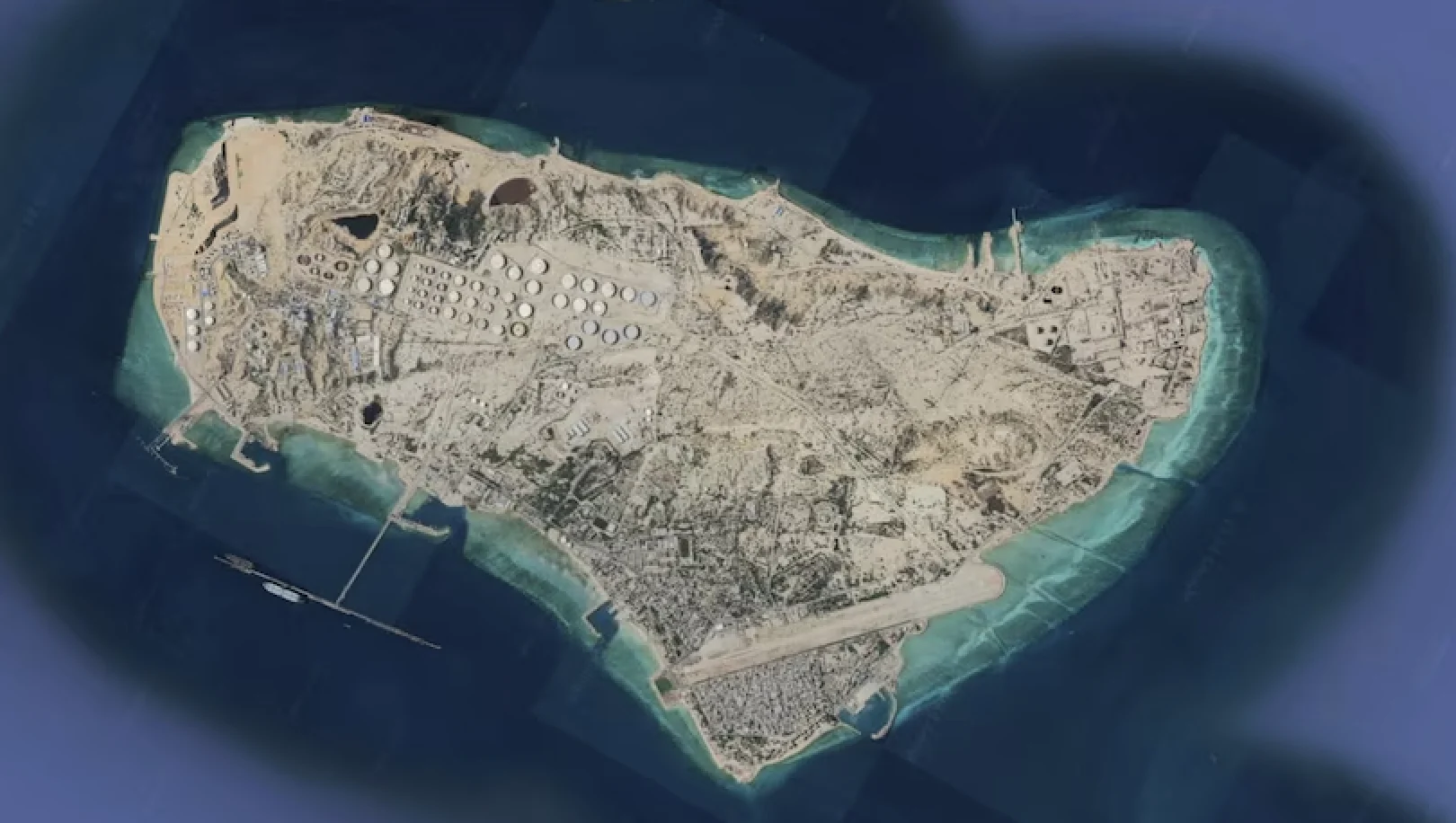
The island’s significance lies in a critical fact noted by analysts: approximately 94% of Iran’s exported crude oil passes through the Kharg terminal, according to data cited by the British newspaper The Independent. Most of this crude oil is destined for China and other Asian markets, making the island the primary exit point for Iranian energy exports.
Where is Kharg located and why is it strategic?
The island is located in the Persian Gulf, northwest of the Strait of Hormuz, one of the world’s most important maritime routes for oil and natural gas transportation.
Kharg hosts Iran’s largest oil terminal, with extensive storage and loading facilities for crude exports. Satellite images reveal the scale and density of the energy installations, emphasizing the island’s centrality in Iran’s oil system.
According to analysts interviewed by The Independent, any external control over Kharg would have a direct and profound impact on Iran’s ability to fund the state and sustain its military effort.
A target capable of suffocating the Iranian economy
and energy experts consider that seizing or neutralizing the island could cut off the regime’s main source of revenue. Petras Katina, a researcher in climate, energy, and defense at the Royal United Services Institute, told The Telegraph that capturing Kharg would have “catastrophic” consequences for Tehran.
According to several analysts cited by The Independent, oil exports represent approximately 40% of the Iranian government’s budget. Interrupting this flow would mean drastically reducing the regime’s ability to pay salaries, fund the armed forces, and maintain social programs.
Read also: Iran War: Donald Trump admits to conditional peace negotiations with Tehran (with video)
Global impact on the oil market
The strategic importance of Kharg gains even greater prominence at a time when navigation through the Strait of Hormuz is facing significant disruptions. The Islamic Revolutionary Guard Corps has claimed to have taken full control of the maritime route, causing interruptions in energy transportation and ripple effects on international markets.
Prices reacted immediately. The barrel of oil surpassed $100, while Iranian officials warned that the price could reach $200 if the conflict intensifies, a scenario with potential recessionary effects on a global scale.
A military and political triumph
Some analysts argue that the island could function as a bargaining chip in future negotiations. Michael Rubin, a former Pentagon official and analyst at the American Enterprise Institute, argued that controlling Kharg would prevent the Iranian regime from paying military personnel and public officials, thereby pressuring internal stability.
At the same time, it emphasizes that in a post-conflict scenario, the island could ensure access to essential oil revenues for financing the reconstruction of the country.
A high-risk target
Despite its high strategic value, experts warn about the military risks associated with any attempt to control the island. Such an operation would expose American or Israeli forces to direct attacks by Iranian forces, including missiles, drones, and asymmetric naval actions.
The oil analyst Tamas Varga, cited by CNBC, considers that losing Kharg would be a severe blow to the Iranian regime, cutting off one of its main sources of funding.
Read also: Pentagon announces the “most intense day” of attacks against Iran
An island already marked by war
Kharg has a history of conflict. During the Iran-Iraq War in the 1980s, it was targeted by attacks ordered by Saddam Hussein in 1984, an episode that triggered what is known as the Tanker War, marked by systematic attacks on ships and energy infrastructure in the Persian Gulf.
Interestingly, the island had already appeared in American political discourse for decades. In 1988, in an interview with The Guardian, Donald Trump stated that an Iranian attack on US forces would justify taking the territory. “One shot against one of our men or ships and I’d finish off the island of Kharg. I’d go in and take it,” he declared at the time.
Almost 40 years later, the small island is once again at the center of a conflict with the potential to redefine the regional balance and have global consequences for the energy market.
