

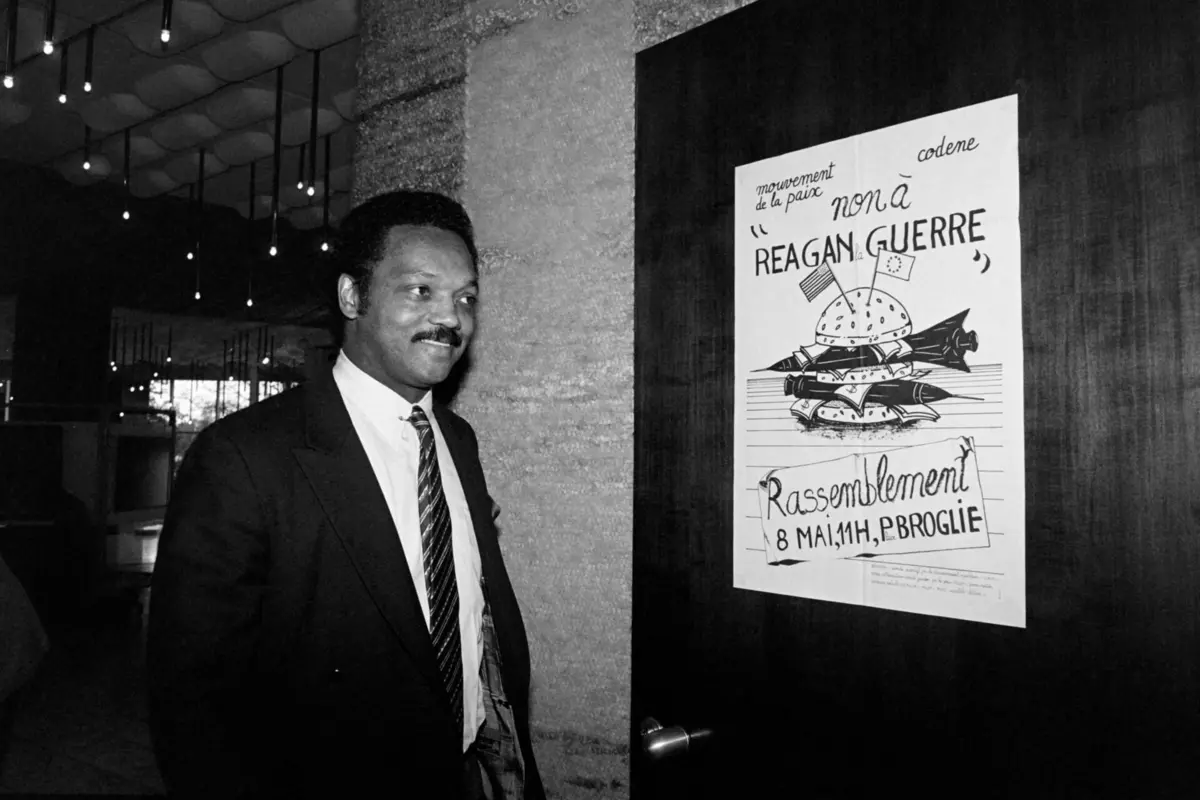
Born on October 8, 1941, in Greenville, South Carolina, Jesse Louis Jackson emerged in the 1960s as one of the closest collaborators of Reverend Martin Luther King Jr joining the Southern Christian Leadership Conference (SCLC) and actively participating in campaigns for racial equality, the right to vote, and against segregation in the southern states of the United States.
Jackson was in Memphis on April 4, 1968, when Martin Luther King Jr. was assassinated, an event that deeply marked the civil rights movement and consolidated his role as one of its continuers. After King’s death, Jesse Jackson founded the organization Operation PUSH (People United to Save Humanity), focused on promoting economic justice, social inclusion, and the strengthening of African American communities. Later, it also created the Rainbow Coalition, expanding its intervention to a multiracial and inter-religious platform dedicated to the defense of human rights and the political participation of minorities.
Over the following decades, Jesse Jackson became a national and international figure in the fight against racial discrimination and in the defense of equal opportunities. In 1984 and 1988, he ran for the Democratic Party primaries for the presidency of the United States, becoming one of the first African Americans to seriously contest the presidential nomination of one of America’s major parties. His 1988 campaign received millions of votes and consolidated his influence in American political discourse.
Jesse Jackson played an active role in informal diplomatic missions and international mediation initiatives, engaging in negotiations for the release of prisoners and contacts with foreign leaders, reinforcing his projection as a global defender of human rights. In recent years, his health has progressively declined. In 2017, he announced that he had Parkinson’s disease, but he still occasionally made public appearances and attended events related to civil rights.
