

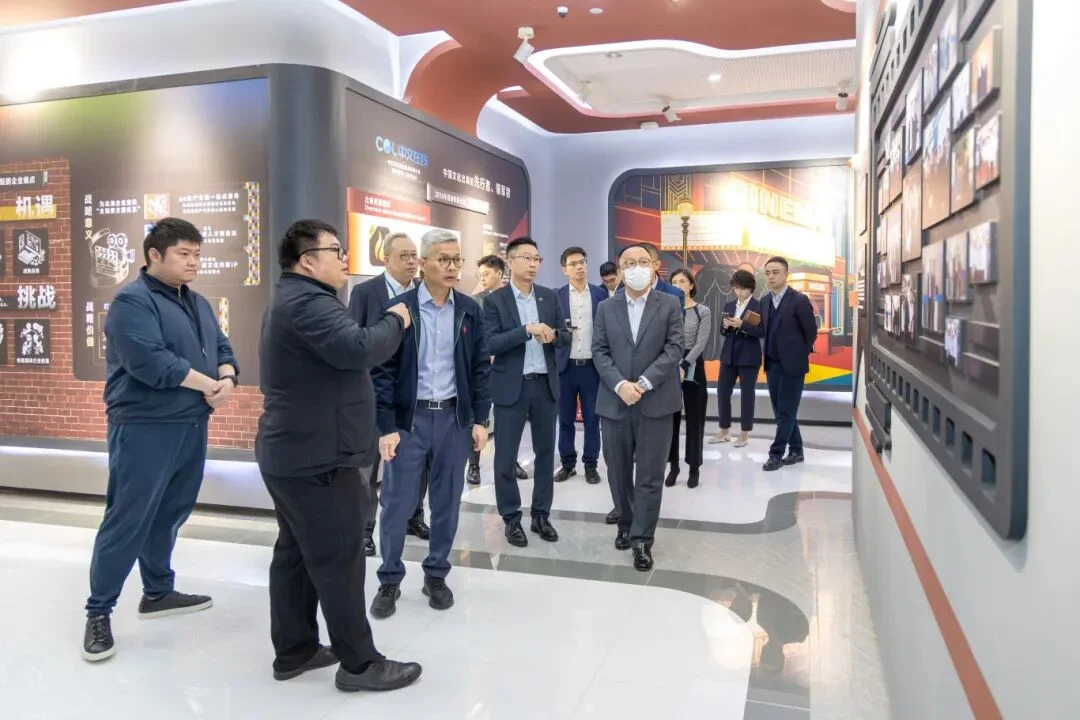
His first stop was the China-Portuguese (Spanish) Speaking Countries Economic and Trade Service Center (referred to as the China-Portuguese Economic and Trade Center), where he assessed construction progress.
Tai and his team first received an operational report from the center, which was jointly established by Hengqin and Macau to serve as a one-stop service platform for businesses aiming to enter Portuguese and Spanish-speaking markets. The center has launched a 1 billion RMB industry development fund and has partnered with Huawei and Beijing Wenhua Online to start trial operations for the “Hengqin International Digital Talent Training Base.”
Additionally, the integration of comprehensive service stations in Shenzhen, Macau, and countries such as Portugal, Brazil, and Mexico is underway. Tai acknowledged the center’s achievements and urged for accelerated progress to assist mainland enterprises in “going global” and to facilitate the entry of businesses from Portuguese-speaking countries.
Later, Tai visited the Chinese Medicine Laboratory in Guangdong Province for discussions. This laboratory leverages the research capabilities of Guangzhou University of Traditional Chinese Medicine and Guangdong Provincial Hospital of Traditional Chinese Medicine, achieving significant development in creating an innovative technology platform.
Set to operate in 2025, the first combined Chinese and Western medicine digital clinic will pioneer “human-machine collaborative personalized treatment.” Tai encouraged the laboratory to continue advancing and to develop into a high-end research platform with national and international influence.
In the Hengqin Innovation Industrial Park, Tai learned about the progress of the first “industrial upgrade” project in the cooperation zone. The first phase involves five factory buildings that are scheduled for completion by the end of 2025, with an expected operational date in June 2026.
Three of these factories will be reserved for Macau enterprises to support their expansion needs. Tai emphasized the importance of focusing on key industries for investment and improving the upstream and downstream ecosystem to create a resource-rich and innovative development platform.
Finally, the group inspected the Hengqin Micro-Short Drama Base, which, leveraging “Chinese Online,” aims to combine local Macau scenes with the Hengqin ecology to create the first micro-short drama filming base in China focusing on overseas markets.
Currently, the first phase has constructed 94 overseas-style scenes and undertaken multiple projects. Tai pointed out that the base aligns with Hengqin’s vision of becoming an “International Leisure and Tourism Island,” and he hopes it gains recognition quickly。
Tai stressed that this year marks the start of the national “14th Five-Year Plan” and is a crucial year for the second phase of the cooperation zone’s construction. All departments should leverage Hengqin’s capabilities and Macau to promote industry collaboration and attract talent through key projects, driving the zone’s high-quality development.
