

It was a “somewhat confusing presidential campaign – as the world is at the moment -” but Cristina Osswald made a point of following it. And on that sunny winter day in Macau, the Portuguese woman celebrated the possibility of choice.
“Whenever possible, I listened to interviews, debates, and presentations by the candidates. But it seemed to me that perhaps there is this issue of a dispersion of votes, which is part of democracy, isn’t it? And especially when you live in a regime that is not democratic, you clearly appreciate democracy more,” the professor at the Macau Polytechnic University told Lusa after voting.
But the path that a Macau voter takes to the moment of voting, Osswald points out, is not ideal. Having lived outside Portugal for six years, the professor noted that “procedures have improved,” although “they remain below expectations.”
“The world is increasingly global, I see no reason why there shouldn’t be electronic voting,” said the professor, who, before Macau, lived in Florence, where she had to travel to Milan to vote. “We can go to the bank [online], to the tax office, and not being able to vote online seems like something that doesn’t make much sense. I think that’s where there should also be greater investment. For example, here, people with limited mobility cannot come to vote,” she said.
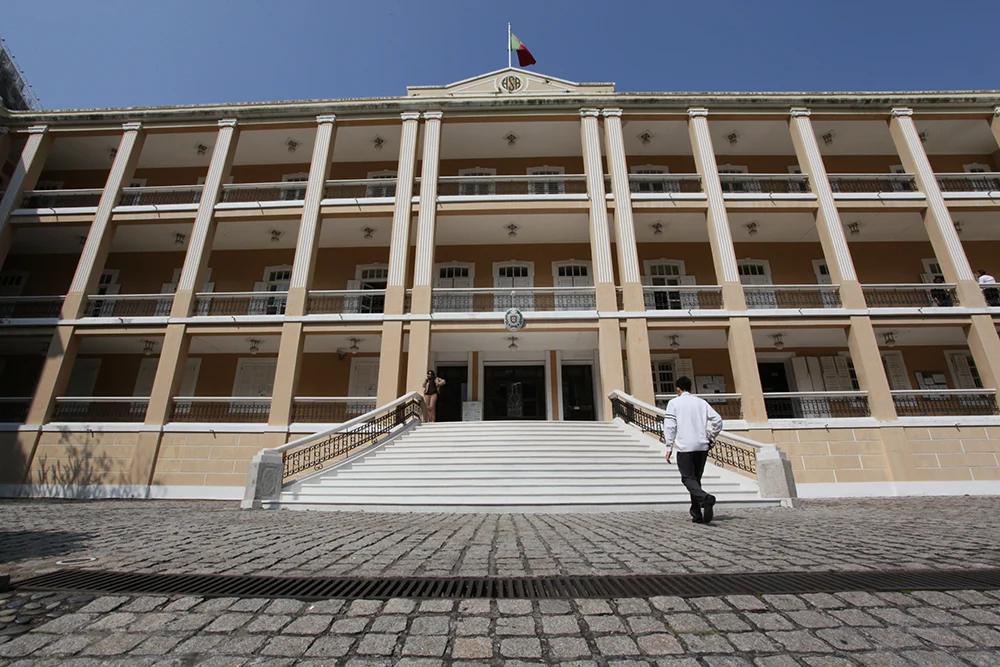
Cristina Osswald looked at the staircase leading to the Consulate General of Portugal in Macau and Hong Kong, where elderly people were struggling to climb the steps – despite the fact that there was another door at the rear of the building with elevator access.
“It’s democracy that loses out. In times that are complicated and, I would say, almost dramatic, I think it would be extremely simple to be able to vote online,” continued the teacher, also referring to the “lack of information” in Macau about the procedures leading up to the election. “I know many people here in Macau, especially older people, who don’t come to vote because it wasn’t publicized that we had to register beforehand,” she noted.
Electronic voting has been a long-standing demand of the Council of Portuguese Communities, a government advisory body on policies relating to emigration and Portuguese communities abroad. Rui Marcelo, president of the Regional Council of Portuguese Communities in Asia and Oceania, told Lusa last year that the issue “has been raised several times and with several governments.”
Félix Teixeira, a retired laboratory technician who has been living in Macau for 30 years, argued that online voting could be particularly useful in regions where “travel is difficult.” “Macau is small, so it doesn’t matter here.”
And what are the expectations for the presidential elections? For the former employee of the Institute for Municipal Affairs, the multiplicity of faces on the ballots is a good sign: “More voices are being heard,” he said. And for emigrants, he emphasizes, being there is like being closer to home: “If you are not in direct contact with the country, you are out of the loop, out of politics and out of the social sphere,” he elaborated.
According to the consulate, there are more than 150,000 Portuguese passport holders among the residents of Macau and Hong Kong. However, the number of registered voters is almost three times lower: 57,748, according to data provided to Lusa by the diplomatic representative.
From the top of the stairs of the historic consulate building – the former Hospital de São Rafael, founded in 1569—Macanese couple Francisco Xavier Leong and Alina da Luz call for more attention to those abroad. “We hope that the new president will be more careful with foreign citizens, not only from Portugal,” said Leong. “We vote because we are Portuguese and, as good citizens, it is our duty,” his wife added.
For the couple, who live nearby, voting in person is simpler. Francisco Leong even admitted to “more difficulty” with the electronic option.
“Fortunately, in Portugal, we have always had great confidence in the election results. Many people have doubts about electronic voting, but I think that if it is well managed, it is a good option,” said José Paulo Esperança.
Speaking to Lusa, the professor of finance at the University of Macau said he expects high turnout in the election because “there are concerns for Portuguese democracy” and “worrying candidates.”
“Portugal – and the world – is undergoing developments that concern me. Because there is a growing rise of the far right and phenomena that are very worrying,” he said.
In the 2021 presidential elections, 1,479 people voted in Macau, or 2.1% of the total number of registered voters (70,134). Marcelo Rebelo de Sousa won in this Chinese region with 64.62% of the votes, followed by Ana Gomes (14.45%) and André Ventura (8.03%).
