

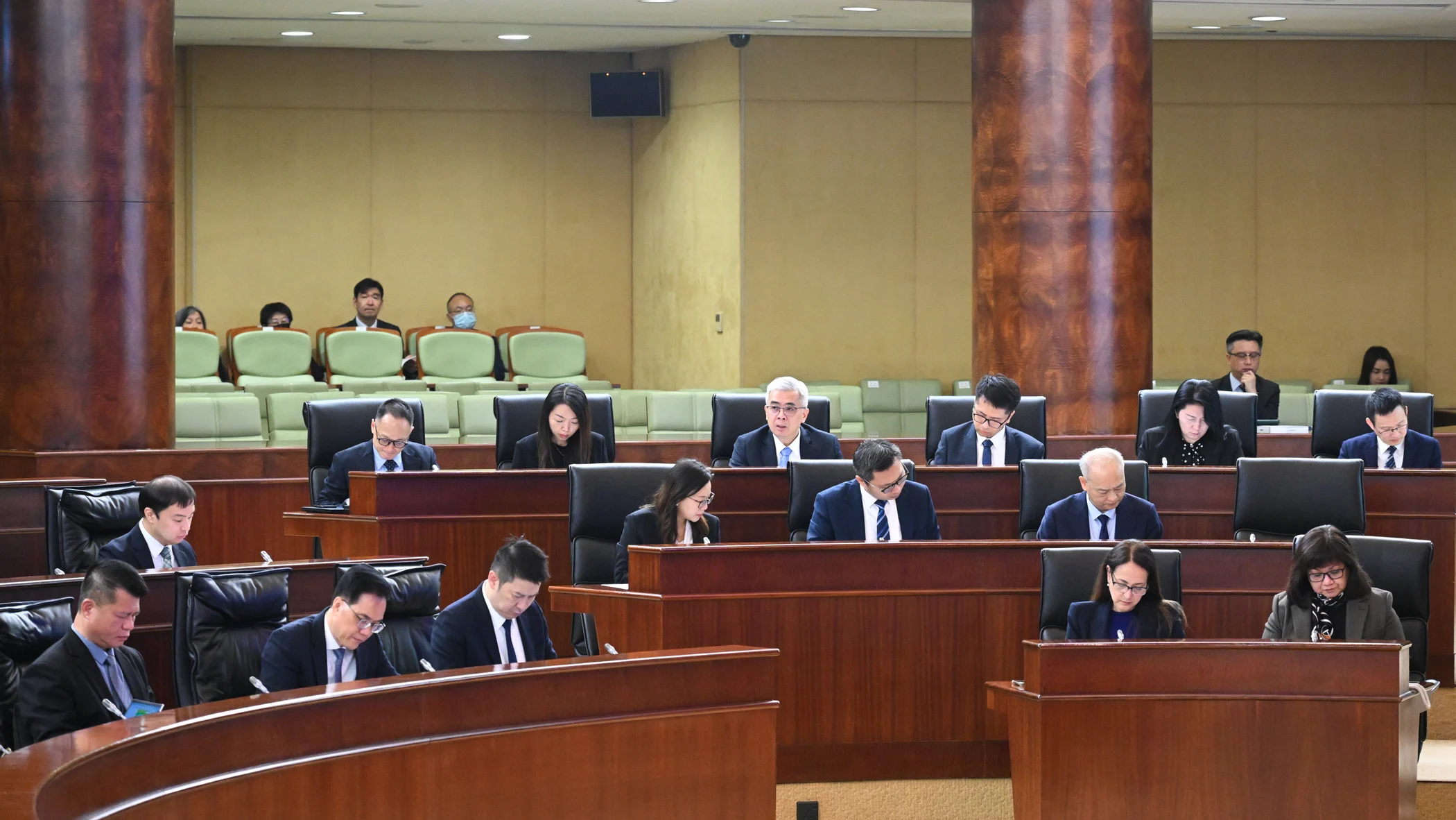
For the first time as Secretary for Administration and Justice, Wong Sio Chak outlined the government reform guidelines, emphasising that the goal is not to increase the workload of civil servants, but rather to reorganise functions and redistribute human resources so that departments can “achieve more with less effort”.
According to academic Lou Shenghua, this reform has clear political framing and strong practical relevance. “Administrative reform reflects the Government’s commitment to implementing the spirit of President Xi Jinping’s speech during his visit to Macau in December 2024. At the same time, it responds to public expectations for higher-quality public services and demonstrates the Executive’s determination to deepen reforms.”
Over the last 25 years, the administrative system has become increasingly complex, showing overlapping functions and high coordination costs. Therefore, the reform “comes at an opportune moment”, Lou Shenghua told PLATAFORMA.
Wong Sio Chak stated that the Public Administration and Civil Service Bureau (SAFP) has already completed the organisational restructuring plan, to be implemented next year. This phase covers several key departments, including the reorganisation of the Office of the Chief Executive’s Support Services, the Municipal Affairs Bureau (IAM) and the Public Works Bureau (DSOP), among others. The Cultural Affairs Bureau (IC) will also be merged with the Cultural Industries Fund, and the Sports Bureau (ID) will undergo a similar integration.
The general principles of the reform include eliminating duplicated functions, concentrating resources, streamlining approval procedures and strengthening coordination, moving the administration closer to a “large department” model and reducing administrative costs arising from interdepartmental coordination.
During the debate, several legislators focused on the merger between the IC and ID. Wong Sio Chak explained that integrated structures for culture, sports and tourism have been adopted in mainland China and Hong Kong. In Macau, the Tourism Office is not included in the reorganisation because it has its own revenue sources and was transferred to the Secretariat for Economy and Finance in the previous term. Nevertheless, Wong Sio Chak stressed that the Government will continue to evaluate the best functional arrangement for each entity.
Quota System Shows Results
In the area of human resources management, since the implementation of the quota system in 2020, the total number of civil servants decreased from 32,641 to 31,257 by the end of October 2025, a reduction of about 4.2 percent. According to Wong Sio Chak, this decrease is mainly due to retirements and interdepartmental reallocations, without compromising service operations. He added that the quota system will continue to play a key role in rationalising human resource distribution.
Regarding the reform of consultative bodies, the Government will establish limits, determining that the same member may not serve on more than three consultative entities and setting maximum term limits, in order to strengthen social representation and improve the functioning of these bodies.
Improvements in Promotion and Training
Enhancing the system for qualified civil servants is one of the pillars of this reform. According to Lou Shenghua, improving governmental efficiency depends on building a stable and competent team with clear development opportunities. “In terms of promotions, it has been defined that leadership and management positions should, as a rule, be filled by staff from the immediately lower level, establishing a coherent model of professional development that ensures career progression and strengthens the stability and professionalism of the public workforce,” he told PLATAFORMA.
He added that greater transparency and gradual advancement will increase internal motivation and help resolve longstanding issues of opaque promotion practices. “In the medium to long term, this structure will contribute to building a solid base of qualified staff capable of sustaining administrative reform,” he concluded.
Cross-Border Governance
Cross-border public services were another key topic in the LAG debate, with legislator Lao Chi Ngai questioning the sustainability and institutionalisation of administrative cooperation between Macau and Hengqin. In response, Wong Sio Chak stated that both jurisdictions have already entered a phase of two-way interconnection, forming an essential foundation for the future integration of public services in the Deep Cooperation Zone.
On Macau’s side, the Government Services Centre on Avenida de Venceslau de Morais now offers three remote service counters, covering 120 services from six Hengqin departments, allowing residents to “handle Hengqin matters in Macau”. In Hengqin, the New Neighbourhood and the Citizen Service Centre have installed three counters offering 175 services from 11 Macau departments, enabling the model of “Macau matters handled in Hengqin”.
The institutionalisation of these cross-border services is a demonstrative example of Macau–Hengqin integration within the Greater Bay Area, explains Lou Shenghua: “The expansion of cross-border public services is one of the main strengths of this administrative reform.” This interconnection will serve as a “pilot platform for deepening governmental coordination between the two regions” and will bring tangible improvements to residents’ daily lives, “consolidating a new path for governance innovation” for Macau within the Greater Bay Area.
