

Eric Ka Chon Leong lost his sight at the age of five due to glaucoma. Although he underwent surgery in Hong Kong, the operation did not restore his vision and he returned to Macau unable to attend school in the same way as other children his age. In the 1990s, information in Macau was limited, and his family instinctively believed he should enrol in a school for the blind — but such an institution did not exist. After much difficulty, the family managed to contact other parents of visually impaired children. Faced with an uncertain future, they collectively sought help from Paul Pun, then Secretary-General of Caritas Macau.
“At that time, Mr. Pun made a room available at Caritas headquarters to serve as a classroom and hired teachers to teach us. Call it life-skills training or various activities — essentially, they organised activities to give us opportunities to adapt to group life,” Eric told PLATAFORMA.
Morning classes followed the first-year curriculum of São João de Brito School, while afternoons were dedicated to Braille. Content was sometimes adapted, and social experiences were also an essential part of the programme.
“For example, if a classmate was absent due to illness and the teacher felt we could manage, he would take us to a stationery shop to buy materials, so we could learn to pay and distinguish banknotes by touch. He would also take us outside to listen to traffic, understand directions and judge the distance of vehicles.”
According to information on the website of the Education and Youth Development Bureau (DSEDJ), all public schools — except Concordia School for Special Education, which exclusively offers special education — and 40 private schools participate in the inclusive education plan, which integrates students with functional disabilities, including visual, auditory, linguistic and other impairments. The Rehabilitation Centre for the Blind, under the Holy House of Mercy of Macau, provides support to visually impaired people aged 16 or above.
Challenges in School Integration
The small group, consisting of only three students, lasted for two years. Paul Pun believed that even if the students stayed there for ten or twenty years, they would never obtain socially recognised qualifications, so he persuaded the parents to transfer the children to São João de Brito School.
Initially, the parents were very protective. “They thought we would be bullied and feared society would not accept us.” In addition to worrying about possible discrimination from classmates, they were concerned about insufficient learning support and teaching assistance.
After negotiating with Caritas, they agreed to try it for a month. For Eric, moving from a three-student “literacy class” to a formal school did not evoke high expectations. “After transferring, I suddenly realised how big the environment was — it was no longer that small corner with a bathroom next to the classroom,” he says. Despite the dramatic change, he says he adapted.
The biggest challenge at school was the lack of Braille textbooks. “That is what I find most unfair for an integrated student,” he says. “Why can others simply open a book and read, while we have to transcribe everything into Braille before we can even study?”
To keep up, Eric’s mother sometimes borrowed textbooks during the summer holidays to transcribe them. “While others rested during the holidays or after finishing homework, for us it felt like an endless process,” he explains.
“Learning to live with many sighted classmates with different personalities helped me understand my role and find my place among people. I learned to understand social dynamics and recognise emotions in an inclusive environment. If I hadn’t grown up that way, perhaps I wouldn’t have developed this sensitivity,” he says.
Breaking Stereotypes
Describing a childhood different from that of other children, Eric speaks of a “conflict between reason and emotion, and a struggle between pessimism and optimism, which ultimately trained me to become an optimist with my feet on the ground”.
These experiences strengthened his determination to pursue psychological counselling and social services. “Psychology is an amazing field: it allows me to use knowledge and skills while finding ways to help others.” His family, however, had a different view: they believed that studying would not guarantee his future and that learning a profession such as massage therapy would be safer.
What motivated him to continue was a book he read in primary school, *I Cannot See, But…*, written by Chong Chan-Yau, President of the Hong Kong Blind Union, who is also visually impaired. Two decades later, the book’s message remains clear to Eric: “The spirit of the book is this: why must visually impaired people limit themselves to massage work? Why only study music? Why can’t we learn according to our interests? Why can’t we pursue knowledge-based professions?”
Chong Chan-Yau’s achievements in defending equality deeply inspired Eric. With perseverance, he completed a degree in Psychology at the University of Saint Joseph in 2012 and earned a master’s degree in Counselling and Psychotherapy. He has worked for thirteen years as a psychologist at the Visual Rehabilitation Centre of the Holy House of Mercy.
Professional Challenges
Eric believes that society still understands little about visually impaired people and that the labour market has evolved very little. Many employers are reluctant to hire visually impaired individuals, fearing workplace limitations or lack of support capacity.
“Nowadays, if someone hires an employee, they expect them to perform many tasks. If they hire a social worker, they expect them to also organise events, assist before and after activities… and they think, ‘If I hire you, will I have to take care of you as well?’” For Eric, this mentality is understandable, but difficult for many visually impaired individuals to accept.
As a solution, he suggests that the Government subsidise companies that hire people with physical disabilities, enabling them to employ an assistant. The subsidy could cover half the salary or a fixed amount. He gives the example of a social worker with mobility difficulties: the subsidy would allow the hiring of someone to accompany them during home visits or other external tasks.
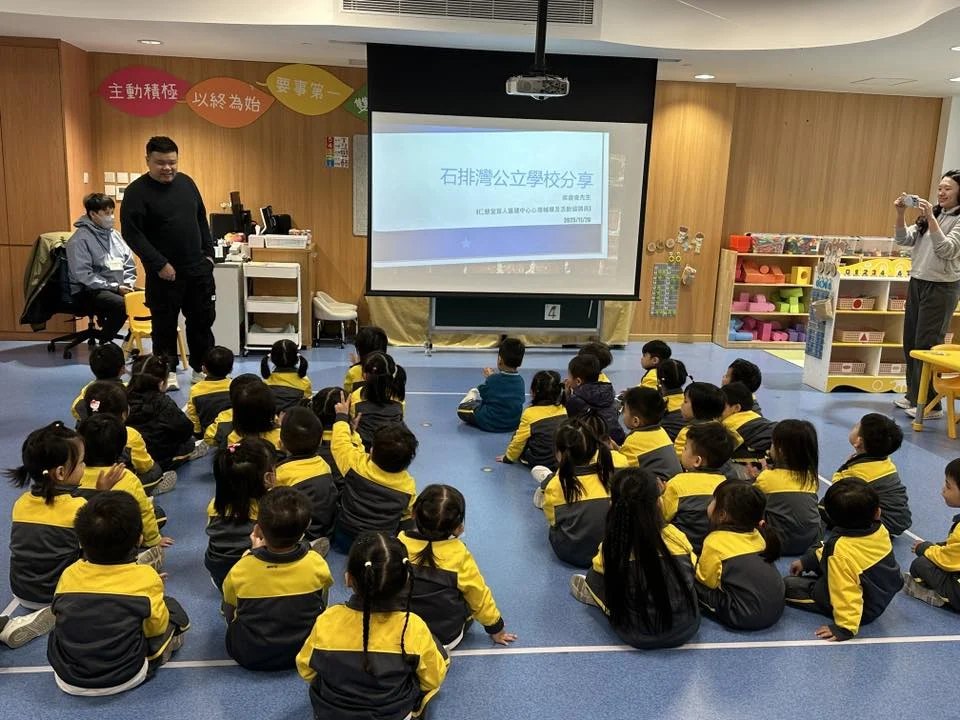
For Eric, the main long-term challenge requires “awareness-raising”, an ongoing educational effort. Through his work, he hopes to develop programmes for young people and children, promoting civic education and teaching from an early age how to interact with and support visually impaired individuals.
