

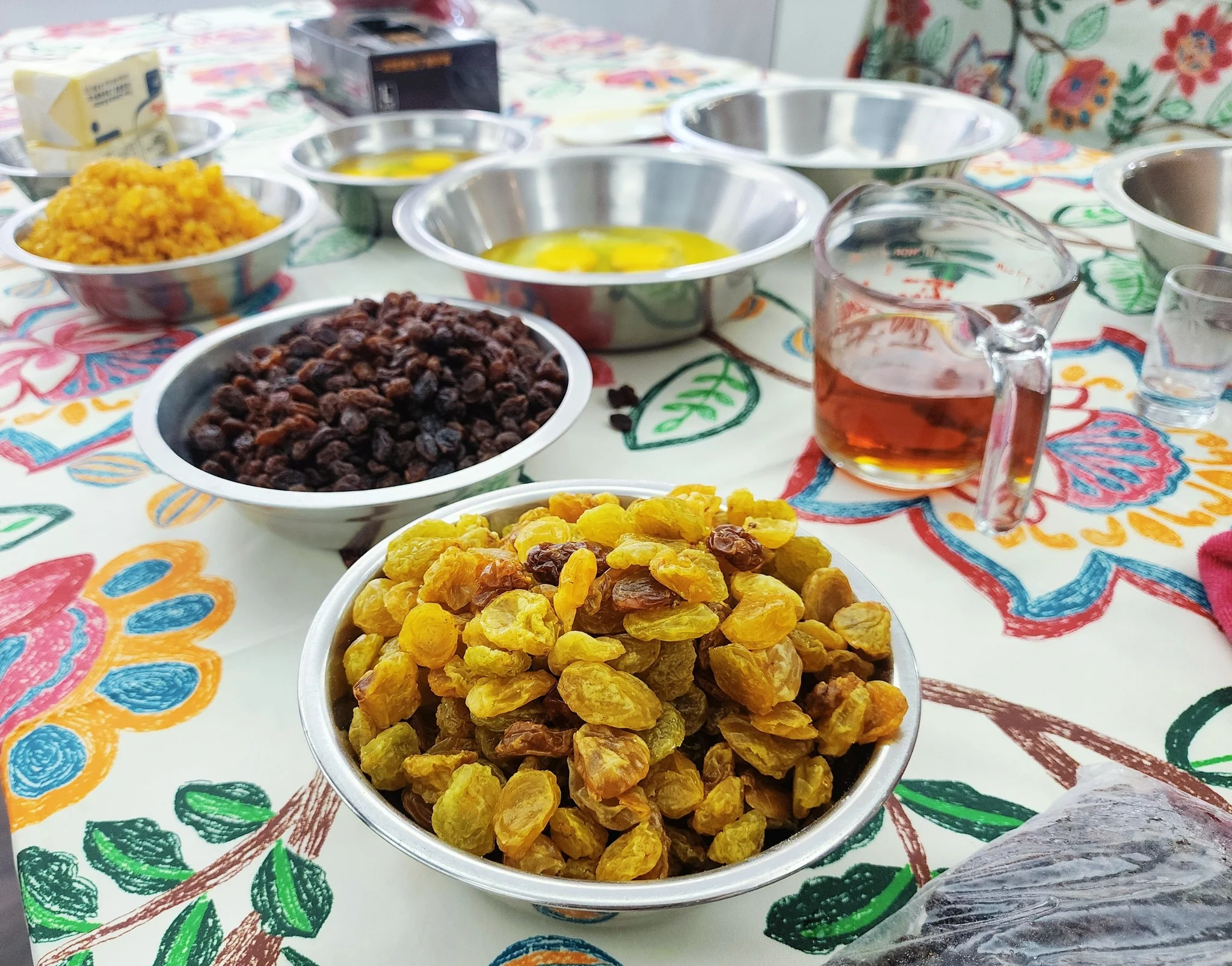
Raisins, Portuguese wine, and orange peel are more than just ingredients in the “Cake”; for Fátima Sousa, they evoke the taste and warmth of her mother’s kitchen. Last weekend, the Macanese Association and the Macanese Cultural Studies Association jointly held a workshop dedicated to this traditional “Cake,” a staple in Macanese households. Fátima, who led the demonstration, hopes to see greater promotion of Macanese cuisine. Although it has already been recognized as intangible heritage, she believes more people should teach it — since reading a recipe is not the same as knowing how to make it.
Every family has its characteristic dishes — unique flavours that carry cherished memories between loved ones. For Fátima, the “Cake” represents precisely that. It was the dessert her mother personally taught her to make before passing away, shortly before Christmas. She recalls that in the past, her only task was to prepare the ingredients for her demanding mother, who insisted on using only Portuguese wine — specifically dark Port wine. Fátima smiles as she recalls how, once, she couldn’t find dark Port and bought white instead, earning a sharp scolding. After her mother’s death, Fátima stopped making the “Cake” for a while, but later thought that perhaps her mother had taught her the recipe so she would continue the tradition. Since then, she has kept it alive — and her family says that each time she makes it, it tastes better and more like her mother’s.
The “Cake” is a common dessert in Macanese homes at Christmas. According to Ubaldino Couto, a member of the Macanese Cultural Studies Association, “there is still little research on the Macanese ‘Cake’.” Based on the information he has gathered, some Macanese families enjoy the cake as part of their Christmas Eve supper, after midnight mass, singing carols while celebrating. As each family has its own preferences, recipes vary. Some consider the Macanese “Cake” similar to the British Christmas cake, though its exact origin remains uncertain. Traditionally, the cake is baked in large quantities to be shared, and while it is most common at Christmas, Macanese families also prepare it for other important occasions such as weddings.
Marina de Senna Fernandes, from the Macanese Association, explains that “Christmas preparations involve many tasks” in Macanese culture, and that the raisins for the “Cake” must be soaked in wine well in advance. In the past, families would start as early as October or November — which is why the workshop was held at this time of year. Traditionally, the raisins were soaked for months — the longer, the better. Since the cake contains no eggs or milk, and Macao’s autumns used to be cooler, it could be stored for a long time if properly kept. Once baked, it should be wrapped in a kitchen cloth and refrigerated, then brushed with wine every week before serving to keep it moist.
Preserving the Tradition
Modern life is faster-paced, and many complex traditional dishes have faded from family traditions. Ubaldino Couto notes that “these days, few families go to such lengths,” preferring the convenience of eating out during festive seasons. He explains that one of the reasons for founding the association “was precisely to make these traditions known,” pointing out that Chinese culture has been widely recorded and promoted, making it very familiar to most people. Everyone shares memories of the dishes their mothers prepared for celebrations and how much effort the elders put into them — and the same is true in Macanese families.
Ubaldino also observes that, due to population size, “cultures like the Chinese have left far more records and references, while there is very little documentation on the Macanese.” Many people, he adds, think these are just ordinary homemade dishes with nothing special about them. He believes one of the most important tasks is “academic research,” recalling that, in the past, several people wanted to study the topic but struggled to find interviewees. Part of the reason for creating the association was to use their own networks to facilitate research — because each person who contributes leaves another record, giving future generations more references.
Macanese gastronomy is diverse, extending far beyond Minchi and African chicken. For Marina, “Macanese food represents identity” and tells a beautiful story — that of a place where people arrived for trade or missionary work but eventually put down roots. They might have come from Portugal, Africa, India, South America, China, or Malaysia. Fátima also sees Macanese cuisine as a “fusion of different cultures” and hopes that more people will come together to showcase and promote it. Although it is already recognized as intangible heritage, she believes more people should teach it — because a recipe alone is not enough. Many, after watching a live demonstration, realize how complex it is and prefer to buy it rather than make it — which, she says with a smile, is perfectly natural.
