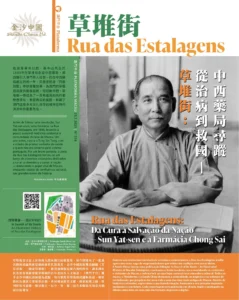
Once a bustling hub for artisans and merchants, Rua das Estalagens now welcomes a new wave of entrepreneurs blending tradition with innovation. Sands China has published a bilingual edition of In Search of Its Roots – An Illustrated History of Rua das Estalagens, revealing the stories behind this historic street and inviting residents and visitors alike to rediscover its century-old shops and cultural atmosphere. Each month, Plataforma and Sands China will highlight the community, businesses, and revitalisation efforts that aim to breathe new life into one of Macao’s oldest streets. Through captivating stories, we explore its transformation, honouring its past while shaping its future. Each report will be published in Chinese, English, and Portuguese on the last Friday of every month, in print and digital formats.
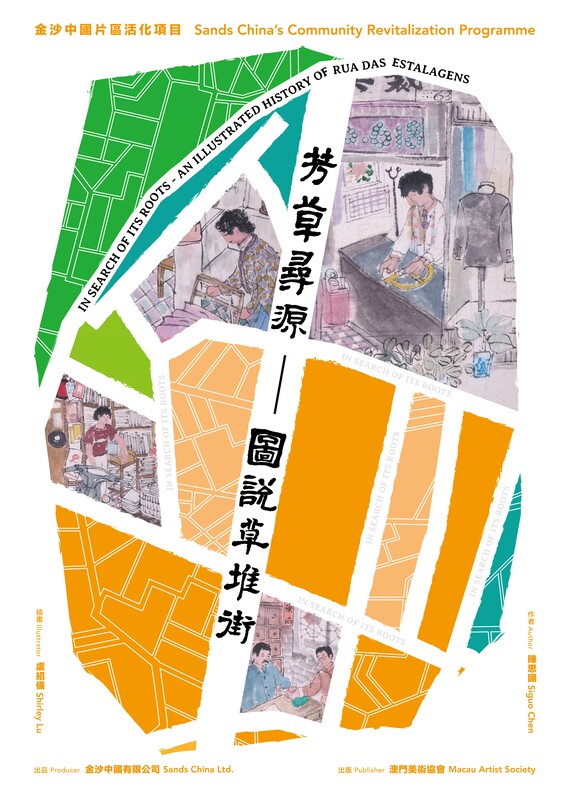
Learn more about In Search of Its Roots – An Illustrated History of Rua das Estalagens
- Producer: Sands China Ltd.
- Publisher: Macau Artist Society
- Author: Siguo Chen
- Illustrator: Shirley Lu
A troubled start for Sun Yat-sen in Macao
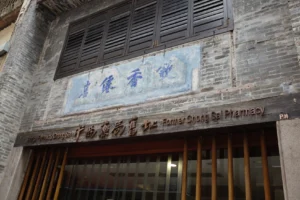
Chong Sai Pharmacy was founded in 1893 by Sun Yat-sen to provide Western medicine to Macao’s Chinese community. Today, it is a museum dedicated to the life of the man who founded the Republic of China. Plataforma
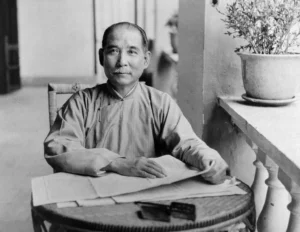
At No. 80 Rua das Estalagens, the building preserves one of the most important memories linking Macao to modern Chinese history: the former Chong Sai Pharmacy, founded in 1893 by Sun Yat-sen. Before leading revolutions, Sun Yat-sen walked this very street to bring Western medical treatment to Macao’s Chinese community.
Born in Cuiheng Village, then part of Xiangshan County (now Zhongshan City, in Guangdong Province), Sun Yat-sen developed ties to Macao early on. In 1878, at just 13 years old, he passed through Macao on his way to Hawaii to join his older brother. Later, as a student, he would pass through the city frequently, especially on trips between Hong Kong and Guangdong, where his parents lived.
Sun’s academic journey began at the Diocesan Home and Orphanage and Queen’s College in Hong Kong. He then enrolled at the Pok Tsai Medical School in Guangdong and later studied at the College of Medicine for Chinese in Hong Kong — now the Faculty of Medicine of the University of Hong Kong. During this period, he formed close ties with fellow reformist Chinese students Chan Siu-bak, Yeung Hok-ling, and Yau Lit. The group regularly exchanged ideas and discussed politics and became known as the “Four Bandits.”
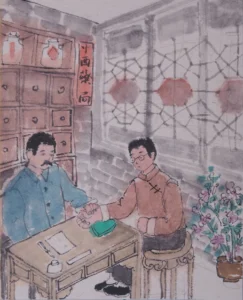
Shortly after completing his medical studies in Hong Kong, Sun Yat-sen began working in Macao, becoming the first Chinese doctor to practice Western medicine in the city. Illustration from In Search of Its Roots – An Illustrated History of Rua das Estalagens
It was through Yeung Hok-ling that Sun met Ng Chit Mei, a Macao businessman who introduced him to the local elite — key supporters of his early medical career in the city.
In July 1892, Sun graduated with distinction. Two months later, in September, he became the first Chinese doctor trained in Western medicine to practice in Macao. With the support of the local community, he offered free consultations at Kiang Wu Hospital and opened a small clinic at No. 16A Senado Square, next to the Holy House of Mercy.
“Sun Yat-sen was already known for successfully treating long-standing illnesses among the families of prominent Macao businessmen such as Cao Ziji and Ho Lin Vong. When they learned he had completed his medical studies, they persuaded him to come work here,” explains Siguo Chen, author of In Search of Its Roots – An Illustrated History of Rua das Estalagens.
Also read: Rua das Estalagens: Unsung Heroes – Guardians of Macao’s Art and Culture
As Kiang Wu Hospital did not yet have a Western pharmacy, patients struggled to obtain the medicine prescribed by Sun. This limitation led him to found Chong Sai Pharmacy on 29 July 1893, on Rua das Estalagens, with the support of Wu Jiewei.
For several weeks, he divided his time between the hospital, his clinic, and the pharmacy. But resistance grew. As he wrote in his autobiography Kidnapped in London, he was barred from treating Portuguese patients and his prescriptions were not accepted by local pharmacies due to the absence of a European diploma — making his career in Macao unsustainable.
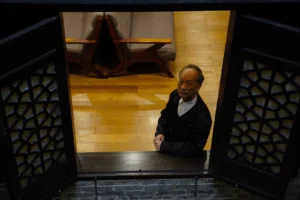
Siguo Chen, author of In Search of Its Roots – An Illustrated History of Rua das Estalagens, stands inside the former Chong Sai Pharmacy. Plataforma
On 26 September 1893, Sun published a notice in the Eco Macaense newspaper:
“I have urgent matters in Guangdong province; Chen Kongping will handle all affairs pertaining to Chong Sai Pharmacy.”
In the following months, Sun relocated to Guangdong and consolidated his revolutionary path. Chong Sai Pharmacy closed soon after, no longer under his direction.
“The pharmacy was essentially built for Sun Yat-sen to operate. Since local pharmacies refused to dispense his prescriptions and Kiang Wu Hospital didn’t yet have a Western pharmacy, Chong Sai Pharmacy served as the outlet for his treatments. Once he left Macao, there were no more patients, and therefore no business,” explains Siguo Chen.
Two years after leaving Macao, in 1895, Sun led the failed Canton Uprising. Over the following years, he organised several attempts to overthrow the Qing dynasty. His perseverance culminated on 10 October 1911, with the outbreak of the Wuchang Uprising, which ended centuries of imperial rule and gave rise to the Republic of China.
More than a century later, the Macao SAR Government acquired the site in 2011, launching a restoration project led by the Cultural Affairs Bureau. In 2016, the site reopened to the public as the Former Chong Sai Pharmacy, featuring a permanent exhibition on Sun Yat-sen’s life, the history of the building, and archaeological artefacts found on-site — a museum that remains open today.
Today, No. 80 Rua das Estalagens stands as a space of memory: a physical reminder of Sun Yat-sen’s presence in Macao, where his medical vocation reflected his compassion and vision that would reshape Chinese history.
Tung Sin Tong: Over 130 Years of Public Service
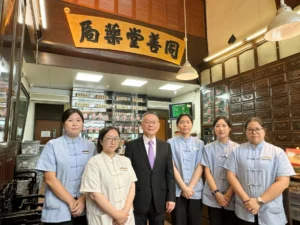
The Tung Sin Tong Charitable Society owns a number of establishments dedicated to health and education. Plataforma
One year before Sun Yat-sen opened his pharmacy on Rua das Estalagens, the Tung Sin Tong Charitable Society was founded near this street. The initiative came from a group of Chinese merchants and philanthropists seeking to support the local Chinese population — largely excluded from the colonial medical and welfare system. It has made an outstanding contribution to the city’s charitable development.
According to its current chairman, José Chui Sai Peng, at the end of the 19th century, life was hard for the majority of Chinese residents, who had limited access to healthcare and education. Tung Sin Tong was created to fill that gap by offering traditional Chinese medical consultations, herbal medicine, charitable giving, maternal health services, and funeral support, aligning with its core value: serving the world whole-heartedly with concerted efforts and welcoming all people with benevolence.
Soon after, its scope expanded. In 1924, it founded the Tong School for the poor, which began accepting girls in 1936 — one of the first institutions among Chinese people in Macao to do so. Over the decades, it added adult night classes, opened nurseries, and built a full 15-year free education system, long before the SAR Government adopted such a policy in 2007.
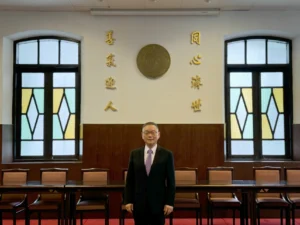
José Chui Sai Peng, president of the Tung Sin Tong Charitable Society. Plataforma
Medical services also grew. From its original dispensary in Senado Square, Tung Sin Tong expanded to operate five clinics, offering traditional Chinese and Western medicine, as well as dentistry and physiotherapy. Today, it treats approximately 1,000 patients per day.
In times of crisis — such as Typhoon Hato in 2017 and the COVID-19 pandemic — the association consistently mobilised its resources to deliver food and healthcare, and rent was temporarily reduced for tenants severely affected. They also launched a short-term support programme for involuntarily unemployed residents. Most recently, it opened a Traditional Chinese Medicine centre focused on treating long COVID symptoms.
Throughout its more than 130 years of continuous adaptation, Tung Sin Tong has maintained one guiding principle: compassion. As José Chui Sai Peng puts it: “Times change, but benevolence does not.” The spirit of mutual support among the Rua das Estalagens community has withstood the test of time, remaining vibrant and ever enduring through the centuries.
From glassmakers to textile merchants, Rua das Estalagens holds the legacy of industries that shaped Macao’s economy for generations. In our next edition, to be published on August 29, we explore the stories of Cheong Seng Glass and Ngan Kong Fabric, and how their crafts have endured — and adapted — across a century of change.