

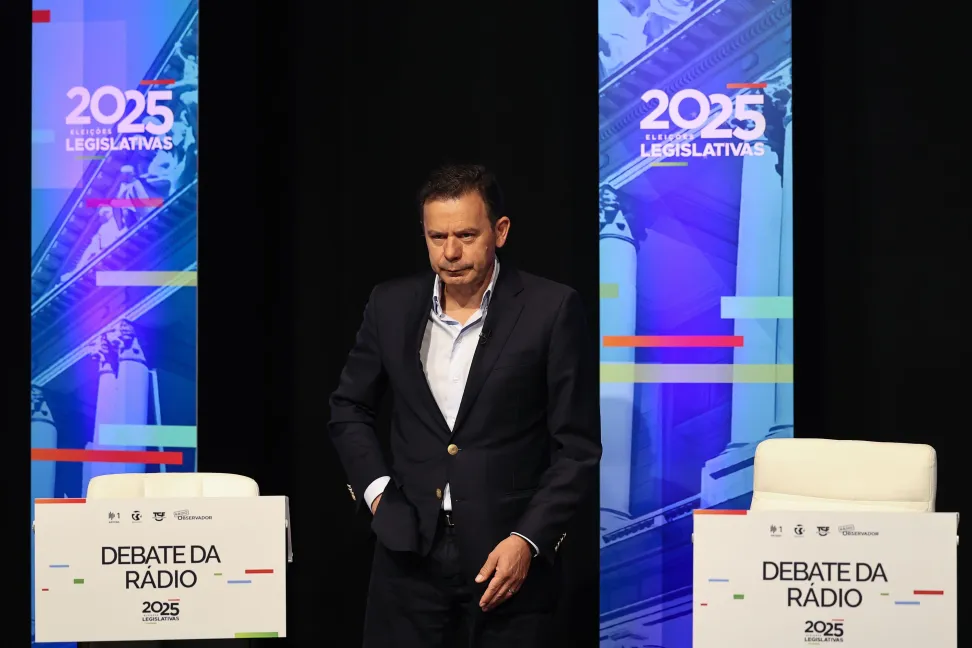
Luís Montenegro was speaking at the close of the PSD/CDS-PP parliamentary sessions, which have been taking place since Monday in Évora.
“We are more than ever the central political force in our democracy, this can be seen with the naked eye, just look at parliament,” he said, considering that the other parties on the left and right have more marked “ideologies and positions”.
In this sense, the PSD president and prime minister considered that these two parliamentary groups are best placed to “build bridges” with both sides of the chamber. “Dogmas and ideologies do not constrain our actions.
We are much more marked by the will and the determination to solve the real problems of the people,” he said, arguing that the PSD and CDS-PP constitute “a political force for dialogue.” However, he warned that these parties, which support the government, regard dialogue as a tool to bring positions closer together, not as a means to stall decisions.
In his speech, which lasted more than half an hour, Montenegro also sought to emphasise that immigration policies are not the “be-all and end-all” of the government’s actions. It emphasised that the Portuguese people voted for the government’s program on May 18.
“The Portuguese people chose parliamentary representation for some political actors at levels ranging from one member of parliament to three members of parliament, and at best six members of parliament. These actors speak on behalf of the Portuguese people, who form the majority of the Portuguese people,” he said, in an apparent message to BE, PCP and Livre.
If in a democracy the majority must respect the minority, it is also a golden rule of democracy that the minority must respect the majority,” he appealed.
Montenegro, who arrived at the conference accompanied by the speaker of parliament, PSD MP José Pedro Aguiar-Branco, sought to summarise some of the issues the government has already initiated or decided, emphasising that this government has been in office for less than a month. “We are taking our time while moving steadily forward,” he assured.
The prime minister highlighted several issues in the government’s legislative agenda, including income tax reduction, a policy allowing younger students to use mobile phones, a review of citizenship discipline, the simplification of budgetary rules, the status of the elderly, changes in the distribution of court cases and a new cybersecurity law.
On immigration issues, Montenegro stressed that the changes now proposed follow on from the action plan launched a year ago by his first government “to resolve a situation that required improvement”.
At one point in his speech, the sound system failed, but the prime minister made a point of repeating the idea, which journalists in the room could hear clearly, although they were unable to immediately record it.
“And contrary to what sometimes seems to be the case, I am very cooperative and collaborative with the media,” he said, provoking laughter from the audience.
Platform with Lusa
