

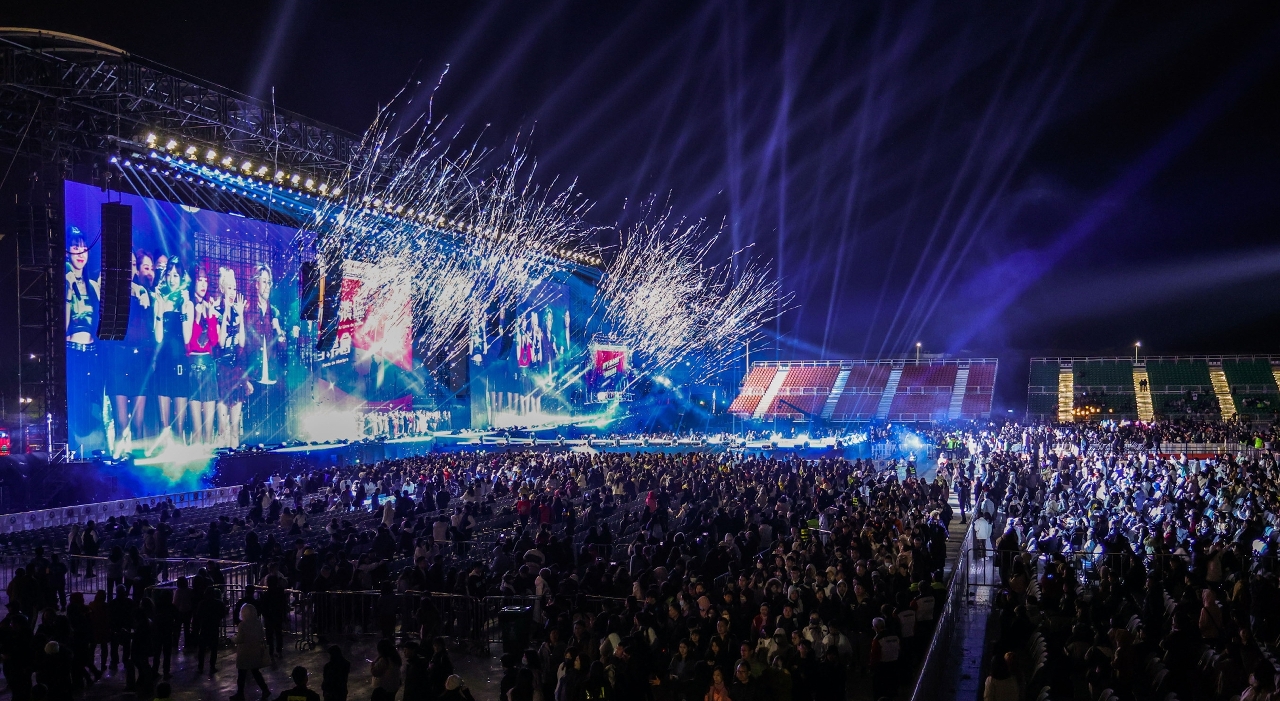
The first large-scale open-air venue, with capacity for 50,000 spectators, has been operational since its inauguration at the end of 2024, but has so far only hosted two events with more than 10,000 people. With an investment exceeding 80 million patacas, the venue represents a step forward in Macau’s local event-hosting capacity and scale. Industry representatives interviewed by PLATAFORMA acknowledged the venue’s great potential but pointed out the heavy upfront investments, uncontrollable weather conditions, and high coordination costs.
While the venue represents “progress for Macau,” hosting events there entails “huge financial pressure” and “complex operational risks,” said Sunny Chio. Organizing an open-air event for 50,000 people requires a budget in the tens of millions, and events with such high budgets are rare in the local market. As a result, he expects that events at the venue will likely remain infrequent.
He also noted that since it was designed as an open-air venue, it is entirely exposed to weather changes. “Macau’s typhoon season is mainly at the end of summer and into autumn. If bad weather hits during an event, the entire activity might have to be canceled or postponed — and that risk is entirely borne by the organizer,” he explained.
If an event is canceled, organizers lose not only artist fees, venue setup, and early-stage advertising costs, but also face ticket refunds and other administrative losses. Chio gave an example: “If ticket holders also booked hotels or flights, the organizer might have to help coordinate compensation. By contrast, indoor venues can usually continue even in bad weather.”
Beyond weather-related challenges, Chio said this venue’s operating model differs from integrated resorts, which come with support systems. As such, organizers must handle all logistics themselves — security, crowd management, ticketing, and transport. “In the past, when we held events at venues like the Venetian or Galaxy Arena, we only needed to coordinate with the event unit and promoters. The venue handled routing and setup. But for this open-air venue, nearly every detail has to be coordinated by us with government departments, which adds significantly to administrative costs and organizational difficulty,” he explained.
For now, part of the industry is adopting a wait-and-see attitude. Unless the government offers more flexible policy support, it will be difficult to attract more small and medium-sized enterprises to use the space. “We’ve been seeking suitable international artists and music festivals to collaborate with, but given the higher weather risks in summer, we expect events can only be held after October,” Chio said. As an interim solution, he suggested opening the venue to food festivals, sports events, or community celebrations to increase its usage and resource efficiency.
New Venue Supports the Local Market
With a more positive outlook, Lawrence Che, founder and CEO of Chessman Entertainment Production Co., believes the venue opens new possibilities for Macau’s entertainment market: “In the past, many artists or organizers wanted to host concerts for over 20,000 people in Macau but had to give up due to the lack of suitable venues. Now, there is finally a chance to make that happen,” he told PLATAFORMA.
He recalled the two events held since the end of last year — the first on December 28, and the Father’s Day event in June — both attracting over 10,000 spectators. “Organizing events like these in such a short time isn’t easy, but it proves Macau has the capacity to host large-scale open-air shows and brings new energy to the city,” he explained.
Still, Che pointed out that the risks of open-air venues cannot be ignored. “The Father’s Day event was held under a Typhoon Signal No. 3. If it had been raised to No. 8, the event would have been canceled. For shows of this scale, artists’ schedules are very tight, so rescheduling is very difficult.”
Compared to professional stadiums or venues with retractable roofs — such as Hong Kong’s Kai Tak Sports Park or the Tokyo Dome — Macau’s open-air venue is still a temporary solution. “Even though it’s not ideal, building it in eight months with basic facilities is already a big step forward,” he said, noting that constructing a fully equipped large-scale venue typically takes five to ten years.
According to the Cultural Affairs Bureau, current rental rates for the venue are around 500,000 patacas per day. “Compared with neighboring cities, the price is quite competitive. As for ticket prices, even though it’s an open-air venue, stage, staffing, security, and temporary structure costs are high, so tickets are not necessarily cheaper than indoor venues,” Che explained.
Regarding the outdoor venue and other existing venues, Che believes gaming operators and local companies are not competitors, but complementary players: “For international artists like Andy Lau and Jacky Cheung, it’s hard to bring them to Macau without the support of the gaming operators. Growing the performance market requires cooperation from various parties. Venues should be seen as shared platforms, not as competition.”
Chessman Entertainment Production Co. is currently in talks with several international and Chinese-language event companies, with plans to launch large-scale projects as early as the first quarter of 2026.
International Reputation in the Making
For José Wong, Associate Director of the Faculty of Hospitality and Tourism Management at the Macau University of Science and Technology, the open-air venue is a test for the “City of Performing Arts” policy, but its real impact can only be observed over time and with the hosting of more events. “Many international artists want to perform large-scale outdoor shows for more fans and to balance costs and revenue. But choosing Macau often depends on the city’s reputation and support infrastructure.”
Macau has advantages in tourism convenience, hotel capacity, and a unique blend of Chinese and Western cultures. However, it still lags behind major Asian cities like Tokyo, Osaka, Bangkok, and Hong Kong in terms of international recognition. “The global market is still unfamiliar with Macau. The city needs more influential stars and flagship events to continuously raise its profile,” Wong said.
Although only a few events have been held so far, early observations show positive effects. “Each major event helps stimulate nearby restaurants, hotels, and businesses, but more events are needed before we see significant changes in the data,” the academic explained.
Performances also help extend tourists’ stays and attract a “new kind” of visitor, focused on cultural experiences. “Especially visitors from outside the Greater Bay Area tend to stay one or even two to three nights to attend performances — unlike the traditional gaming-centered tourism model,” Wong said.
As such, government departments should study the behavior and needs of these cultural tourists as soon as possible — including their consumption preferences, itinerary planning, and how they receive information. “If tourism operators can keep up with this trend, it could drive a deeper transformation and modernization of Macau’s tourism industry,” Wong explained.
PLATAFORMA reached out to the Cultural Affairs Bureau for information on applications to hold outdoor events in the second half of this year, but received no response by the time of publication.
